A discussion with Kate Durbin, Lara Glenum, Cheryl Helm, Eddie McCaffray, Danielle Pafunda, Vanessa Place, Marie Smart, Carolyn Thompson, and Meghan Vicks
Facts
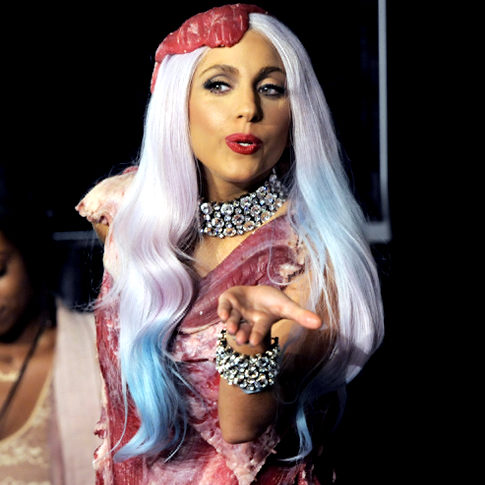
The Meat Dress (including boots, hat, and purse) was designed by Franc Fernadez. Lady Gaga wore the dress while accepting the Video of the Year Award at the 2010 VMAs. She famously asked Cher to “hold her meat purse” as she gave her acceptance speech. Yes, it is indeed real, raw meat. In Gaga’s own words (to Ellen DeGeneres) “It’s certainly no disrespect to anyone that’s vegan or vegetarian. As you know, I am the most judgment-free human being on the earth. It has many interpretations, but for me this evening, it’s ‘If we don't stand up for what we believe in, we don't fight for our rights, pretty soon we’re gonna have as much rights as the meat on our bones.’ And I am not a piece of meat.”
I. Meat Dress - Reactions? Why those Reactions?
Cheryl Helm: I didn’t expect my reactions to be so visceral. The meat-as-bodyart battle was joined when the Vogue meat bikini cover shot broke: a minor tidal wave compared to the tsunami unleashed by the VMA Meat Dress. I’d already debated my own moral issues and argued with everyone else’s. I thought I’d already been through the “Ew, that’s so...no, wait!...Oh my God, that’s meat...Oh. My. God. She’s beautiful” phase.
I added my own euphoric whoops to Gagadom’s celebration when she won Video of the Year, and I squinted slightly as the camera tracked her approach to the stage at a distance. I thought: “Oh My God, she’s had someone create a fabric to perform the Meat Bikini photo. Wow, look at how the fabric marbling traces the contours of her body, wow, that’s really nice looking” (that single observation probably cost me all my butch points, painfully acquired over decades of transgressive living). Then I thought, “Oh my God, is that real meat she’s wearing?” When she asked a nonplussed Cher to hold her meat purse, it sank in. “She didn’t!” Well, yes actually, she did! Then came the momentary shock, like a cold slap on the chest.
Reactions are often keyed to expectations. I was expecting another reference to a magazine cover. I was expecting some kind of bold statement, like last year’s “Paparazzi” missile, launched right into the belly of the beast. I was expecting something spectacular because spectacle is what she does. She gave us all three but not in the way I expected, and I was really not prepared for the impact.
Then I shook my head and thought, “I dunno about the donkey dick, but that dame has got brass balls.”
If the meat bikini was sexy (along with the sexy meat model pose), the Meat Dress seemed more defensive than grotesque, as so much of her fashion does. The big hats say “Back Off,” the veils say “Keep Back,” the spiky geometrics say “Touch me anywhere and I’ll hurt you.” The Meat Dress says “Turn Away” but its siren call to the eyes commands, “Look at Me.”
With the Meat Dress, Gaga seized control of the collective gaze and wouldn’t give it back. You might feel uneasy, infuriated, even repulsed, but you couldn’t stop looking. Or you couldn’t stop averting your eyes but after a few seconds, sliding them surreptitiously toward her, just one more glance to confirm that your roiling discomfort had good reason. And you weren’t the only one. Millions were searching “Meat Dress” for images and blogs, as if talking about it could somehow purge them of the dis-ease she’d caused. The media and Internet gleefully provided the digital meat to sustain the conversation, bordering on obsession.
Then came the moment when it didn’t matter any more. As she took the mike and began to speak, of her fear of letting her fans down (as if that were possible), the emotional unveiling of the new album title that she’d been tossing into everything for weeks (whoever is driving the Gagabus isn’t very good at keeping secrets). Then she sang, tears trickling down her face. Only a few lines, but in those few moments, everything else fell away. It didn’t matter what she was wearing…could have been anything, could have been nothing at all. Then it was just that young magnificently talented woman and her voice, singing to herself, singing to us, singing for us. Whatever else she meant to say with the Meat Dress was forgotten for a few heartbeats. These are the times when she is most transgressive because she transgresses her own transgression of the moment.
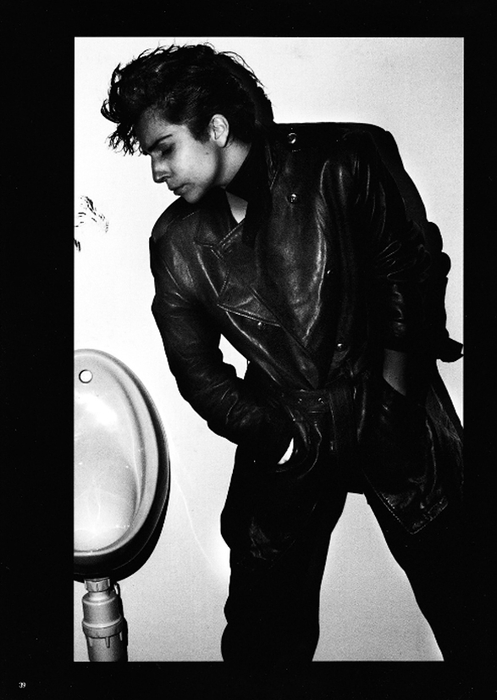
This year she continued the thrust of last year’s “Paparazzi,” but sharpened and cinched in a notch or two. It also felt like an end of The Fame, wrapping up a three-year-long performance art project that mutated and evolved on the hoof. Performing the Meat Dress felt to me a little like a 3D vanitas moment unrelated to Sterbak, like a dancer in a shadow box. Most of all, it felt like the ending to something in her aesthetic, her message, her personhood. As a performance, it was like closing a long-running show with a BANG. Which always implies another beginning somewhere down the road. It hints at an inner seismic shift that has largely happened out of sight, unusual for an artist who is always dissolving boundaries between what is public (almost everything) and what is private (nearly nothing). Perhaps it was a process for her, unfolding as she wrote the songs for Born This Way, and began to visualize and block out the next journey in her mind’s eye. The Meat Dress is a classically flamboyant “Farewell, but don’t forget to watch me.” And when she’s hiding that one eye, she’s saying “Come look, see what I have for you next.”
Eddie McCaffray: My initial - and continual - reaction was nausea. It’s an unthinking, visceral “Ew! She’s got slimy meat-food all over her,” which is to say I find nothing morally problematic about it. I don’t agree that this is a waste of food, or disrespectful to animals or to people who don’t get enough to eat. It’s the world order that causes people to starve - not doing things with dead animals besides eating them. Beyond this, it’s not as though any of that meat would have gone anywhere but to rich, well-fed people. They’re expensive, high-quality cuts, and even if they weren’t - she didn’t snatch them off a relief plane to Ethiopia. The “principle of the thing” should not distract attention from the reality of a problem.
Meghan Vicks: I go for the obvious: Well, that dress is not gonna last long. More than anything, I was struck by the idea of decay, that Gaga’s Meat Dress could be worn for five, maybe ten hours before becoming rancid. A vision of the Meat Dress decaying under my gaze, coming apart at the seams, turning to dust.
I can’t imagine a more perfect fashion statement, let alone a more perfect statement about the nature of existence. Gaga’s Meat Dress is impermanence embodied; its near-immediate decay display the sooner-or-later fate of all dresses - and all beings. Wearing the dress is a kind of embracing the impermanence and constant-changing nature of existence.
Danielle Pafunda: My first response to Lady Gaga’s Meat Dress: finally! Second: why don’t I ever get to wear a Meat Dress? I’m petty like that. Also petty, great, there go all my meat-dress poems. Third: that’s not vegan. Why is it worse? Everyone’s wearing silk and leather and eating marshmallows, but something about the deep pink meat is all too recently live, dead, slaughtered, split-second-post-gasp. Fourth: Oh, wait, is it meat or is it one of these? No, it is REAL meat. Whatever that is. Fifth: those boots look clunky. Sixth: I was recently at an academic dinner party with a professor from the animal sciences department. I can’t remember if this happened before or after the Meat Dress, though I suspect before, as I didn’t inappropriately yelp out, just like Lady Gaga! when he told me about carcass judging. Carcass judging works like this: the carcass of a 4H steer competes against the carcasses of all other 4H steers. Best carcass (best steaks per square inch?) wins. Carcass judging can work like this: ultrasound technology allows us to judge the carcass while it still performs as the steer’s body. That is, run the wand over the body, and we can determine where the best steaks lie. Run the wand over ANY body, and we can find its steaks.
Lara Glenum: I didn’t see the actual awards ceremony, so I first got hit with the photo of Gaga standing next to Cher. The sheath-y quality of the meat looks oddly vaginal: the dress inverts the vagina into a costume, an external organ. Snatch gone wild! Gaga’s snatch has externalized itself and is suckering onto her body, swallowing it, shoving her head back into her torso, binding up her feet.
How delightful that Gaga’s gripping a tiny silver astronaut waving an American flag! And she’s waving it like a strap-on! How delightful that she’s posed next to Cher in all her uber-hetero gobbledygook!
That Gaga inserts the meat purse into Cher’s bondage princess aesthetic is totally priceless. Here, hold my organ! Gaga provides a foil for the real monster standing next to her: compulsory heteronormativity. Internalized chauvinism. Social institutions writ large on women’s bodies.
Cher’s not sexy. She’s signal-y. Overwritten with sexual cueing. Trussed up like a Christmas chicken. The butcher’s floss binding Gaga’s feet mimics this. This all reminds me of Hans Bellmer’s controversial photograph of poet and artist Unica Zurn (also trussed up with butcher’s string) “Keep in a Cool Place”:
II. The Meat Dress and Body Politics
Meghan Vicks: Pop stars are supposed to be deliciously-proportioned bodies to be collectively gaze-fucked. Gaga’s like, you want me as a piece of meat, you got it. She over-identifies with the idealized body, thereby revealing its perversity.
Remember when somebody asked Gaga what she eats (what a stupid question, by the way), and she replied, “Pop stars should not eat.” Same thing. She’s hyperbolically performing the role of the pop star, who doesn’t eat but is nonetheless a juicy piece to be consumed by everyone else. It’s sadistically hilarious.
Cheryl Helm: The difference between the bodies we wear and the selves we project are either poles apart or joined at the hip. Neither makes for comfortable living. Gaga doesn’t just perform the role of the pop star, she wears it. And she performs everything she wears, especially her body and what she puts on it.
At the VMAs, she projected four bodies, in that one’s perception of her changed with each wardrobe she wore, and what she was doing and saying. In the McQueen, she is regal, with her own color guard. But she is also an eccentric pop star accompanied by four ‘dishonorable’ soldiers. Freaks, in the eyes of their industries. Yet visually, she seems softer: McQueen envelops her. Crowned, she is Our Lady of Veils, Queen of the Fae, Fragile but Fierce.
The black leather Armani turned out to be too heavy (this from a woman who walked around in 40+ pounds of fresh meat for at least an hour). She performed herself then, laughing about not having thought out the logistics of accepting awards when she planned the wardrobe, almost as if she’d forgotten that she was likely to win several. Instead she’s left to wing it with an explanation and a sardonic remark about “Fashion roadkill” (and does that foreshadow the Meat Dress? Maybe.) And then a jubilant raucous triumphant yell. Note how different is the body she projects. Also note that animal activists were not complaining about the yards and yards of leather she was wearing.
By this time, we are visually preconditioned to expect something gauzy or flowy or gowny, silk or satin with lace, or at least taffeta, probably with hat and veil, for her third wardrobe. But no. The body she shows us is herself turned inside out, what we all are, our bodies, our meat. She is both provocative and evocative, the hard-ass media star (“Well here I am, boys. Bite me”) and the still-so-young artist, tearful and relieved, sharing her fear of disappointing her fans and her soaring joyful celebratory voice, all in 30 seconds or less. She is vibrant and alive, fully present and fully authentic in that moment.
The fourth performance was the photo shoot in the press room afterwards. She is no longer the beautiful, tearful, soulful singer she was on the stage. She’s the Meat Model. Snap. Snap. Paparazzi everywhere. She’s nowhere near her own body most of the time, but she’s workin’ it, hitting all the poses and smiles and smokey looks. Snap Snap. “I am your projection, I am the raw truth of what you think you see.”
“Do you like what you see? You wanna video me?”
One of the most telling photos is a shot of the paparazzi shooting her, not from the very base of the stage but pulling back as far from her as they could get but still make the Shot. She forces them to look at a body they don’t want to see but are compelled to photograph; it’s their job. Instead of being held prisoner by the paparazzi, she has captured them. Triumph in Raw Meat.
Holding the paparazzi at bay with nuthin' but meat.
Carolyn Thompson: Like many of Gaga’s fashions/looks there is a sense of perverting the heterosexual male gaze. Also, perhaps the Meat Dress is a counter-statement to Katy Perry’s recent look in the “California Gurls” video, in which she oozes candy-coated lick-me eat-me sexuality. Instead, Gaga offers up a much less palatable culinary-inspired fashion for us to visually consume: the image of the meat draped over her beautiful body is repulsive.
It’s also interesting she’s dripping in diamonds that carry a pop-star opulence; this juxtaposition between the ‘bling’ and the meat seems to be a commentary on the sort of conspicuous displays of opulence and sexuality you would typically expect of a pop star at the VMAs: saying “when we act that way we turn ourselves into nothing but meat.” Rather than glorifying the ‘bling’ and putting up an attractive and desirable image of the female pop star, she creates an image that disgusts and repulses. Yet the viewer still manages to marvel at the detail and beauty in the Meat Dress; but that’s just Gaga for you, no matter what she wears she’ll still look amazing.
Eddie McCaffray: It’s become a humongous cliche to talk about “objectification” and, as is often the case, the banal repetition of the concept risks robbing it of its meaning. I can say that I have viscerally experienced myself seeing other people as animals, or meat, or monsters - those scenes from Mean Girls, where Lindsey Lohan suddenly sees all the high school students shrieking and leaping like monkeys is a great example. I’d wager a lot of people have had an experience along those lines. It’s a break-down of normal perception into which you can hypnotize yourself. It’s worth re-emphasis that Lady Gaga is revealing the nausea implicit in objectification. Unfortunately even she probably can’t breathe life back into the ossified idea of “objectification” - those who will understand already do - but we can hope.
Danielle Pafunda: Gaga came up in my gender studies class discussion of the beauty ideal. We were yakking about the feminist critiques and implications of Lady Gaga’s gender performance, and I stop and ask these thirty students, 18-20somethings all; wait, do heterosexual men find Lady Gaga attractive? NO! they all laugh. Why not? I ask. Because she’s weird.
Kate Durbin: As somewhat of an (still culinary related) aside, did anyone else notice Katy Perry’s mocking of Gaga’s gun bra in her “California Gurls” video, with the whipped cream spraying bra? Katy also notoriously critiqued Gaga’s “Alejandro” video, calling it “cheap” and blasphemous. I wouldn’t be surprised if Gaga did in part wear the Meat Dress as a response to that.
Cheryl Helm: Well, doesn’t that say it all? Gaga brings guns, Katy brings...whipped cream? <smirk>
Carolyn Thompson: Yes absolutely, Kate. I noticed Katy Perry’s whipped cream bra was a response to “Alejandro,” which is what led me to think the Meat Dress might be a cheeky comeback. The two women as pop-stars are polar opposites in many ways (yet interestingly have overlapping fan bases). Katy Perry’s entire career has been built upon objectification as a sex object (ever listened to the lyrics of “I kissed a girl”?). While Gaga defied boundaries of sexuality, beauty, and gender norms in the “Alejandro” video, Perry is and has been the pop star with the classic, pin-up girl beauty - big blue eyes, big DD breasts, dimples, a little button nose, and a ditsy personality (for the most part), whereas Gaga has always been the one who looks a little strange, whose nose is just that bit too big for mass consumption, whose body was just a bit too thick at the beginning of her career, who was called a hermaphrodite for her androgynous appearance. Perry tweets “Watch my video it’s so hot it’ll melt your dicks!” while Gaga tweets “while escorted to cop car lil monster in full fashion yells ‘but i have to change my tampon!’ yes yes yes”... In other words Perry capitalizes on her appearance by sugar-coating it for tasty consumption, while Gaga perverts and twists the heterosexual male gaze by wearing a Meat Dress that repulses, even while she looks beautiful - long blond Barbie hair and sparkling eyes.
III. Meat Dress & DADT
Eddie McCaffray: Communicating in the mass media is more war than anything else, and a powerful weapon in that war is shock, is making people look by means of fascination or revulsion. Plenty of people will dismiss the dress, but plenty of others, Gaga fans or not, of all political stripes, will want to find out why she wore the Meat Dress. And if they try to find out, they might end up learning about DADT. And if they do that then maybe they will be persuaded to get involved or to change their position on the issue.
Which reveals, I think, the relatively old-fashion optimism in this line of political advocacy. If you get people to think, at least some will have to agree with us because we’re right. I’m certainly an opponent of DADT, and I think that position (mine) is right. But in a more cynical, more modern understanding, we also know that simple repetition is often what convinces people of this or that idea. So maybe just by forcing more exposure to the idea that DADT is bad, Gaga will bring some people around.
Also implicit in Gaga’s statement to Ellen about rights and meat is the poem/statement of Pastor Niemoller: “First they came . . .” Her statement seems very much in the vein of “if you don’t stand up for the rights of others, no one will stand up for your rights” - I don’t know what that has to do with a dress made out of meat, but the point is that in the weirdness of the Meat Dress, people are brought to consider a totally different idea. Shklovsky writes that art “defamiliarizes” the world, making the everyday strange. In doing, art makes us realize, for example, what it means for the stone to be stoney. In Gaga’s case, instead of making the stone stoney, the Meat Dress makes the proverbial stone human rights-y.
Cheryl Helm: I’d wrestled a little with trying to grasp the relationship between the dress and DADT and thought I had it after I re-watched the Ellen interview, several times (homework, honest!). She made the link explicit during her speech in Portland Monday, “Equality is the Prime Rib of America.” But if it was true that the wardrobe changes referenced both Magazine Shoots and DADT, what knitted the three together in both contexts? It’s not like Gaga to miss a connection, however tenuous it might be. Monday, when I watched her speech in Portland, I had one of those random EUREKA moments when something I’ve puzzled over clicks into place. The McQueen performance was overtly connected to DADT by Gaga herself, the image of four honorable soldiers prevented from serving by DADT. Lady Liberty is wearing black, the color of mourning for the equality we do not have. The Meat Dress, of course, is the Equality as Prime Rib of America motif.
Meghan Vicks: Cheryl, you just blew my mind. To make sure I understand: there are parallels between Gaga’s VMA costumes and recent magazine spreads. Those parallels are as follows:
And these three magazine covers/spreads, as well as the three costumes at the VMAs, tell the following story: DADT exists in the United States; Lady Liberty is therefore in mourning; Equality is the Prime Rib of America.
My mind is seriously, seriously blown. Thank you.
Danielle Pafunda: Agreed! My mind is also blown. Wow.
IV. Meat Dress & the Monstrous, the Carnivalesque, the Abject
Meghan Vicks: I’ve always been taken with the way Lady Gaga performs an inside-out and upside-down figure. She dons shoes on her shoulders (upside-down), materializes bubble dreams and wears them as armor (inside-out, mixes up corporeal with spiritual), asserts the technological telephone is an extension of the human body (blurs line between bloodied and bloodless), styles her hair into a hat or a bow (where does body end and costume begin?), makes out with a man - or is it a woman? - in “Love Game,” brassiere-ies her boobs into two machine guns - or two huge phalluses - in “Alejandro” and on the cover of Rolling Stone, inserts television screens into the lenses of her sunglasses, or razors instead of lenses, or cigarettes, or rhinestones (in any case, sunglasses are no longer meant for seeing, but for something else altogether), and now she wears meat as a dress (what’s normally inside shields the outside).
Lady Gaga’s bodily spectacle (that is, how she performs herself) invokes a world turned on its head and reversed: girl becomes boy, body becomes machine, breasts become dicks, dreams become flesh, flesh becomes costume, and vice-versa. It’s a carnivalesque aesthetic - an image and state of being that are not polished or finished, but continually becoming; a time-out from official hierarchies, prevailing truths, and rigid boundaries; grotesque jesters, fools, tricksters. And this is something to celebrate! It’s a very positive aesthetic, because of the chaos it brings upon official order.
So Gaga’s Meat Dress falls in the same carnivalesque vein, and the fact that she wore it while accepting the most coveted VMA implies, for me at least, the reign of the jester. And Cher’s standing there holding Gaga’s flippin’ meat purse! Love it!
Kate Durbin: What’s not to love! The Meat Dress is so disgusting it’s beautiful, one of the defining attributes of (a version of) the grotesque. I realize some who have intense ethical issues with meat may not agree with this sentiment, but I really did find myself wanting to take a chunk out of it, wear it, fuck it. I’m thinking of Bahktin’s notion of the grotesque body, of the celebratory aspect of it - it’s unabashed praise of farting, defecating, urinating, fucking. The fact that Gaga wore this dress in her first major appearance since her “Alejandro video,” which was her video that dealt most directly with religion, seems significant.
Bahktin + Gaga’s Meat Dress also makes me think of the traveling show Body Worlds - the “Original Exhibition of Real Human Bodies” - which Gaga’s costume resembles. This of course relates to your notion of Gaga’s inside-out aesthetic, Meghan. And let’s not forget that Gaga is making us gag-a (reflex) once again.
There is also the literary aspect of the grotesque as that which evokes empathy and/or pity as well as disgust, which I think the Meat Dress does. We sympathize with the cry “I am not a piece of meat” even as we are repelled by the blatant horror of the female celebrity’s state shoved in our faces.
Danielle Pafunda: Gail Kern-Paster in her introductory chapter to The Body Embarrassed: Drama and Disciplines of Shame in Early Modern England talks about the way the classical body - the body in art - was all surface, no interior. The grotesque body leaks, has orifices, strange fluids, mutates. Then she goes on to discuss the many threatening leaks of the Early Modern Euro female form, which threatening leaks are still with us today, even if more thoroughly plugged. The Meat Dress is a fashion exoskeleton of sorts. It says, here is my permeable leaky toxic delicious juicy fascinating interior, on my exterior, protecting my interior! There’s also Elisabeth Bronfen’s great work on the corpsified female form in Western art and literature. She reminds us of Poe’s edict: the death of a beautiful woman is the most poetic subject. (For woman, read feminized-beloved). Which maybe it was when the only poets allowed at the pen were fey boys. Now, perhaps the most poetic topic is how we wear death? Our bodies are filled with it. I read that meat-eaters have something like ten pounds of meat lodged in their intestines at all times. Plus there are all our own dead cells sloughing off, the colonies of bacteria, fungi, protists, whatever else lives in there. We’re about 25% fat, 50% water, and I don’t know what percentage creepy crawlies. What’s astounding to me: so much of this meat does my bidding.
V. Phenomenology of the Meat Dress?! (I’m laughing! But at what point does meat become Meat Dress? Or stop becoming Meat Dress?)
Vanessa Place: When it is en point, which it was not.
Marie Smart: At what point does meat become Meat Dress? The minute putting a steak on your head becomes a hat. You see, you cannot make a dress out of meat: we all know that a mud pie is not really a pie, even though you can certainly eat one if you enjoy making people cringe. I’m not trying to say that I didn’t like the Meat Dress, nor do I think it a completely superfluous gesture (we’re talking about it, aren’t we?) - but I do want to point out that aesthetic judgment here is a moot point. Would you feel any differently about it if it had cap sleeves?
If it is (im)possible for this dress to be beautiful, it is also (im)possible for it to be grotesque. You cannot love or hate the Meat Dress without loving or hating the fact that Lady Gaga wore it. In fact, reactions to her beefwear would have been slightly different if she hadn’t won her award – can you imagine Lady Gaga sitting and shifting in cold meat while politely clapping for another winner? Cap sleeves wouldn’t change much, but that would make it a completely different dress.
This garment is one of the best metaphors of fame that has ever graced the red carpet, subject to normalization more than normal decay. We won’t be seeing entire lines of beefwear any time soon, but it’s been reported that this type of meat is quite clean and before much time it will turn into perfectly civilized jerky. Marjan Pejoski swan dress at the next Oscars anyone? It doesn’t seem so outlandish at this point - but then again, no one could wear that dress like Bjork did in 2001.
Danielle Pafunda: Marie, I love the image of Lady Gaga sitting overlooked in the Meat Dress, politely clapping! I think that would’ve been somehow a better circumstance for the dress, on the margins of the festivities. And, I have to say, my reaction to the Meat Dress was not wholly unlike my reaction to Bjork’s swan dress, though that was on the whole a more candied feeling, perhaps a more naive thrill. Or just how fluffy the dress!
Eddie McCaffray: Ok, so, phenomenology and the Meat Dress. The school of phenomenology to which I subscribe regards itself as an attempt to understand something fundamentally unknowable (almost even undefinable) by examining, pragmatically, “experiences.” What does the Meat Dress “mean”? Because we can’t close the book on what it means to “mean” we have to simply examine our everyday experience of seeing someone wearing clothes made of meat.
This must be, for almost everyone, a very jarring experience. Meat isn’t for wearing! It’s for eating! She’s making the food dirty by getting it all over herself - and herself dirty as well. This is kind of a strange idea, isn’t it? Doesn’t most everyone regard themselves as clean, not least because they spend lots of time and energy and care on being clean? And the same is true for food - so how can food make you dirty or you make food dirty? Perhaps what this reveals is that there a different ideas of cleanliness, and two things which are both clean can still be incompatible - they can create uncleanliness from nothing besides their own respective cleanlinesses interacting in an improper way. Perhaps this is the only origin of dirtiness: the combination of things that we aren’t supposed to combine.
Anyway, I’m sure Heidegger is now participating in the hermeneutic circle in his grave, if you know what I mean. I feel dirty, probably because I’ve combined German philosophy with a dress made out of meat.
Meghan Vicks: Eddie, I love it! In keeping with your spirit, I’ll further complicate the issue. Aren’t we huge slabs of meat? Animated, certainly, but meat nonetheless? So now we have a huge slab of meat wearing a dress of meat, and both the meats are clean, but somehow they become dirty when they touch each other, and one’s “the body” and the other’s “clothing” ... Umm, I’m starting to freak myself out, cause I no longer know what the heck meat is, or how to tell the difference between the big slab of meat that is Gaga and the meat that she’s wearing as a dress. BE YE WARNED: THIS IS HOW HEIDEGGER DESTROYS YOUR SANITY. DELICIOUS!
Eddie McCaffray: A-ha, but no! This is how he saves your sanity. Heidegger put his finger on the pulse of western philosophy - and he diagnosed its problem with understanding just what humans are. They’re not meat. They’re not even a substance, not when you get right down to it. From Aristotle to Descartes, humans have been understood as a thinking animal, or a thinking thing, or some object with properties of some kind. But Heidegger argued that what a human really is, Dasein, is a nexus of practices, a self-interpreting interpretation of the world.
Danielle Pafunda: It reminds me of that ancient Greek punishment/torture - a criminal would have his head lodged in a burlap bag containing a dog and a chicken, and then he (all three of them!) would be tossed into a river. I think Agamben talks about this in Homo Sacer, or maybe it’s Girard in The Scapegoat? Anyhow, I am so feverishly terrified of this bag image. In part because I can’t quite get my head around it, but also because it functions like an allegory. It asks, which animal suffers most? What is the moral?
Vanessa Place: It is, as I’ve said elsewhere, the allegory of the allegory; meat is and isn’t for eating, as cannibalism is verboten but eating-out is desirable in many senses. Too, one may beat one’s meat so long as it is not still on the hoof and meat is only murder if its inanimate, which the dress is not. And it has been a very long time since the Cartesian understanding of humanity has segregated us into corpus & cerebellum, for if we understand anything now, we understand that, like the computer is more or less a chip, we are nothing but chipped beef.
VI. Gaga’s copycat-ing & the Meat Dress
Vanitas: Flesh Dress for an Albino Anarectic
Meghan Vicks: Ever read anything by Kathy Acker? One of her main aesthetic methods is plagiarism, which is adopted for a variety of reasons. She wants to make problematic the concept of ownership, because it necessitates a subject/object hierarchy, and also because “in my world people don’t even remember their names, they aren’t sure of their sexuality, they aren’t even sure if they can define their genders.” She is also working with the Derridian notion that “nothing exists outside of the text” - in other words, we exist in and are defined by narratives (a bastardized summary of a very complicated subject - sorry!).
So Acker plagiarizes. For instance, in her novel Don Quixote, Acker hijacks Cervantes’ hero-knight, turns hims into a girl (Sancho Panzo is rewritten as a dog - who talks!), then sets her off on a quest through texts, including Bronte’s Jane Eyre, Sophocles’ Oedipus the King, Bely’s Petersburg, Dante’s Divine Comedy, Giuseppe di Lampedusa’s The Leopard, Shaw’s Pygmalion, Wedekind's Lulu plays, Beckett’s Waiting for Godot, Eliot’s The Mill on the Floss, and Shakespeare’s Romeo and Juliet, among others. Yeah, she nearly rips off the entire flippin’ canon.
However, by invading and appropriating these various texts for her own ends, Acker also embarks on a feminist social mission: to create feminine subjectivity, to reveal the sexuality and pain that these texts and discourses had previously concealed, and to find a place for feminine desire and love.
Plagiarism here is viewed in a positive light, as a way of taking over those texts that are informed by the oppression of women and other people outside of the mainstream of power.
I think Acker’s method is quite similar to Gaga’s. Yes, Gaga copies and rips off other artists, and here she’s ripping off Jana Sterbak, but that’s the point!
The Meat Dress is just another example in a long line of Gaga’s costumes that reflect, mimic, copy, or plagiarize various icons, trends, and figures of culture. By copying familiar and not-so-familiar cultural images, Gaga embodies the body that is a product of its culture. She also reflects back to us the culture that shapes our own beings, and forces us to engage with it.
Cheryl Helm: All artists stand on the shoulders of their predecessors, and sometimes their peers. Otherwise they’d be much shorter, and maybe unemployed.
The apprentice artist begins by studying, practising, and perfecting the techniques of other artists in the same genre. Eventually, they begin to produce their own work that may imitate, mimic, or reference the works of others. But it doesn’t always rise to the level of outright plagiarism, of which Gaga is frequently accused.
There are only so many notes in a scale, so many colors on a palette, only so many movement phrases of which a human body is capable. These are building blocks of art. It’s how the blocks are stacked that may distinguish one artist’s work from another, no matter how many of the components are “borrowed” from another artist or collection of artists. Two key design factors are construction and context.
For a musician, influences are also like notes on a scale. It’s the arrangement of those notes, the sequencing, the timing, the tempo, the architecture, that shape the melody and tonality of a song, that make it fresh, new, and innovative. I cannot tell you how many rock n roll tunes use identical chord progressions, sometimes in the same keys, and yet sound nothing alike. Likewise, each dance is a series of master movement phrases that are the vocabulary of most dancers everywhere. The artistry is in the assembly of those movements into a cohesive whole. For example, the first time I saw the performance of Gaga’s “Teeth,” choreographed by Laurieann Gibson, I was immediately struck by how some of the phrases reminded me of Alvin Ailey. As it turned out, that’s where Gibson began her modern dance career, in Ailey’s company. Yet the dancing in “Teeth” in no way resembles anything of Ailey’s that I’ve ever seen. But it is clearly referenced.
With the Meat Dress in particular, certainly other artists have constructed, worn, or installed dresses and sculptures and other art pieces made from meat. For the most part, however, these performance pieces and installations occur in the somewhat rarefied atmosphere of galleries and/or fashion shows. To my knowledge, it’s never been interjected into a pop culture performance. And that distinguishes Gaga’s Meat Dress from Sterbak’s. Context and intent.
In fact, it’s Gaga’s compulsion to blur the boundaries of form, function, aesthetic, medium, genre, and context in the creation of her performance art that makes her work innovative rather than derivative. She admits that she is constantly referencing in her pieces. Her work encompasses and blends Broadway, theater, vaudeville, burlesque, cabaret, dance, avant-garde film, technology, fashion, art installation, constant cultural references, and shoutouts to her influences into one madly spectacular, inspiring, moving concert that feels at once hauntingly retro, exuberantly contemporary, and eerily precognitive.
Danielle Pafunda: I love the analysis, here! I also think that it is bizarre to suggest that there is proprietary right to a Meat Dress. Every last one of us is in some sort of Meat Dress. I can’t help but add to the list of great meat art Lady Gaga isn’t-ripping-off-but-adding-to, Carolee Schneemann’s 1964 Meat Joy (a must see!).
Vanessa Place: Acker is an apt literary reference, but there has been a practice of appropriation and re-contextualization in the visual arts for some time, most notably with Sherie Levine’s appropriations of Weston in the 1980s, as well as work by Richard Prince and others. Acker is also more pastiche, whereas this particular piece is wholesale appropriation - quite in line with Levine’s work of that period. Again, the perhaps more radical gesture is the gesture of working within a visual art/conceptual art tradition, not the now-bourgeois gesture of insisting on the “new” or even the transgressive/abject. To put it another way, what Gaga appears to be aiming for is a place in the future canon, and that is perhaps more dangerous/interesting than a cliched insistence on the outre for the sake of l’autre.
VII. Meat Dress and the Media
Meghan Vicks: Everyone’s talking about the Meat Dress. Some have already parodied the Meat Dress, including Kate Walsh, who wore a tofu dress on The Tonight Show; and everyone has something to say about the Meat Dress, from the Situation to Kristin Chenoweth, and nearly 2,500 readers at The Huffington Post alone. Gaga’s ability to generate media frenzy around pretty ridiculous objects - a dress made out of meat, a teacup, Kermit the Frog ensemble, etc. - not only says something about Gaga’s own understanding of the media in today’s culture, but also says something about the present nature of media. Have you guys seen this Onion video “Some Bullshit Happening Somewhere”? If not, go watch it then come back. I’ll wait.
(Yes, I’ve pulled out my red pen and circled myself, lover of pontificating upon bullshit.)
Lady Gaga has our attention, so no matter what she does it becomes meaningful. Our media dubs meaningful whatever it chooses to focus on; it doesn’t matter if its a teacup or a Meat Dress, or a fight against Don’t Ask Don’t Tell. And Lady Gaga gets that. She understands how to manipulate the media, and that attention equals power.
Kate Durbin: I thought it was interesting how Ellen immediately “countered” the Meat Dress by providing a vegetarian (kale) option for Gaga to wear. It was clear that Ellen was uncomfortable with the Meat Dress, seeing as she is a vegan, and tried to distance herself from it in a playful way. The outfit she provided Gaga with had a skirt, which Gaga smoothly and immediately incorporated into the Meat Dress. Gaga claimed no offense to vegetarians and vegans as she is “the most judgment-free human being on the earth”- totally flipping the idea that she might actually be the one offending others. She also got Ellen to “wear” the kale bikini (Ellen in a bikini? What what?). If the look on their faces in the photo below is any indication, Gaga looks like Miss America who has just won the pageant, and Ellen looks like she doesn’t know why she’s at the pageant in the first place. I think this is another great example of Gaga’s brilliant media manipulation as well as how Gaga’s image is constantly flickering to reflect whomever she is coming into contact with. Meat to kale in one night? Just another quick costume change!
VIII. Meat Dress and the Gaze (Attention and/or Attention-whoring)
Kate Durbin: Gaga’s literalizing and creating a grotesque parody of the state female celebrities find themselves in regularly. On the one hand, this could be seen as so obvious a gesture as to elicit “duhs!” from the viewer, and yet ...
Vanessa Place: And yet not parodical at all, which is the beauty of it. The metaphor is so literalized that it becomes a metaphor of-itself. Put another way, it is a precise confrontation with what we imagine we want, only want kept hidden.
Kate Durbin: It’s an extremely tired cliche that Gaga is literalizing. A literal “dead horse.”
Vanessa Place: No, it’s not, not in the sense it is being literalized. Unlike some of the previous comments, I will champion the meat. I love meat. I am meat. In fact, the meat that I am is all that I am. And I desire the meat that you are. I see very little abject in this or even carnivalesque. Carne-valesque, perhaps, in the manner of a beautiful burlesque.
Cheryl Helm: I dunno about ‘literalizing’. All I know is that Gaga used the Meat Dress to commandeer the Gaze, appropriate it for her own projections. Shock and Awe, baby. Which merely adds to the visceral discomfort of the beholder who finds that s/he is no longer in command of hir eyes, and therefore no longer in control of what hir eyes are making hir feel. As for “attention-whoring,” Gaga doesn’t exactly stand on the street corner waiting for someone to pick her up. Hell, no. She reaches into the car, drags the driver out, throws hir down and screams: “Now! Show me what YOU got!” I think that’s about as close to whoring as she ever comes, so to speak.
Danielle Pafunda: Well said, Cheryl! Lady Gaga is a gothic figure in that respect; we’re drawn close to her, and then repulsed by her, but we can’t turn away. She’s ferreting out all our vestigial Victorian organs. I think this is gorgeous feminist methodology. Plath did it. Loy. Kahlo. Marina Abramovic. Acker, whom we mentioned, got real literal with it. Maybe Yoko Ono’s Cut Piece. If you know the gaze will be trained on you, then fix that gaze, pin it, turn the viewer on, and then shame hir, pervert hir, corrupt hir, gross hir out, etc.
IX. How much guts does it take to wear the Meat Dress?
Carolyn Thompson: It takes A LOT of guts to wear a Meat Dress! I get squeamish just touching meat to prepare a meal! But I was vegetarian for eight years so maybe that’s why. I think the meat must have been incredibly fresh. It was kept in a refrigerator (interestingly the refrigerator of another one of my favorite singers - Sam Sparro, who lives in LA) overnight before the VMAs. I had a visceral reaction to seeing Gaga wear that meat; it’s the first time I have genuinely felt shocked by her. I think it was very brave but must have been disgusting to wear. It was the first time I felt repelled by Gaga like I wouldn’t want to give her a hug - shocking! But I think the repulsion is the point and in that way it does show her genius ability to manipulate the media and the public.
Meghan Vicks: Surface area of meat = surface area of the epidermis you wish to cover = amount of guts it takes to wear the Meat Dress. Bam.
Cheryl Helm: Oh Snap! Presumably you were an engineer in a former life.
And while we’re calculating yardages of guts required, let’s add in the exponential factor of setting herself up to replicate, on a socio-emotional scale, the worst humiliation and disdain she experienced so often from her schoolmates, who neither understood nor accepted her. It would have been an altogether different experience for the artist had she walked into an arena to greet thousands of friendly fans who remind her of herself, and who embrace her because she is one of them. Instead, she chooses a wardrobe that will provoke an auditorium full of not-so-friendly peers, who neither understand nor accept her. Raw meat is tough, but it is not armor. It must have felt like high school all over again. That’s a déjà vu experience I would not willingly recreate for any amount of anything.
Kate Durbin: Interesting, Cheryl! It seems apt to bring up Stephen King’s Carrie. Both of Gaga’s VMA performances are her bloodiest and goriest - totally invoking certain high school nerd girl revenge narratives.
Danielle Pafunda: Actually, I wonder if it takes guts to wear a Meat Dress when you’re performing in front of so many people ... I think about this a lot. It has to do with the body in pain, too. I’m never in as much pain when people are watching me as I am when alone and I can be totally unmade by it. When I was giving birth, I thought if I could have a large enough audience, it wouldn’t hurt so much, it would be intoxicating to shudder a human out of my body, to shit on myself, to splatter blood up in the air, over my own head. It is hard to be alone with one’s abjection, but it is beautiful to perform that abjection. Or maybe I’m just talking about my own personal artist’s statement. I relish translating shame into art and really, isn’t this what hypnotizing the gaze is all about? If you’re going to shame me with your stare, then I’m going to shame you by showing you something you should never have to see? Anyhow, that’s not to say that it didn’t take chutzpah to be the Lady in the porterhouse, but that it is better to be Carrie onstage than to be Carrie, no? Though I do wonder what sort of panties you wear with a Meat Dress. I can’t think of anything nonabsorbent enough.
Meghan Vicks: Get out of my mind, Danielle! I swear I’ve asked myself and my students the same question, usually in relation to tragedy. For instance, does King Lear realize how beautifully tragic he looks when he carries his dead daughter; does he take any measure of pleasure from it? Or is it only beautiful once you put him on the stage, once King Lear becomes King Lear?
Am I’m getting too far afield of the Meat Dress? Certainly there’s a Meat Dress somewhere in Shakespeare’s oeuvre? There’s kinda a Meat Dress in the Odyssey - Odysseus straps a sheep to his belly to escape the cyclops’ cave. LADY GAGA JUST WANTS TO RESTORE EPIC WHOLENESS TO THE ESTRANGED MODERN WORLD, Y’ALL!
The original Meat Dress? Odysseus wears a sheep.
Danielle Pafunda: Ohmygoodness, Meghan! You’ve just led me to something we cannot leave out: the very original Meat Dress, the copy on which all future copies are based!, is in the myth of Pasiphae. When Daedalus builds Pasiphae a cow suit (wooden armature with cow hide over the top) so that she might seduce the white bull, she’s donned the first Meat Dress! It’s different than wearing a hide for warmth or to signal one’s greatness as hunter or warrior. This is a decadent meat costume, and thus a dress (aren’t all things decadent coded feminine by the patriarchy?). Also, Pasiphae is daughter of Helios (the sun!), which is almost exactly like being a pop star of Gaga’s magnitude. Epic. Wholeness.
Pasiphae and the original original Meat Dress!
Drake sez, “Gimme some of that BAD GIRL MEAT DRESS!”
X. So, darling readers: What do YOU think of the Meat Dress? What did we nail? What did we leave out? What were your own reactions to and thoughts about the Meat Dress? Please join our discussion!
Author bios:
Kate Durbin is a writer and performance artist. She is the author of The Ravenous Audience (Akashic 2009), Fragments Found in a 1937 Aviator's Boot (Dancing Girl Press 2009), FASHIONWHORE (Legacy Pictures 2010) and Kept Women, forthcoming from Insert Press. She holds an MFA from the University of California in Riverside.
Lara Glenum is the author of two books of poetry: The Hounds of No (Action Books, 2005) and Maximum Gaga (Action Books, 2009). With Arielle Greenberg, she is the co-editor of Gurlesque, an anthology of contemporary women’s poetry and visual art (Saturnalia Books, 2010). She has recently collaborated with sound, visual, and digital media artists on Meat Out of the Eater, a multimedia installation. She teaches in the MFA in Creative Writing Program at LSU.
Cheryl Helm: Retired by disability as a lifetime writer for engineers, I am a shamelessly unreconstructed hippie and an unapologetic Liberal. My butch feminism is neither heterophobic nor heterosexist, my partner is Dutch, my granddaughter is a Little Monster, my music is loud, my blues is joyful, my ancestry is complicated, my patience is thin, and my cat has been pregnant for damned ever.
Eddie McCaffray is a new PhD candidate in Arizona State University's history program. Besides the joy of hunting for the hidden meanings in pop culture, his pursuit of Lady Gaga studies has netted the additional boon of having his writing held up as an example of the purplest possible prose on various far-flung Internet fora. In his spare time, he studies medieval institutions (like universities and medicine) and dawdles with German philosophers.
Danielle Pafunda is author of Iatrogenic: Their Testimonies (Noemi Press), My Zorba (Bloof Books), Pretty Young Thing (Soft Skull Press), and the forthcoming tales of a mommy vampire Manhater (Dusie Press Books). With Alissa Nutting she’s at work on a collaborative short fiction collection about sad animals, dead pearls, and salty carnivals. She’s on the board of directors at VIDA: Women in Literary Arts, and teaches gender & women’s studies and English at the University of Wyoming.
Vanessa Place is a writer, lawyer, critic, and co-director of Les Figues Press.
Marie Smart is a faculty member at the Academy of Art University in San Francisco and a PhD Candidate at the University of Southern California. Her dissertation focuses on Late Modernism under the Occupation in France.
Carolyn Thompson was born in 1983 raised mostly in New Haven, Connecticut with four siblings and single mother. She attended Catholic school before escaping to NYC at age 18 to attend Eugene Lang College at the New School in Manhattan. There she pursued a concentration in Urban Studies and experienced the liberation and excitement of knowledge, discovery and writing, while continuing to explore political activism for feminist, anti-war, and pro-gay causes (among others). After graduating in 2006, she worked for non-profit organizations, most notably in the affordable housing sector. In 2008 she moved to Sydney, Australia to accept a scholarship at Macquarie University for a PhD in Human Geography, due to be completed by August 2011. Her research interests are broad but focus on power and inequality, the cultural production of urban space and its meanings, and postmodern theory.