"[Gaga Stigmata has] very modern, edgy photography to free flowing, urban narratives without censure to analytical essays, et cetera—like Gaga, imagination without ... limits. And the beauty is that anyone can submit work to the site, so artists and writers from all over the [world] have joined this experiment." -The Declaration.org

"Since March 2010, [Gaga Stigmata] has churned out the most intense ongoing critical conversation on [Lady Gaga]."
-Yale's The American Scholar

Showing posts with label Alejandro Video. Show all posts

Sunday, March 6, 2011

From "Alejandro" to "Born This Way," Dirge to Liberation

By Cheryl Helm

The following piece is the sixth in our series on Lady Gaga’s video for “Born This Way.” Click here for our previous analyses of the video.

Eight months ago, Lady Gaga released “Alejandro” to great hoopla over its religious imagery, and over its (apparent) similarities to Madonna’s “La Isla Bonita” (musically) and “Vogue” (choreographically). Now she’s gifted us with “Born This Way,” a film with far more expansive religious imagery, and whose main controversies are the graphic birth scenes and inevitable debate over whether the song is a Madonna knockoff of “Express Yourself” (musically) and “Vogue” (the spoken/rapped lyrics).

“Born This Way” is not a narrative sequel to “Alejandro” (as “Telephone” follows the narrative line of “Paparazzi”). Rather, when compared with “Alejandro,” “Born This Way” reveals major conceptual pivots in Gaga’s aesthetic, and dramatic evolution in her approaches to certain themes. The most notable evolutions between the two videos are found in Gaga’s depiction of female power figure(s) and protagonists, in the progression from a closed gay community to an open inclusive community, and in a seeming shift away from the treatment of religion solely as a means of social and political oppression to a more catholic spirituality as a source of solace and strength.

Compare, for example, how the communities of the two films are shot and introduced. “Alejandro” is shot in cold low lighting, which matches its tonal darkness that stems from being a grievously sad story set in a bleak militant dystopia where solace in any form is in very short supply. Soldiers march bearing emblems of the Holocaust and its horrific human toll, which, as we well know, was justified by institutionalized racism and homophobia.


In contrast, “Born This Way” is shot in warm low-light that simulates birthing environments. The dancers are seen kneeling, in preparation for their births into full-grown offspring of the Eternal Mother. It is as joyous and celebratory as “Alejandro” is sorrowful and elegiac. While “Born this Way” is a liberation birth dance, “Alejandro” is a dirge, and an angry one at that.


“Born This Way” is strikingly different from “Alejandro” in tone and subtext, but a more careful examination of common elements and character types reveals them to be companion pieces that signify a change in Gaga’s overall project.

Institutional Religion vs. Popular Spirituality
An important distinction between “Alejandro” and “Born This Way” lies Gaga’s depiction of religion and faith. To the extent that “Alejandro” is, in part, about faith and freedom, it is both springboard and study in contrast to the philosophy behind “Born This Way.” Whereas the faith of “Alejandro” serves as sanctuary, escape, and justification for oppression, the faith of “Born This Way” functions as respite, solace, and a catalyst for liberation. The faith of “Alejandro” deals in stasis and death; “Born This Way,” in life and rebirth.

“Alejandro” presents faith in the context of a specific religious institution, which is rigid, controlling, and oppressive. It is faith in doctrine; it is a faith in which the light of divinity has gone out. The iconography in “Alejandro” is explicitly Christian, and of the Catholic variety. Crosses, crucifixes, rosaries, and nuns serve up an abundance of controversy. This Christian imagery is accompanied by symbols of oppression. For instance, a helmeted soldier and Gaga-as-nun are strung up like puppets, signifying that religious faith is a kind of bondage (and not the fun kind) – a sardonic twist in a film laden with lots of sex but no pleasure.


In contrast, “Born This Way” depicts faith as affirmative – something that can be called upon as a source of strength and comfort. More importantly, perhaps, the faith here is independent of any explicit religion or doctrine. The video contains a plethora of religious/spiritual images, however they are nondenominational: eastern and esoteric imagery abound while the cross is used only sparingly. From the upright and inverted triangles replete in both political and esoteric meaning, to the Eternal Mother’s lotuses, butterflies, and Third Eye chakra, “Born this Way” signals a shift away from religion (e.g. the Catholic Church) to a more universal, dare we say “catholic” (katholikos) expression of faith. Lyrically, Gaga invokes God explicitly (God makes no mistakes) and implicitly (Capital HIM), not as a basis for oppression but a spiritual affirmation of one’s own inherent divinity.


Two Faces of Liberation
The driving narratives of both “Alejandro” and “Born This Way” is a quest for acceptance liberation, but from opening to closing shots, those quests take place in very different worlds, and seek opposing kinds of freedom. These differences are largely functions of Gaga’s evolving artistic/political intentions and messages in the two videos.

“Alejandro” was created in the context of the debate over Don’t Ask, Don’t Tell. Although the video never overtly addresses the issue, it is nonetheless an impassioned plea for the abolition of policies, regulations, and laws that discriminate against LGBTQ people. Institutional liberation requires the rejection of religious influence behind every homophobic law and policy. On the surface it appears to be a denial of faith, but what it really requires is a change in the way people exercise their faith.

“Born This Way” is the Gospel of Gaga, which advocates for self-actualized liberation: self-acceptance, self-respect, self-empowerment. To achieve it requires no institutional acquiescence, no defeat of personal opponents or bullies (in fact, there’s not a hint of any adversarial personal or institutional relationships). It is an act of faith to embrace ourselves with full belief that we are exactly as we were meant to be, whether we consider ourselves to be divinely created or not. It is an article of faith to say, “I am beautiful, I am perfect in my own way,” and walk by that faith, live by it.

What Gaga seeks in “Alejandro” is escape, not self-liberation. She uses religion to avoid dealing with her grief and her frustrated relationships. In “Born This Way” Gaga seeks to find and express the liberation that is already hers by birthright. The Gaga of “Alejandro” desperately looks outside herself for freedom in other people and things, and uses sex to force her way to acceptance by a group that doesn’t really want her. The Gaga of “Born This Way” seeks her freedom within, and shares the quest and celebration of this freedom with kindred folk.

The Goddess/Queen Archetype
“Born This Way” begins with a Creation Myth, a Gaga Genesis tale. The Eternal Mother is a figure of Light, giver of life, protector of her young. We first see the back of her head, bearing a face that evokes both Metropolis as well as the faces on her offspring. The opening sequence accompanying the narrative is among the most visually powerful in Gaga’s oeuvre, particularly the skyward turn toward G.O.A.T., where constellations form a pair of ovaries. There, the Eternal Mother is the womb, and the vaginal birth canal is an amber-lit translucent ramp. She is attended by a midwife, and flanked on both sides by dancers in soft shadows. Note the recurrent appearance of the letter “V” visually framed in different ways, which reinforces time and again that “No, I don’t have a penis. I have a vagina. Now watch me put it to work.”


Her nature is procreative. She is chained to her birthing throne, her hoof-like feet raised in stirrups, but is otherwise not confined or restricted. At the birth of evil, she herself is torn in two, the Evil Mother sitting atop a lightning bolt ziggurat, birthing twin skeletal figures and an AK-47 (I’ll see your machine gun bra, and raise you a rapid-fire monster gun). Her corollary in “Alejandro,” the cyborg queen, trains an army of soldiers; the Evil Mother gives birth to the weapons with which to equip this army. While the army is not explicitly defined as evil, the birthing of their weapons is an act that promotes death instead of life. Rather than retaliate, the Eternal Mother wonders, “How can I protect such perfection without evil?” This is the essential nature and the moral challenge she passes on to her children.


The Dark Queen of “Alejandro” is as menacing and lustful as the Eternal Mother is protective and nurturing. She is an insectile cyborg vampire who exists in darkness and who rules a dystopia redolent with militarism.


She lusts after Alejandro’s barb-wired heart, stroking her red lips as the heart passes by in a funeral procession. This lust takes on added meaning as she opens her mouth and flashes gold fangs. She hides her eyes behind steampunk goggles, sardonically opening each lens one at a time to sing “she won’t look at you.” She’s malevolent and uncomfortably seductive, even though she never participates directly in the rampant sexual performances.


She is attended by a sleeping armed soldier and a high-ranking officer who peers over her shoulder as she reviews the troops. Under her watchful gaze, the soldiers perform their martial drills and Spartan training against the backdrop of a screen where images of war and violence are projected. The training exercises militarize sexuality and sexualize militarism. The eroticism is muted by their aggression and violent movements as the soldiers circle, embrace, shove, choke, and slam each other to the ground. These are the Cyborg Queen’s offspring. But she’s not birthing a new type of humanity; she’s overseeing the training of an all-too-familiar master race of soldiers.


The Innocent Starchild vs. The Nun
In a vast nursery of gestating heads in translucent wombs, one Starchild has already begun to mature and take complete form. She is the new race in its infancy. Her wide-eyed look and playful nature speak of virginal innocence and oneness with oneself. She has not yet had to fight the battles for self-acceptance and respect that her older siblings are engaged in. She’s just a baby. She still remembers who and what she is. She is spiritual by her very nature. Like her Eternal Mother, she’s a creature of Light.


In contrast, the nun of “Alejandro” represents the grieving woman who buried Alejandro’s love. She flees to religion for solace, not only from her grief, but also from other unfulfilling relationships that require more than she wants to give (“Don’t want to talk, don‘t want to touch, just smoke my cigarette and hush”). Dressed in passionate red, she ingests rosary as an act of communion, and prays for release from the love/attraction of these men.


When she is dressed in pure white and bearing St Peter’s Crosses (papal symbol of humility), she seems to have achieved the spiritual release and wisdom sought by her red novice. She also appears free of the lust that drives Gaga to bed and dominate the soldier in the barracks. But lust is imposed on her by the soldiers: they surround and force her into a violent group grope in which she eventually sacrifices her religious purity for not-entirely-mutual sexual desire. In a clearly wry moment during the orgy/rape scene, however, the white nun’s cross over her crotch is revealed to be an arrow pointing to her vagina, as if to say…no no, gay boys, it goes in HERE! It’s also a sight gag: See, I have a vagina. No penis.


The Essential Gagas
To perform the central character in both videos, Gaga literally strips herself down to the essentials. In “Alejandro,” director Steven Klein forced her to cut her hair and appear without makeup, to make her feel more vulnerable in keeping with her character. In the barracks scene, she wears only a nude set of Calvin Klein underwear, silk hose, and pumps with a sensibly high heel of perhaps four inches. Her eyebrows are bleached and she wears virtually no makeup except for dark lipstick, giving her a pale, ethereal, fragile look. Even at her most sexually aggressive, she seems almost doll-like, the kind you would take home, put up on your shelf, and dust occasionally.


The Gaga of “Born This Way” is also minimally costumed and makeup. Most shocking is that Gaga gives up shoes and stockings altogether. She dances barefoot, wearing only a half-sole dance shoe for added stability and traction. In stark contrast, this Gaga is fierce and muscular, both physically and emotionally. This is not some porcelain doll, this is a strong woman fighting for her freedom from prejudice and condemnation, and celebrating her liberation.


The Pas de deux
In “Alejandro,” Gaga seeks to gain acceptance within the group of soldiers through sexual domination. The scene is highly sexual, yet not erotic: desperation and frustration characterize the mood.


None of the characters in this scene derive any kind of pleasure or even sexual release. Gaga’s partner responds to her advances with violent aggression bordering on rape. Both force themselves into this sexual pas de deux, and neither is satisfied by it.


In “Born This Way” Gaga partners with model Rick Genest (Rico), aka Zombie Boy, in a playful, joyful pas de deux. Using one of her favorite motifs, the mirrored performance, Gaga’s makeup mimics Rico’s whole-body tattoos, and she wears a matching Mugler tuxedo (which may reference her male alter-ego, Jo Calderone, instead of Madonna as some surmise). Alternately coltish and fiercely passionate, Gaga uses Rico as partner and sometimes prop, while he remains largely impassive as one would expect a non-hungry zombie to do.


The Dance
Gaga’s relationship to the dance company is quite different in the two films. In “Born This Way,” she celebrates and embraces them in relationships that are non-sexual; they share a common origin, quest, and struggle. This company is as diverse with respect to race, gender, class and fashion as is the human family at large, reinforcing “Born This Way” as anthem and ode to inclusivity.


More importantly, Gaga is the featured dancer, and dances solo throughout the video. BTW has been called Gaga’s liberation album, and this is certainly reflected in her movement, and her fiercely joyous personae.


In “Alexandro,” Gaga’s relationship to the company is fraught with desperate attempts to engage them either as sex partners or as comrades. Gaga has described this as trying to have the same kind of relationship with gay men as they have with each other, but they don’t want her. The dance revolves around the company, not around her. Compared to the rich diversity of “Born This Way,” the dancers in “Alejandro” are homogenous with respect to race (and possibly, gender) and fashion. This homogeneity visually reinforces the film’s German subtext and connection to fascism, which cannot wholly be separated from the notion of a master race that is exclusive by its very definition.


Group Hugs, Gropes and Orgies
“Born This Way” features a number of group scenes in which Gaga lies in a tangle of bodies, touching and being touched, stroking and being stroked.


In some scenes, they lie in amniotic fluid/Mugler latex goo, recalling their common origin as the Eternal Mother’s children. These scenes are highly sensual but not explicitly sexual.


The orgy scene in “Alejandro” is violent and blatantly sexual. The soldier/dancers surround the nun in white, grab her, push her, shove her, toss her, hoist her in the air and throw her down to couple with a soldier on the floor.


In its own queer way, this scene is related to a rite of passage by which Gaga earns acceptance as a soldier. In a decidedly Fosse-inspired ensemble dance, she sheds her Liza with a Z vest, and dons a bra with machine guns attached.


In the end, she gains acceptance not by becoming more herself, but by becoming more like them. It’s not liberation; it’s surrender and resignation. In the closing shot, the red nun’s features dissolve, as if her embrace of religion has consumed her from within.


Implications
The trajectory from “Alejandro” to “Born This Way” signals something of a quantum leap for Gaga musically and narratively. There’s a clear progression in how she creatively, politically, and spiritually portrays female power. Does this reflect a shift in Gaga’s interpretation and/or depiction of a more conventionally recognizable feminist philosophy? More likely, it is a deeper reflection of how she has long defined her personal and artistic mission statement:

“Women are strong and fragile. Women are beautiful and ugly. We are soft spoken and loud, all at once. There is something mind-controlling about the way we’re taught to view women, and my work is both visually and musically a rejection of those things. But more importantly, it is a quest.”
Showstudio.com, In Camera with Lady Gaga, May 2010

Rather than adopting a more recognizable feminist stance, her depiction of the female in “Born This Way” signals a broadening of her visual and musical vocabulary as she pursues her own quest for defining and empowering her own femaleness.

There’s also a clear shift in how she has chosen to shape her stance on LGBTQ equality. The militancy of “Alejandro” clearly stems from its ties to the policy of DADT, which was repealed not long before “Born This Way” was filmed. The song itself was written months before this political watershed, and we all surely know there are battles yet to come for equality on all fronts (marriage, adoption rights, etc.). It is unlikely that Gaga will abandon her strong political activism and advocacy on these issues, but she is striking at the heart of how we become victims of legalized bigotry and social bullying in the first place. Our oppression begins with believing that we are as others define us. When we accept that we are inherently less than because of race, gender, sexual orientation, physical appearance, etc., oppression is easy, whether it is institutional or social.

“Born This Way” also lacks the open attack on religious institutions (specifically the Catholic Church) that foster homophobia and misogyny, and that drive the legal codification of these prejudices. Instead, once again, she broadens her visual and lyrical vocabularies of faith and spirituality to make them as inclusive as the narration of the song itself. No doubt, she will continue to personally and artistically confront religious institutions that promote bigotry, but what she has done in “Born This Way” is to enrich the soil of spiritual alternatives in which this generation can grow and thrive without needing the approval of church or state.

Ultimately, with “Born This Way,” Gaga has shifted the frontline of activism. She has taken the battle away from a focus on outside forces and opponents, and instead towards a deep inward embrace of our inherent self-worth that needs no approval or institutional acceptance, thereby strengthening us both personally and in community. Considering the physical, visual, and musical energy of “Born This Way,” it is clear that the artist has experienced some kind of major leap forward on all fronts. A Hallelujah moment.


Author Bio:
Cheryl Helm is an old transgressive hippie, devoutly politically incorrect to all corners. She sold her soul to rock and roll in the 50s, picked up her first good electric guitar from Patti Smith’s husband (Fred “Sonic” Smith, RIP) in the late 60s, and never looked back. “Rock n roll, bitches, do or die,” as Gaga says. She’s written poetry, prose, the L-Word fan fiction, essays, editorials, music criticism, and some things she can’t quite define. She’s written alone and with others, published in obscure ancient feminist literary journals no one ever heard of, as well as alternative presses, newspapers, Creem Magazine in its glory days, blogs, fan forums, leaving digital traces behind like glitter.

Click here to follow Gaga Stigmata on Twitter.
Click here to “like” Gaga Stigmata on Facebook.

Thursday, December 16, 2010

Contemplating Jo

by Cheryl Helm


Lady Gaga lives and creates her own iconography in sudden, separate moments captured by – snap snap – the lens opening and shuttering closed. The camera lens. The video lens. The cell phone lens. The lens of the eye of the beholder. She knows how to make the camera love her because she is, in those moments, its sole reason for being. And through the camera, she seduces us. Through the lens, she burns her image directly into our retinas and straight on through to the other side. This is where she lives and this is where we perceive her. As Gaga herself said, in Manifesto of Little Monsters, “It is in the theory of perception that we have established our bond, or the lie I should say, for which we kill.”

But we have an odd visual relationship (our bond) with Lady Gaga: one that is projective and reflective, and one in which most of us don’t grasp our own roles. Projection and reflection are both one-way streets. Gaga holds the balance of power. She projects the image she wants us to see. Then reflects back to us what we see, when what we see actually originates with her projection in the first place. That is a pretty serious visual mind-fuck. As mind-fucks go.

Jo Calderone may be one of Gaga’s greatest visual mind fucks. This guy is seriously outside the boundaries of Gaga’s “normal” gender performances, and that in itself makes him quite queer in the “Old School” definition of the word. Even the questions he raises are problematic in one way or another. You can only go so far in thinking about some aspect of Jo’s performance before you reach one of those “But what about....?” moments. And before you can say Stefani Germanotta, you’re off on a different tangent.

And then you start talking to yourself.

What can you glean from someone who’s nothing but a collection of images?
Hey! Someone went to a lot of trouble to create Jo; I’m sure he didn’t come quick or cheap. If anything, the effort that went into creating, capturing, and displaying him testifies to his importance in Gaga’s exploration of a fluid identity which, at the least, suggests a very crowded interior hologram of self. He also bears silent witness to the power of Gaga’s images and imagery, both of which create the illusion of a persona who may or may not actually be there.

It’s in her mental, emotional, and visual images that Gaga embeds the underlying messages of her work. Imagery is both part of her aesthetic and her dominant medium. No other pop artist has or does create primarily for commentary-saturated visual presentation. More Warhol than Madonna, everything she does is designed to have a specific visual impact, from wardrobe/styling to the set design, art and fashion installations, and film. All to stage her music. Except the music is really the bait. It’s really all about Show and Tell.

And everything she shows us is a projection or a reflection of someone or something, wrapped in a sonic of visual narrative. So, too, is Jo Calderone. Gaga is very particular about how she presents visually, and just how many messages or commentary she can cram into one presentation. Well, Jo comes packed with mute commentaries, even if they’re all oblique as hell. But what is he, exactly? I believe her Manifesto of Little Monsters helps explain or at least narrows our choices.

“We are nothing without our image. Without our projection. Without the spiritual hologram of who we perceive ourselves to be, or to become, in the future.”

This really is central to Lady Gaga’s artistic philosophy: that our image, our projection, and our spiritual hologram (as we perceive ourselves) are vital to our existence. We are nothing without them, she says. That’s a pretty powerful personal declaration. All three are aspects of the self, but they manifest differently. Logic dictates that Jo Calderone is at least one of these: image, projection, spiritual hologram. None of these is the self itself, but they usually provide clues about that self, because an image is usually a shadow of something real. Usually.

So contemplating Jo almost inevitably leads back to some meditation on or about Lady Gaga. Merely by “showing” Jo Calderone, revealing him to the camera, and from the camera to our eyes, she has started a viral buzz of speculation about who he is and what he means. Is Jo Calderone a statement? Or is he a question?

Isn’t Contemplating Jo a lot like reading tea leaves?
Worse. When reading tea leaves, at least you get a nice cup of tea for your trouble. Contemplating Jo, usually at 3:00 in the morning, leads to not enough sleep and a longer list of possibilities than I started out with. Besides being a carrier of Gaga’s viral subversion of gender in as many permutations as she can think of, he confirms the philosophy underlying Gaga’s work: that constructing a persona from pop-cultural sources can be an expression of personal truth. If so, what personal truth does Jo reveal about Gaga? See what I mean?

So in keeping with Gaga’s mischievous delight in visually spamming us with multiple messages at the same time, we have Jo Calderone and many possibilities as to what s/he represents. These are a handful of mine. I’m sure you have plenty of your own.

1. Jo is a fictive construct, a one-off look created for a fashion shoot to get double exposure (so to speak) in the same issue of a magazine.

Fictive yes, a definite construct, but one-off? I think not. Because he comes with a bio, his own Twitter account, and a lot of viral buzz. That’s a lot of effort just to create a one-time persona for a fashion shoot. Besides, Lady Gaga is not one to waste a good persona, even if it DOES get her double billing. She’s more calculating than that.

2. Jo references the persistent rumors that Gaga is either intersexed or transsexual.
Doesn’t work for me. Because for those ‘critics,’ the image that is so gender transgressive is the image of Gaga as woman. They don’t see her as male even though their very argument posits that she is one. They see her as dragging a drag queen. Some of these folks may genuinely believe she’s male, but the image they see is the male as female, not the male as male. They cannot imagine, or describe, what they think the man beneath Gaga, so to speak, looks like.

And if they were to try to describe the man who drags Lady Gaga, well, I don’t think he’d look like Jo Calderone. For one thing, he simply looks too heteronormative to successfully drag any woman, much less Gaga. More importantly, like Gaga’s pinup girl, he’s decidedly out of his time element. He’s a very 50s character in 21st century fashion. He’s a fan of rock n roll and Elvis, but also likes Dean Martin and Frank Sinatra. He’s a proto-tough, but not rough, guy, a rebel with or without a cause, West Side Story in Palermo. He’s vulnerable, with his James Dean worried brow, but doesn’t show any chinks in his affective armor.


He’s too cool to care, the cover says. His poses are nonchalant, and his expressions serious. Unlike Gaga whose invasive stare commandeers the lens, Jo studiously avoids looking directly at the camera except for a couple of heavy-lidded glances where dark makeup and shadowed eyes make him just vaguely creepy, much like Gaga’s use of the grotesque in her female imagery. There’s a hint of pathos, the suggestion of some hidden wound, but his studied casual poses seem to shrug them off.

Jo is the kind of guy that baby butches like myself back in the day tried to look like…duck’s ass haircut, preferably with fins, held in place with Brylcreme or even better, Butch Hair Wax (honest). But beneath the diffident stance, he’s got the vulnerability of Fabiano Forte and the soft sadness of Sal Mineo. Not exactly household names in twenty-first century America.

That doesn’t mean he doesn’t reference the hermaphrodite or tranny rumors. He could be Gaga’s answer to the question they don’t ask: “but what does he really look like?” A parody of a parodic cultural phenomenon in the GagaVerse.

3. She’s performing drag. And didn’t Madonna already do that?
Well, maybe. But I don’t think so. I have not performed drag, (I just lived it in my 12-year-old baby dyke self, and she hung around my life for a long time), but it seems to me that a drag persona is a reflection of some self-image within the person performing the drag. Especially if it’s deep dragging, which is almost always very nearly autobiographical.

Case in point. In another lifetime, I was on the road with one of the earliest all-girl bands out of Detroit. One of the week-long gigs we played was in Omaha, Nebraska. We played a room in a hotel that also owned a local drag club, and both the band and the queens stayed in the same hotel as part of our salary. I spent a lot of off time hanging out with Charles/Cocoa. When he was dragging, she was Cocoa. And when she was not, he was Charles, an effeminate gay man but a man nonetheless in his own mind and therefore, exactly so. And he would sometimes have to lecture Cocoa to behave herself or she was going to get them both in trouble. The point is that Cocoa is a part of Charles, a projection of a sexy self-image he has of himself as female. There’s never been the slightest indication that Gaga’s spiritual hologram includes a male self-image.

It’s also somewhat lazy to compare Jo to historic examples of females doing drag performance, most notably Madonna’s, since everything Gaga says and does gets filtered through a side-by-side comparison with Madonna. The essential difference is that Madonna never drags deep enough to surrender her femininity; her drag characters always look like a woman in drag. Jo Calderone does not. And that argues against the theory that he is a drag performance; the subversive visual cues of the paradox that is classic drag are nowhere to be seen.


The most striking feature of Jo Calderone is just how male he seems. Jo isn’t even a comfortably androgynous figure. Androgyny requires ambiguity to work; it is both male and female, and neither. Jo is not the least bit ambiguous. He translates as male despite the almost certainty that he is performed by a woman. His images lack the kind of ambiguity that makes androgyny work, that makes you look. His androgyny is something perceived, not seen; it stems from what you think you know about him, not what you are being shown. If this is drag, it is a very queer form of drag.

4. Jo is the mirror image of Gaga.
This is probably one of the few things you can say about Jo with reasonable certainty, and entirely consistent with Gaga’s aesthetic in practice. A great deal has been written about Gaga as a reflective performance artist, and she speaks of the importance of mirroring and reflecting her audience in her performances. And in many ways, he is an image of Gaga reversed. You only need look at the two alternative covers for Vogue Homme Japan, in which she appeared both as Gaga and Jo Calderone.


He’s male to her female, Sicilian to her Italian American, olive skinned, almost swarthy in some shots, to her porcelain whiteness, brunette to her (current) blonde, working class origins to her middle-class origins, “wants to own his own garage” compared to her “wants to become the world’s most famous pop star” (and she’s already there).

The prominent nose, wide mouth, and slight overbite that pose cosmetic challenges for Gaga are accentuated in Jo’s profiles, in ways that seem to strengthen the impression of his maleness. In fact, Gaga seldom appears in a pure profile shot precisely because it would emphasize those features. The very same facial features that some say are plain or even ugly in Stefani Germanotta seem to reinforce the impression of Jo Calderone as a good-looking guy.

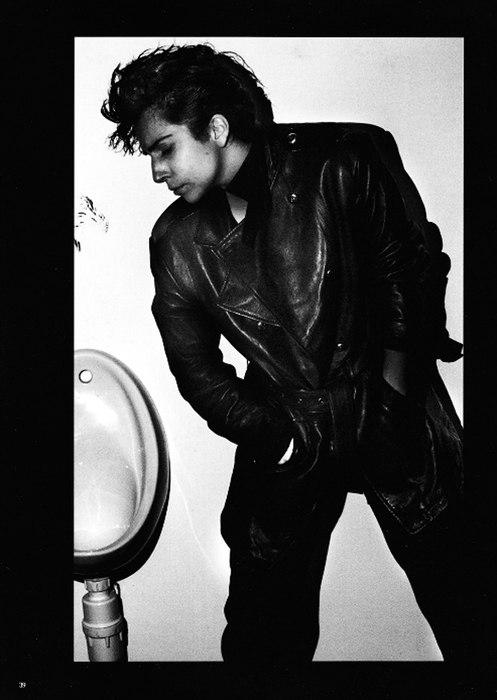
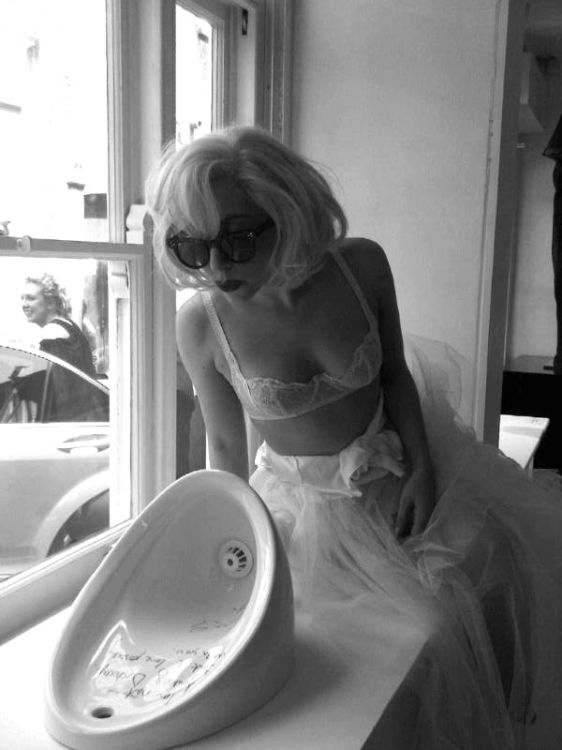
In addition to the alternate covers, we are also given another example that supports the idea of Jo as Gaga’s mirror. In posing next to a urinal, Jo invokes a very similar image of Lady Gaga peering into her creation of an homage to Duchamp’s urinal (shown in side by side photos below). It is a not-so-oblique wink and a nod to both performances, yes, but also a pointed commentary about gender. Consider how differently Gaga and Jo regard their urinals. For Gaga, it’s a work of art; a urinal is of no practical use to her at all. As a man, Jo would find the urinal useful, if not essential, and he probably doesn’t care if it’s art or not, as long as he can take a piss in it when he needs to.


5. Jo is how Gaga would see herself if she were a gay man.
This isn’t as far-fetched as it seems. In his interview with Gaga for the summer double edition of Rolling Stone, Neil Strauss wrote: “When she uses words like ‘fierce,’ or describes her sexual conquests of beautiful men, one sees why the hermaphrodite rumors about her have been so persistent: She seems, at times, like a gay man trapped in a woman’s body.”[i]

This observation is reinforced in the “Alejandro” film, evident in the frustration she shows when the men will not accept her as they accept each other, not even sexually, and perhaps especially sexually. Jo Calderone might be as close as Lady Gaga can get to being a gay man. That seems awfully personal, but Lady Gaga’s art is personal with a capital P, in addition to being pure artifice and spectacle.

If so, this implies something pretty big coming out of Born This Way, which has become Gaga’s anthem and war cry for the last several months. Something provocative, that’s a given. But maybe something very unexpected, too. We assume that BTW references the gay community that Gaga has so passionately embraced and has taken that passion to the next level, overt political action. But this mantle has already been laid across Jo Calderone’s shoulders. And it may mean more than we know.

6. He could be one of Stefani Germanotta’s long lost Sicilian cousins.
I’m speechless.

7. Keep it Simple Stupid
On the other hand, he could be very simply and obviously what he is: a male image created for a photo shoot in which she also appears as the Meat Model; interesting juxtaposition of images but…duh. Nothing so complicated. More like one of her trickster “Made you look!!!” moments.

And that she did. For now, we can only speculate and contemplate. Whereas the meaning of the Meat Bikini was made explicit later, Jo is still something of a blank, as personas go. The Meat Bikini came to life, became more than just an image, when Gaga used the same concept at the VMAs by wearing a meat dress, and tied it directly to DADT. She also reinforced its feminist message by picking up the magazine cover on Ellen’s set, and asserting that, “I’m not a piece of meat.” The reaction to the meat bikini in Vogue Homme was nowhere near the flood of opinions that resulted when she walked around wearing meat in plain sight. And hugging people, some of whom didn’t seem too comfortable getting that close to an uncooked steak dinner.

This is what happens when an image becomes incarnate. It becomes real. The persona acquires a life of its own. And that is where Jo Calderone is problematic. He hasn’t acquired a reality because he hasn’t yet been made flesh. He’s more like a blind date; we don’t know what to anticipate because we haven’t been properly introduced. He’s still a construct, a static image on a glossy page. Or rather, he’s rather like an empty suit still bagged up and hanging in Gaga’s wardrobe closet.

Jo Calderone is a two-dimensional slide show, not the living, breathing, performing hologram that is Lady Gaga. So we can’t quite know what to make of him. We see him but we don’t quite know what we’re looking at. And we don’t know what she plans to do with him, now that she has him. Maybe she doesn’t know either. That’s a meditation for a different evening.

But what I really really really want to know is: when she performs him, how is he going to walk in stilettos? He’s a mechanic, for crissakes.


When we meet him eventually, as I think we will, leaning hipshot against an old muscle car, a soft pack of Marlboros rolled into one sleeve of a grease-stained white tee…

What is she going to do to make him look taller?

Are you done? Good. Now I get the last word.
Contemplating Jo, insofar as “what does Jo mean,” is a bit like trying to know the unknowable, unless you want to go rummaging around in Lady Gaga’s psyche, and I’d recommend against it. But there are some conclusions that can be drawn.

Gaga clearly does not intend to confine her explorations of identity to female personae. Jo seem so jarring precisely because up to now, Gaga has only projected images of femininity, often conflicting, and often simultaneously seductive and grotesque. As much as she pushes the boundaries of how we define sexiness in a woman, Gaga always and everywhere projects as female, even when the forms are almost completely unrecognizable or extravagant parodies. She certainly performs drag but when she does, she drags other famous women who’ve inspired her (Madonna, Marilyn Monroe, Judy Garland, Jean Harlow, Marlene Dietrich, Veronica Lake, et al.), as well as reflecting iconic stereotypes like the pinup/calendar girl, but portraying them in transgressive. She can be awkward, gawky, not always attractive in some poses, but stunningly beautiful in others, but she’s indisputably female…despite the handful of hostiles who insist that she is intersexed or transsexual.

Gaga drags Marilyn Monroe

With the addition of Jo to her ensemble of characters that push the boundaries of gender and sexuality, he merely increases the discomfort that comes from not quite knowing what hers is. Unlike all the other characters Gaga has dragged, all her other personae, Jo is wholly and emphatically male, from the top of his pompadour to the tips of his shoes (which I imagine to be pointy-toed boots with stacked Cuban heels). There’s not a whisper of femininity in his looks, his posture, his poses, the visual energy he projects, or his brief biographical interview. He affirmed his gender in an August 27th tweet that said “I am a man. I am a human being. I am me. And I was Born This Way.”

Yet he seems oddly out of place in the man’s world depicted in Vogue Homme Japan, a glossy men’s fashion magazine that seems to be aimed toward affluent gay men. Sculpted faces and hair in high fashion, and properly toned, minimally clad male bodies are the norm. With the exception of Gaga as the Meat Bikini pinup girl, there are very few photos of women in the issue, and they are posed mostly as fashion accessories to the men they appear with and who seem decidedly disinterested.


Jo is doubly transgressive, not just in what he implies about Gaga’s identity but in his own right, by virtue of debuting in a magazine where he seems so out of place. He has nothing in common with the other models or the men in the other articles, and he doesn’t fit the magazine’s presumed demographic either. He doesn’t translate as notably queer in the sexual sense, if his answers in the interview are any clue (and they must be, because we’re not given any other information about him). Being working class to the bone and proudly so, he also breaches the very clear socioeconomic class boundaries of the magazine and its readership. He may be too cool to care, but we all know there’s a price to pay for that kind of deviance.

The sense, and pain, of being a misfit permeates Lady Gaga’s work, reflected in her performances and discussed at length in many of her interviews. She’s repeatedly spoken of feeling like a freak, an outcast, someone who didn’t belong. It was true in high school; it’s true to a large extent in her experiences in today’s pop music industry. She has a large following of fans who feel the same. Looking at Jo in the context of the magazine in which he appeared, he sticks out like a sore thumb. Like everyone in Gaga’s sphere of influence, Jo is different. He doesn’t belong. He doesn’t fit.

And there is simply no more perfect word for defining the freak, the misfit, or the outcast: that word is queer. Without using the word directly, Lady Gaga has nonetheless restored queerness to everyone who qualifies. The Monster Ball has become a celebration of Queerdom across a very broad swath of humanity. Anyone can drag, everyone can drag. The Monster Ball and by extension, the GagaVerse, is a place where “you can be whoever-or-whatever-you-wanna-be free,” as Posh puts it.

It’s the shared transcendent embrace and celebration of one’s queerness by artist and audience alike, as much as the music and performances themselves, that have produced the eerily intimate, mutually reflective love affair between Gaga and her Little Monsters. It is also the shared burden of mutual pain and mutual anger that requires more than a spectacular dance party to channel and discharge. It takes a battle cry, “Born This Way,” that everyone can take up. She invokes this phrase often, most notably in her concerts where she unleashes a fiery exhortation to her fans not be swayed or dissuaded or crushed by the daily litany of all the things they aren’t and all the things they can’t do, the sermon which affirms that everyone is a superstar and everyone is Born This Way.

In Gaga’s body of work, “Born This Way” isn’t just an explanation for one’s gayness. It’s an argument for every queer’s queerness. Queerness has been made more inclusive. For someone who is both gay and queer at the same time, it’s like a door opening into other parts of yourself that you may not have embraced. You can finally be gloriously queer in ways that have nothing to do with your genitals or where you like to put them.

And Jo Calderone seems to say, we’re all queers on this bus. And we were Born This Way.


[i]“The Broken Heart & Violent Fantasies of Lady Gaga,” Rolling Stone, July 8-22, 2010.


Author Bio:

Cheryl Helm is an old transgressive hippie, devoutly politically incorrect to all corners. She sold her soul to rock and roll in the 50s, picked up her first good electric guitar from Patti Smith's husband (Fred 'Sonic' Smith, RIP) in the late 60s, and never looked back. "Rock n roll, bitches, do or die," as Gaga says. She's written poetry, prose, the L-Word fan fiction, essays, editorials, music criticism, and some  things she can't quite define. She's written alone and with others, published in obscure ancient feminist literary journals no one ever heard of, as well as alternative presses, newspapers, Creem Magazine in its glory days, blogs, fan forums, leaving digital traces behind like glitter.