"[Gaga Stigmata has] very modern, edgy photography to free flowing, urban narratives without censure to analytical essays, et cetera—like Gaga, imagination without ... limits. And the beauty is that anyone can submit work to the site, so artists and writers from all over the [world] have joined this experiment." -The Declaration.org

"Since March 2010, [Gaga Stigmata] has churned out the most intense ongoing critical conversation on [Lady Gaga]."
-Yale's The American Scholar

Showing posts with label Spectacle. Show all posts

Friday, August 26, 2011

On Plastic: The Endless Garment

By Laurence Ross

The following is the seventh piece in our series on Lady Gaga’s “Yoü and I.” For previous analyses, click here.

Imagine (if possible) a woman dressed in an endless garment, one that is woven of everything the magazine of Fashion says, for this garment without end is proffered through a text which is itself unending … This endless garment has a double dimension: on the one hand, it grows deeper through the different systems which make up its utterance; on the other hand, it extends itself, like all discourse, along the chain of words.
– Roland Barthes, The Fashion System

It’s not meant to be an answer … it’s meant to be a perfuse number of questions.
– Lady Gaga

Despite the fact that Jonas Åkerlund did not direct “Yoü and I,” the video seems like the third chapter in a continuing narrative that the Åkerlund-produced videos “Paparazzi” and “Telephone” began. There is Lady Gaga’s glamour-infused romance (the result of which is death), Lady Gaga’s release from jail (the result of which is death), and then Lady Gaga’s escape to/return to Nebraska (the result of which is death). Yes, there is a repeated (rebirthed) theme, but there is also a (funereal) procession, a narrative extension on the discourse. Gaga leaves one man for another, moves from one prison to another, transitions from one state to the next. Gaga is continually killing one version of herself so that the next may be born, which implies two paradoxical sides of Gaga: one that wishes to live and one that wishes to die. “Yoü and I” simultaneously exhibits the separation (Lady Gaga and Jo Calderone) and the synthesis (Yüyi) of these two (seemingly) opposing sides of Gaga’s self. There is the Gaga who wants to be with the lover, submissive and secluded in the Nebraska barn, and the Gaga who wants to be the spectacle, the pop star, the one with agency.

I’ll Follow You Until You Love Me:

Lady Gaga stalks in her stilettos and her Chanel pants past the cornstalks. She stalks toward the one she loves, the one she had left. (“It’s been two years since I let you go.”) She is adorned in funeral garb that echoes her final outfit in “Telephone.” (A video at the end of which she says, “Now let’s go far, far away from here.”) She drops a dark flower to the dirt, because a flower, in the strictest sense, is not what she is offering. (Though, as I have suggested before, there is a Steinian aspect to Gaga’s project/narrative: “Rose is a rose is a rose is a rose.”)


When Gaga arrives in Nebraska, she still seems dressed for the part of the spectacle. Her Chanel and her stilettos stand in stark contrast to her rural surroundings. She is not, however, dressed in the makeshift, more avant-garde attire of the previous two videos. In comparison to fashion adorned with grotesque ruffles and Mickey Mouse print or fashion constructed from caution tape and flags, Chanel is quite tame. As Barthes points out in The Language of Fashion, “There is however a price to pay for the Chanel style: a certain forgetting of the body which we would say takes refuge, is absorbed in the social ‘distinction’ of clothing” (108). In wearing Chanel, the figure (the spectacle) of Gaga becomes less prominent. Gaga’s choice of fashion – away from the makeshift and toward the readymade – brings Gaga one stilettoed-step closer to the generic available to us all.

In the opening scene, Lady Gaga is also once again portrayed as part cyborg, with her exposed mechanic arm and a metal chin above a (heavy) metal voice box. Gaga has played the cyborg before, in her gold-plated attire of “Paparazzi” and with her robotic stutterings – both vocal and physical – in “Telephone,” though in those lavish and urban settings, she is clearly meant to be the centerpiece of those theaters. When Gaga arrives in Nebraska, however, she arrives alone.


Just as there is a price to pay for Chanel, there is a price to pay for Nebraska. A price that Gaga now seems willing to pay. (“But this photo of us, it don’t have a price.”) No backup dancers, no entourage, no spectators. Gaga, as spectacle, as pop star, is already fading away. (“I’ll be a girl backstage at your show.”) Even in the video’s opening shot, she is a blur, a wisp, a haze. In entering Nebraska, in pursuing her lover in Nebraska, Gaga ceases to pursue the stage. The flashing cameras and screaming crowds are replaced by the naked sun and the whistling wind.

We’re Plastic But We Still Have Fun:

In “Yoü and I,” Gaga is ready to give up the spectacle of herself. As Gaga uses her one arm to forcibly raise the other (opening her arms to be embraced?), she sings, “I’d give anything again to be your baby doll.” A doll to be played with, manipulated, and dressed up like any number of plastic toys, a doll to be experimented with. And as Barthes writes in his essay on plastic, “Despite having names of Greek shepherds (Polystyrene, Polyvinyl, Polyethylene), plastic … is in essence the stuff of alchemy” (Plastic 97). Gaga, in the video, seems initially torn by the idea of the doll, even as she sings of her desire to become one. Gaga struggles with the notion of the doll just as Gaga both embraces and rejects the actual doll she is offered by the menacing ice-cream truck driver.


But it is once inside the barn that the real transformations begin. Gaga transfers her agency as a performer to the lover: Gaga becomes the one performed upon. The lover sprays and injects (“Silicone, saline, poison, inject me.”) The first redesign turns Gaga into a being that resembles a yellow canary, a songbird/showbird/jailbird bound and retrained by her captor/curator/lover. “Fashion (as we conceive it today) rests on a violent sensation of time. Every year fashion destroys that which it has just been admiring, it adores that which it is about to destroy” (Language of Fashion 106). Gaga-as-canary is caged, pinned down, in the process of being domesticated. (The harness, the hairpin glasses.) The domesticated canary is the canary that needs to be bred, that needs to be engineered by an engineer.


The triangular shape of the shoulder pads the lover engineers recalls the memory of yet another jail suit – the black-and-white striped ensemble Gaga wears at the beginning of “Telephone” as she is placed behind bars. And the long collar constricting her neck recalls yet another constriction – the neck brace Gaga wears in “Paparazzi” after falling from the balcony. Here, in the laboratory of the lover, Gaga is not the creator, but the created; she is not the visionary, but the vision; she is not the artist, but the art.


In the process of change, of becoming domesticated, Gaga becomes less and less human. In a way, less and less alive. (“Dress me, I’m your mannequin.”) The dark-haired intermediary figure Gaga becomes between her canary form and Yüyi is the most lifeless of the three, and, in a way, the most artificial. “At the sight of each terminal form … the mind does not cease from considering the original matter as an enigma. This is because the quick-change artistry of plastic is absolute: it can become buckets as well as jewels” (Plastic 97). Her movements in this intermediary form, despite the absence of any visible cybernetics, are quite mechanical, her eyes often vapid. She seems, in her floral-coated attire, as severed from life as the flower Lady Gaga drops to the dirt in the beginning of the video. There is nothing left here of the pop star, the spectacle as agent. (“So put your dreams up for Nebraska.”) Nearly all of her human skin is masked, her legs now sheathed in boots and stockings that foreshadow the mermaid’s tail.

Gaga’s final transformation into Yüyi, however, presents us with an unexpected shift. Yes, on the one hand she is literally legless, immobilized, contained within a large bucket, and reliant on the lover to breathe, which is perhaps the epitome of a lack of agency. But on the other hand, Lady Gaga has transformed into a mermaid, a fairytale figure of myth. Once one is in the world of Faerie, the rules of our world, the “real” world, cease to exist.

Gaga may no longer be human and her breasts may now resemble plastic more than flesh, but there is a freedom granted by this transformation. “And as the movement here is almost infinite, transforming the original crystals into a multitude of more and more startling objects, plastic is, all told, a spectacle to be deciphered: the very spectacle of its end-products” (Plastic 97). By muting the initial spectacle of herself and allowing herself to be molded, Gaga gains a mutability that allows her to become the spectacle once again. Once one enters the world of Faerie, one can become anything.

We Are the Crowd:

In comparison to Yüyi who stands out (without legs) as spectacle, the Gaga who dances in the barn is merely one of a larger crowd. The Gaga performing choreography, while perhaps striving for spectacle, ultimately fails. Barthes, in his essay on the striptease, writes, “The dance, consisting of ritual gestures which have been seen a thousand times, acts on movements as a cosmetic, it hides nudity, and smothers the spectacle under a glaze of superfluous yet essential gestures” (Striptease 85-86). The aura of the striptease in these scenes is first generated by the costumes in which Gaga and the rest of the dancers perform (clad in bondage straps and Gaga with cuffs dangling from her hips) and is solidified by the ritual gesture of pole dancing.


Gaga is multiplied in these dance scenes by the rest of the dancers who replicate all of her movements and serve to distract the spectator from Gaga herself. (This distraction stands in direct opposition to “The Edge of Glory” video, in which the stage was Gaga’s and Gaga’s alone.) The camera angles in these dance sequences do not follow and focus on Gaga in the ways we would expect. At one point the camera abruptly tilts and Gaga is out of the frame, the focus instead on the dancers above her head. Gaga may be wearing her aquamarine wig in these dance scenes, but these are the scenes in “Yoü and I” in which Gaga as spectacle is the most obscured, the most diffuse, and the most generic.


Gaga does eventually lose all of her clothing, though it is not on the dance floor. By the time Gaga becomes Yüyi, she is not wearing any garment at all. Or, perhaps, she has (for the moment) become the garment, the accessory to the lover. There is a scene where the lover and Yüyi appear to be having sex, though whether or not they are actually having sex is questionable. (At least sex in the heteronormative, penetrative sense of the act.) The very fact that Gaga is decidedly not human in this form raises the question, is such sex even physically possible? “Feathers, furs and gloves go on pervading the woman with their magical virtue even once removed, and give her something like the enveloping memory of a luxurious shell … the nakedness which follows remains itself unreal, smooth and enclosed like a beautiful slippery object, withdrawn by its very extravagance from human use” (Striptease 85). It is also feasible that at the end of “Yoü and I,” the lover no longer desires sex in the traditional sense. He is no longer naked, but wears rain boots (adapting to her circumstance) and shorts. He is no longer standing above or hovering over her, but curled almost in the fetal position at her side. The scene shifts from one that is overtly pornographic in its intention to one that is much more tame. In this scene, one in which both parties appear to be content, it seems compromises have been made on the behalf of each. Gaga as Yüyi not only regains herself as spectacle, she regains her agency in the relationship. The lover still holds Yüyi at the end of the video, though this hold is no longer a restraining one. The hold is now one of mutual embrace, as Yüyi is also holding him.


This scene of the mutual embrace represents the ultimate synthesis of the two disparate yet co-existing sides of Gaga – the Gaga the lover and Gaga the spectacle. In her song “Fashion,” Gaga sings: “You are who you wear, it’s true.” And if this statement is indeed a truth, then Gaga is her truest self in this scene as Yüyi. As Yüyi, Gaga is wearing nothing (and no one) but herself.

Yellow Dance and We Turn:

There is one more Gaga presented in the video who is arguably the most lifeless – the Gaga in the wedding dress. This Gaga wears the pallid face of a dead woman, her cheeks not rouged but drown in blue. In the context of the spectacle, death is, perhaps, our final show. There is our viewing, and, if we are lucky, the ray of sun(spot)light that pierces the forest canopy to shine on our glass coffin. There is our final application of make-up, our final moment on the stage before we are born forever out of sight by our pallbearers. The Gaga in the wedding dress, the most traditionally domesticated vision of Gaga we are given, is presented as a symbol of death: the corpse. But this Gaga-as-corpse is animate, not lifeless. One life (New York) is given up for another (Nebraska). Though she is filmed in the final scene with a ghostly transparency, the expression she wears on her face seems not so grave. These scenes seem more like a dream than a reality, and in the final scene, the dream (the wedding dress) overlaps the reality (the Nebraska barn). One dream (the pop star) is given up for another (the lover). And if we are merely (and perhaps endlessly) swapping dream for dream, dress for dress, does it matter which we choose?


Barthes concludes his essay on plastic with this thought: “The hierarchy of substances is abolished: a single one replaces them all: the whole world can be plasticized, and even life itself since, we are told, they are beginning to make plastic aortas” (Plastic 99). Lady Gaga, in placing herself in the generic, domesticated role of the bride, shows that whether she chooses to be the pop star or the lover (or anything else for that matter), she can remain our spectacle. As Yüyi, embodying the conflicting sides of herself, Gaga shows that it is possible for us to have our frosted cake and eat it too. That it is possible for domesticity and agency to co-exist. That Lady Gaga can be (and is) both the artist and the art. And that, in a plastic world, if Lady Gaga can become our spectacle, we have the capacity of spectacle as well.

Bibliography:

Åkerlund Jonas, Dir., Telephone. Perf. Lady Gaga. 2010. Film.

Åkerlund Jonas, Dir., Paparazzi. Perf. Lady Gaga. 2009. Film.

Barthes, Roland. “The Fashion System.” Trans. Matthew Ward. London: The Trinity Press, 1985. Print.

Barthes, Roland. “The Language of Fashion.” Trans. Andy Stafford. Oxford: Berg, 2006. Print.

Barthes, Roland. “Mythologies.” Trans. Annette Lavers. New York: Farrar, Straus, and Giroux, 1995. Print.

Formichetti, Nicola. “Yoü And I / LADY GAGA / FASHION CREDITS!!!!!.” NICOLA FORMICHETTI’S BLOG!!. 16 Aug. 2011. Web.

Lady Gaga. “Dance in the Dark.” The Fame Monster. Interscope Records, 2009. CD.

Lady Gaga. “Fashion.” Confessions of a Shopaholic. Hollywood Records, 2009. CD.

Lady Gaga. Interview by Sway. MTV. 18 Aug. 2011. Television.

Stein, Gertrude. Geography and Plays. Boston: Four Seas, 1922. Print.

Yoü and I. Dir. Haus of Gaga and Lady Gaga. Perf. Lady Gaga. 2011. Film.

Writer Bio:
Laurence Ross holds an MFA in Creative Writing from the University of Alabama. He lives, writes, and teaches in Tuscaloosa, AL. His essays have appeared in Brevity, Mason’s Road, Bluestem, and elsewhere. He has recently completed a novel, Also, I’m Dying, in which characters deliver performances of crisis, education, anarchy, vanity, husband, wife, child, and alcoholism, among other things.

Click here to follow Gaga Stigmata on Twitter.
Click here to “like” Gaga Stigmata on Facebook.

Sunday, October 31, 2010

A Special Variety of Soft-Skinned Dangerous Game


Artist Statement: "A Special Variety of Soft-Skinned Dangerous Game” is a series of photographs and video that has developed from an ongoing investigation into camouflage, performativity and the grotesque. My particular interest in camouflage is where art, fashion and warfare overlap, its formal properties and social function. This work is visually aggressive, humorous and sexual. It utilizes visual tactics of camouflage and disguise to rewrite the skins surface in order to exaggerate the process of identification through the psychology of vision. The “Gagaesque” protagonist looks out from a body that desires the viewer’s gaze, from a complicated ever changing, non-classical body that is in the process of understanding its own parameters. The two-in-one body that is represented mimics one of the fundamental tendencies of grotesque imagery, that is it exceeds its own limits. She goes further than her own meatiness; she gives birth to herself over and over again!  


Artist Bio: Jemima Wyman is a contemporary artist who lives and works between Brisbane and Los Angeles.

Wyman's art practice incorporates various mediums, including installation, video, performance, photography, and painting. Her most recent artworks utilize these mediums to specifically focus on visual-based resistance strategies employed within contemporary 'irregular military,' in an aim to explore the formal and psychological potentiality of camouflage in reference to collective identity.

In 2007, Wyman graduated with an MFA with an MFA from California Institute of the Arts in Los Angeles, made possible with the support of a Anne and Gordon Samstag Scholarship.

Jemima is represented by Milani Gallery and has exhibited throughout Australia and internationally. Past exhibitions were held at the Australian Centre for the Moving Image (Melbourne), Museum of Contemporary Art (Sydney), Plimsoll Gallery (Hobart), Westbeth Gallery Kozuka (Japan), 40000 (Chicago), and Steve Turner Contemporary Gallery (Los Angeles). Her work was exhibited in 17th Biennial of Sydney - The Beauty of Distance: Songs of Survival in a Precarious Age. Jemima recently completed a residency at The Elam School of Fine Arts in Auckland.

Wednesday, October 27, 2010

Letter to a Young Monster: In the Spirit of Minor Truths and Major Dreams

by Blair McDonald


Tamworth (Near Toronto) Canada
October 27, 2010


Dear Fellow Monster(s),


What keeps getting lost in all these discussions of Lady Gaga has nothing to do with the politics of interpretation. Sometimes, in our excitement to make sense of things, we cross a line as critics: we engage in inappropriate touching, or better – interpretative molestation. In most instances, Susan Sontag reminds us, “interpretation amounts to the philistine refusal to leave the work of art alone. Real art has the capacity to make us nervous. By reducing the work of art to its content and then interpreting that, one tames the work of art. Interpretation makes art manageable, conformable” (8). We should also recall how Rainer Maria Rilke writes in the “First Letter” of his Letters to a Young Poet (the same letter that contains the quote on the necessity of writing that Gaga has tattooed on her left arm): “With nothing can one approach a work of art so little as with critical words: they always come down to more or less happy misunderstandings” (15).

I do not wish to add to the critical interpretations already surrounding Gaga’s growing body of work. It is not that I do not appreciate criticism, especially criticism of the right kind and the right spirit; it is rather that at this stage in the game, I am uncomfortable with this approach to Gaga. Interpretatively I am reluctant to touch her there. It feels unwarranted, too aggressive, in a word: inappropriate (at this time). Maybe it is because her work is too powerful and I am too proud to submit to it – as if I was overcome with a loss of and for words at the thought of being her “little” semiotician. Or maybe, that in the spirit of interpretation I will never win her heart, never creatively measure up to where I imagine encountering her someday.

What follows is not about analyzing every little thing she has said or worn, every frame in each of her videos, her lyrics, her performances, the tours, her activism, or the liner notes to her albums. No. I want to extend my appreciation of Lady Gaga into a bigger discussion on the nature of art – its necessities and its truths – and from that bring to life a very simple yet missing voice in all this: the work of art and its experience as a concern for pleasure and inspiration. When did we lose our sense of the importance of pleasure and inspiration for experiencing art – especially when that art is something as powerful as music? Is it possible today to respond in that spirit of philosophical appreciation, in the spirit of Sontag, not necessarily against but ambivalent to interpretation, and still have something to say about Gaga?

In her recent Rolling Stone interview (Summer 2010), Gaga makes a revealing and paradoxical claim whose essence, I believe, is rarely understood: “Music is a lie. Art is a lie. You have to tell a lie that is so wonderful that your fans make it true. That has been my motivation and my inspiration for the longest time and the new album is a lie that I want to become true so desperately” (71). To add to the paradox, her new album will be called Born this Way (set for release sometime early 2011), thus further complicating the seams between the fictional and biographical that make up the “truth” that is Gaga. And later in the same interview, another blurring of art + life: “When I wake up in the morning I feel just like any other insecure twenty-four year old girl. Then I say, ‘Bitch, you’re Lady Gaga, you get up and walk the walk today’” (70).

If we entertain the belief that art is both the means and ends of creation, the significance here is that Gaga is making a claim about the creative fiction that she herself is and lives by – that which she affirms daily on and off the stage. The paradoxical nature of these claims, and the controversy they have generated in the general public and media, come from the way in which she makes the everyday her playground for the fantastic; the way she undoes the belief that the great lie of art is a bad thing, and that the artificial is any less authentic or real because it is fabricated. Like a true rebel Gaga champions these; her minor truths – among others. Not necessarily as a reaction (as she said elsewhere in defense of her American Idol performance, “this is not a reaction, this is our [as in the Haus of Gaga] definition of the beautiful we are putting out there”), but a self-fulfilling destiny of art + identity. In her Vanity Fair interview (September 2010), she confirms this belief again: “I am my music; I am my art; I am my creativity. When I look into the crowd [at my shows], I feel like I’m looking into tiny little disco-ball mirrors and I’m looking into myself. And when I wake up in the morning, that’s what makes my heart tick” (331).


Gaga is and has become the fiction of her own creation, the monstrous creation that enigmatically also creates her in the process. Meghan Vicks’ discussion of Gaga’s “trickster” role(s) in popular culture affirms this doubling as well: Gaga is “both the product and the performance.” The truth of the matter is Gaga lives in and through this lie (self-assertively), and all her art is but the occasioning of this simple truth. Rightly, what perplexes many on-lookers is the way in which she productively blurs the traditional lines between art and life, truth and fiction, and the real and the fantastic. In the name of art, Gaga is but another lie in the history of the Big Lie that is Art, albeit a powerfully attractive and distractive one. She is a lie both for the times and for all times, uniting what Charles Baudelaire in The Painter of Modern Life so rightfully champions as true art: the union of the transitory and the eternal. The truth is that there is no other truth than this minor one: Art is the lie that tells the truth. Art: the source of everything that haunts us in dreams and fears is the instrument and the effect, the poison and the antidote, and more accurately, the unresolved within us needing outlet. What gets expressed is both pure fiction and pure truth at one and the same time. The truth of Gaga remains that through artifice she comes to life simultaneously as something other than and also as pure-truth-as-pure-lie. To speak in general: The truth of art is that we live in and through our artifices. We make them as much as they come to make us who we are.

How often, too, is the philosophical nature of Gaga’s claims lacking in appropriate consideration. For instance, in the same RS interview, when asked about her tireless work ethic, she champions the idea of art as catharsis: “In so many ways my music also heals me. So is it heroin, and I need the fix to feel better? Or is it the music is healing? I guess that’s the big question. When you work as hard as I do, or you resign your life to something like music or art or writing, you have to commit yourself to the pain” (70). With this kind of statement there is something to be said for the inspirational power of her work ethic that often gets overlooked in critical commentary. As a creator she commits to her emotional states (the highs and the lows), and is self-aware not only of her own creative process, but also of the release that her music provides for both her and her fans. Aristotle confirms this view of art as well. In the age-old debate on the utility of art, Aristotle responds to Plato’s claim that art is a useless lie, by saying that it is useful for healing and releasing us from uncomfortable emotions.

Art is a precious and necessary release of feeling. As much as we are all dreamers, artists are the dreamers that have the courage and the drive to bring their visions to life. They do something with them; they make something out of them. Their impact is a question of currency. It stands in direct proportion to our faith in these visions. The more we believe them, the richer and more powerful they become and the greater they endure in the hearts of all that hold them dear. As in Gaga’s “Manifesto for Little Monsters,” screened as an interlude during the recent leg of the Monster Ball tour, and featured in writing in her Super Fan Collectors Art Book of The Fame Monster: “It is in the theory of perception that we have established our bond. Or, the lie, I should say, for which we kill. We are nothing without our image. Without our perception. Without the spiritual hologram of who we perceive ourselves to be, or to become, in the future.” Admittedly, not everyone champions Gaga’s artistic currency, but moments like this define her as more than just a pop star, and as someone with remarkable philosophical acuity.


Art ought to be about understanding its pleasures, about finding new ways of appreciating and becoming aware of its effects – a knowledge of how and why art affects us in the way that it does. In Beth Goodney’s piece “Spectacle of the Other Woman: Lady Gaga and Art as Excess,” she argues (with the help of Elizabeth Grosz) that “the appeal of art is in the spectacle, and it is the spectacle that should be engaged with.” For Goodney, the over-analysis of signs has its drawbacks for understanding its transformative and thus “political” potential. The difficulty I have with Goodney’s conclusion, however, lies in the fact that in her resistance to the “all too pointed” nature of interpretation, she signals the radical opposite – what she calls the “allure of the pointless” that will transform norms because of its radical excessiveness. In Goodney’s resistance to interpretation, she champions the political powers that we find in the excess of what interpretation cannot contain. That is, in its sheer overwhelming power the work can transform us. “Rather than trying to understand ‘Telephone,’” Goodney argues, “we can appreciate the very aspects of it that defy understanding, not because the signs are so cryptic that only the most gifted semiotician could decipher then, but because they are arbitrary, superficial or aesthetic” (Emphasis mine).

While I have some sympathies with Goodney’s point, the move against interpretation cannot be one of apathy – it is not just arbitrary signification. In response to things we do not immediately understand, it is too simple and perhaps dangerous to say that it must be without purpose or simply arbitrary. Is there not also something inherently disrespectful in such a claim? However, there also seems to be something perverse in the opposite gesture that seeks to transform every little sign into a chain of conformable and intelligible propaganda – something that, in a way, sucks the very spirit out of the work in the name of that perfect, transparent intelligibility. The question remains: is our only option but to choose sides?

Criticism is neither good nor bad in and of itself. Its virtue is bound up with its intent, its respect for the work and what it accomplishes. The problem is not trying to understand something. The problem lies in the way a work is touched. I am not against interpretation – just poor frameworks and inappropriate fondling. The problem is the way in which something comes to be understood, the politics that come to govern a particular way of seeing, and the resultant eclipse of other modes of seeing. When one has a view in mind of how they want the work to appeal to them, one taints the lens from which they view. Such a perspective runs the risk of being inhospitable to what the work itself is trying to communicate. This leads us to another problem: the is-ness or the itselfness of the object in question. Regardless, what it is is what we make of it. We champion art because as much as it can tell us something about life and ourselves, it is also a significant source of pleasure – an experience of the gift like no other. Learning how to appreciate art goes hand in hand with developing new ways in which to experience it. Because art addresses our senses, criticizing is not the same as feeling. To develop how to feel in the name of the experience that is art is not the same thing as learning how to be critical.

What I feel is sorely missing from discussions thus far is a simple reminder of the idea that art releases us of and from our emotions – both the good and the bad. This is why it is important to recall Sontag’s call for the remodeling of our artistic sensibilities. From forty-six years ago, she commands: “What is important now is to recover the senses. We must learn to see more, to hear more, to feel more. Our task is not to find the maximum amount of content out of the work that is already there. Our task is to cut back content so that we can see the thing at all” (14).

Effortlessly vocal about the magic of art, of spectacle, of her shows (she claims that her show has “a lovely naiveté and melancholy to it: a pop melancholy” [72]), Gaga wants this from us as well. She wants us to experience her art in all its glory – as inspiring, as empowering, as a rare gift to our dulled senses. Lamenting the current lack of imagination in and for music as art these days, she comments: “There is no fervor for the fantasy of music anymore. It’s all about No.1s and who’s on iTunes, and [while] I’m on iTunes and I’m No.1, I still care about the fervor of show business and music and womanhood” (331). The great thing about claims like this is that she walks the walk. Her live show (the Monster Ball) is testament to that belief. Quite simply, it is the best Pop show traveling the world today.


In today’s rather stale climate of so-called intellectual criticism, as mere listeners and observers, is a return to the fervor of music too much to ask? I don’t think so. Today, our greatest shame is that we refuse the intelligence of the senses in the name of criticism. We mock the experience of emotion and child-like wonder as if they were symptoms of one’s weakness and lack of seriousness. With Gaga in particular, her popularity is treated with suspicion (for to be popular and artistic is a rare thing), and for that reason her every move (both in life and art) is subjected to excruciating critique. “A true critic doesn’t feel,” you say, “because their work is to source its meaning – its symbolism.” In certain instances, yes, this is helpful. But the vitriol of their arguments often does more to highlight their ressentiment than to awaken us to a new way of appreciating the work before us or to give us the tools for understanding its cultural impact. And this is the virtue of artistic criticism, or else it is useless. There are virtues and insights found under the microscope of interpretation, but let’s not sacrifice what makes art enjoyable in the first place; let’s not turn a blind eye to the Muse of Wonder it conjures.

How often I am asked in my claims “against interpretation,” what am I signaling? While I think this is a difficult question, my response is to say that art is always bound up with its inspirational power – the spirit that it breathes into each and every one of us. For me, it is as much about what gets produced by Gaga as the fearless spirit underneath it all that breathes life into the entire constellation of her work. This is the source of my multiple appreciations. This excites me not to interpret but to remind myself that I have creative powers too, it puts that faith in me to do what I need to get done, for me to get going with my own creative projects. The courage to bring to life her visions, her dreams, to make of her existence and her work an Event is what breathes life into mine. It is in this spirit that I advocate against interpretation – not as a school, nor a position, but as a becoming-Creator, dreaming of the day when one’s own vision gives way to a life every bit as eventful – albeit in my own way. In this sense, personally speaking, my interpretations will not do her justice; only my own creations can win her heart.

My call to new forms of criticism is simple: it is time to wipe the dust off our eyes and ears; to stop over-analyzing things to the pleasureless point of no return; to stop fondling inappropriately and stamping terms on objects where they don’t belong. And, may I add: to be brave and less prejudiced with how one feels about their encounters with art and what it says about the experience that is life for whatever you choose to champion as art.

In the spirit of Gaga, let’s recall a new but fundamental life lesson that all of us can use, future pop stars or not: The best artists have to kill to make it happen. You have to kill to make art, and today, the rules of the game remain: the more monstrous the more memorable. And the next time the feeling arises within us to critically interpret, let’s try to think how we can do it differently, attempting a voice absolutely singular: inspired and respectful – as if we were in her presence, as consultant, as collaborator, as confidante, as if these words where en route to the Haus of Gaga via the glitter way.

Lady Gaga is the meteorite that our aesthetic senses need for today, tomorrow, and forever. For the time being the following truth stands: “Lady Gaga is the lie that tells the truth.” And let me add, in the writerly self that writes in her wake: “And we, faithful adherents to the work that is, in faithful adherence to its power, its inspirational energy, cherish this lie with all of our hearts. Us, mere fans, no, better, enthusiasts, ‘little monsters’ (whatever our designation) now stand tall with new dreams because of this work which brings to life our own monstrous imaginary – the starry-eyed Muse that now says before everyone and everything: ‘Now it is my turn. Now it is my time to set out to work on the project of my dreams, my fearless work driven by the same relentless courage.’”

As Kanye West so beautifully stated in his recent self-penned essay, La Dolce Vita, (whose recent performance on Saturday Night Live, [October 2, 2010] also suggest influences of Gaga) in the October 2010 issue of XXL: “I am one with the people, and as I change, the people change with me. I am one of the faces of the zeitgeist. (…) I am the voice of the dreamers. I am the creative dream come true, and I refuse to wake up” (79). It is in this spirit of creativity that I place Gaga’s allure, this same spirit that I find so difficult to criticize. How I dream of someday finding the right words, there where you and I need them most.


Yours:
Blair McDonald


+

Appendix:

Excerpt from Blair McDonald, A Day in the Life of, (Lament + Promise, publication forthcoming, TBA):

The other night, walking home, dispirited, like a broken heart but different, I could hear the synth-bass in a car coming up behind me, that familiar opening that I have been championing since day one. Rarely do songs find me there where the events of my life are exacted, rarely do songs have that sort of fearlessness to change one’s perspective on everything for the time being, but this one does, it finds me there where I need it most, in the spirit where I love that chip on my shoulder (hers too), that chip I wouldn’t let go of for anything in the world, a chip rich with venom and on other occasions cavities of gold. The car speeds closer, I was right, I would have recognized that song anywhere and tonight of all nights it is just what I need to snap me back into focus, ‘The best kind of drug for the worst kind of nights,’ I once thought / I once wrote. The car drew close, its tires hissing in the rain and passed right as I approached the bridge, the time on the Nylex clock was 11:13pm, a slight rain meant nothing to my pace and the thoughts start to circle, always I used to laugh when the conditions and my instruments (without a pen) were against me. But let me say it again, obstacles make me possible; they possibilize, they galvanize, with Q-Tip and against Jay-Z, you better not get that chip off your shoulder, keep it next to your heart where it belongs, it’s your monster, creative or otherwise, it is your beacon for all your powers, your antennae to all that circulates unresolved and unvoiced within you. The light went from red to green, rounding the corner the car accelerated into the distance, moving under the street lights that I love so dearly, especially in the rain and for the moment I am caught out here sheltered in reflection, where normally one attempts to find shelter from the rain, I say ‘let it’ and continue, I should be at D.’s by midnight.

~

Bibliography:

Baudelaire, Charles, The Painter of Modern Life and Other Essays. New York: Phaidon Press, 1964.

Goodney, Beth “Spectacle of the Other Woman: Lady Gaga and Art as Excess”, GAGA StigmataSunday, August 29, 2010.

Rilke, Rainer Maria. Letters to a Young Poet (Revised Edition), Trans. M.D. Herter Norton, New York & London: W.W. Norton & Company, 2004.

Robinson, Lisa. “Lady Gaga’s Cultural Revolution”, Vanity Fair (VF 601), September 2010.

Sontag, Susan. Against Interpretation and Other Essays. New York and London: Anchor Books, 1990.

Strauss, Neil. “The Broken Heart & Violent Fantasies of Lady Gaga: The Rolling Stone Interview”, Rolling Stone (RS 1108/1109), July 8-22, 2010.

Vicks, Meghan. “The Icon and the Monster: Lady Gaga is a Trickster of American Pop Culture”, GAGA Stigmata, Friday, March 19, 2010.

West Kanye. “La Dolce Vita” XXL, October 2010.

*

Author Bio:

Blair McDonald is a freelance writer currently based in Ontario, Canada. His dominant interests include Continental Philosophy, in particular, ‘deconstruction.’ He recently worked as an Assistant Lecturer in Communication Studies @ Monash University in Melbourne, Australia and is hot on the pursuit of fresh research and lecturing opportunities. Creatively speaking, he is currently for sale.

Thursday, October 21, 2010

Two Portraits by Kimiko Yoshida


 Kimiko Yoshida, Painting (Balthazar Castiglione by Raphael). Self-portrait, 2010 
COURTESY PACO RABANNE


Kimiko Yoshida, Painting (Queen Marie-Antoinette in a Court Dress by Elisabeth Vigée Le Bun). Self-portrait, 2010 
COURTESY PACO RABANNE


Artist Bio: Kimiko Yoshida studied photography in Japan and in France, where she has lived and worked since 1995. 

Monday, October 4, 2010

Do Ask Do Tell: Lady Gaga and the Politics of Mimesis

by Willow Sharkey

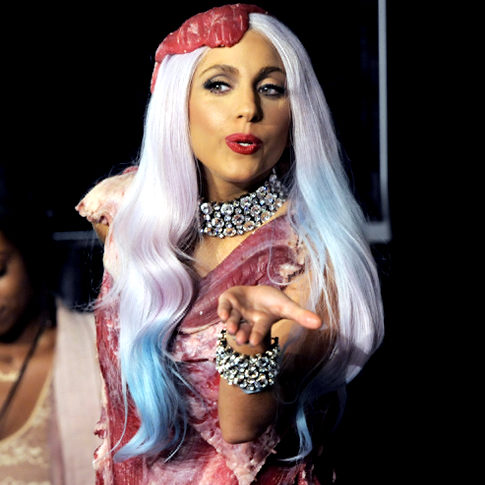
On Saturday Night Live’s September 25th, 2010 episode, in the sketch of Weekend Update, the writers submitted, in their de rigueur amalgam of wryness and serious political commentary (a tone that is both to be taken seriously and just kidding), that Lady Gaga’s efforts on behalf of repealing the policy of “Don’t Ask Don’t Tell,” while commendable, could not be taken seriously because she had only days before worn her dress made of meat to the MTV Video Music Awards.


The incongruity of one day seeing her in a costume so adamantly grotesque and hideously funny, a costume that made its aspirations to the carnivalesque so obvious, and the next day in suit jacket and tie, in a black and white home-made digital video, purposely low-tech and under-produced, pleading with fans to make a concerted effort to engage their representatives and congress-people to repeal DADT, were too much; the nature of one would discredit the polarity of the other. She could not wish to be taken seriously, so suddenly. One does not segue from jester to lobbyist. It is an odd submission for SNL to make, given that the formatting and tone of the show itself seems predicated on the belief that parody and provocations to effect political change are mutually supportive modalities (an idea keenly reflected in the output of Lady Gaga).

Lady Gaga’s project is not quite as binary as this characterization. As has been argued elsewhere, Gaga repeatedly employs a mirroring technique in her work to reflect the spectacle of late-capitalism and pop-culture back to itself.[1] Her overtly political video is more than a ploy to be suddenly taken as something beyond a pop-culture provocateur, a serious voice for reason. The cultural landscape, for one thing, is just too populated with an ironic vernacular of the parodical for that, and Gaga has consistently shown a savvy awareness of how the varying channels of media create and respond to images of her.

Gaga’s work, if reducibly about anything, is about life in spectacular culture, and what riposte may be made. In Guy Debord’s pioneering thesis establishing the codes and characteristics of spectacular culture, he asserts that within spectacular culture, the image is privileged, and the populace submits to the monolithic power of those in control of the image.[2] Gaga’s video may have made her project more explicit and less obliquely political, but it was not a departure from her previous aims and modes of expression – those that seek to create pervasive images that may be democratically engaged with by a public.

Lady Gaga’s constant appropriation of cultural tropes is not only post-modern pastiche methodology, but is also an object lesson for her massive audience in the use of appropriation. In her “Don’t Ask Don’t Tell” video she made explicit what had already been implicit: we live in an age when the seduction of the image can isolate and make one apathetic, but it can also be quite easily appropriated, responded to, and virally spread. It was not by accident that the video was so lo-fi. It was telegraphing the notion – anyone can make this, anyone can participate in civil life, and you can even do it in the modes that feel comfortably like your own.

In the digital age, it is true more than ever that the image, and increasingly, the Internet meme, is a most powerful disseminator of what information the culture at large deems important and captivating. Lady Gaga’s output is a cipher that privileges and empowers reinterpretations of her projects, just as she has used the force of outstanding cultural tropes and excavated, mashed-up, and fed them to the public in her own work. This transposition of agency and responsibility, from pop star to anyone, is itself a kind of emancipatory political stance. Gaga has stated in interviews that her work is about trying to make it “a bit easier to swallow this kind of horrific media world we live in.”[3] This may be accomplished by problematizing the glorification of fame, but also through minimizing perceptions of distance between designated cultural producers and consumers.

The intent to minimize this distance is apparent, for example, in the way Gaga and her choreographer intentionally create dances for her music videos that are stylistically “D.I.Y,” Do-It-Yourself. Of course, one motivation for including dance moves simple enough to be mimicked by an audience and used in their own mimetic viral videos is a marketing savvy that recognizes the popularity of dance in video. And yet with Gaga, there is something else going on: a juxtaposition of the hyper-saturated, hyper-stylized vocabulary of the music video alongside the problematized, strange, anti-pop-star nature of Gaga. Her choreographer stated in an interview that in the process she “created the movement with someone who wasn’t so perfect.” She went on to say “I think that’s what a lot of people identify with. You don’t have to be perfect when you do the ‘Bad Romance’ dance or ‘Poker Face.’ The rhythmic emphasis falls on unexpected beats: They’re based out of an emotion, so when you hear the record, it’s choreographed as an emotional dance, and it’s kind of like people are experiencing her when you do the movements.”[4] Gaga intentionally creates a simple dance vocabulary that can be quickly absorbed and reiterated, a vocabulary that is simultaneously Gaga’s movements and one’s own.

Large swathes of fans have already responded to the absorb-able information by, indeed, creating their own videos that represent Gaga’s source material (and dance moves) along with their individualized expressions. This framework is again witnessed, when on September 17th, 2010, Gaga appealed to her Twitter followers to make their own anti-DADT videos addressed to their governmental representatives. Gaga created source material that could be mimicked and re-iterated by anyone; hundreds of response videos flooded back to her, which she in turn made into a video feed linked from her official media channels and accessible on YouTube. Gaga translated the back-and-forth, call-and-response trait of Internet memes into a direct appeal to political change.

This brings us back to the meat dress. Gaga operates fluidly, demonstrated by her elegant combination of the meat dress and the central metaphor of her anti-DADT speech (“The Prime Rib of America”) delivered in Portland, Maine. Gaga wants to make a case not only for the repeal of an unjust policy, but also to celebrate and instigate any instinct that would counteract the cultural entropy Debord saw as endemic to life in spectacle culture. The Prime Rib of America is composed of, in Gaga’s vision, the individuals who resist that entropy, who counteract it and the life it would create. The Meat Dress was a major publicity moment, one that was endlessly tweeted about, immediately parodied, and recapitulated everywhere, sometimes nervously, sometimes abhorrently, sometimes ecstatically, because it was imaginative.

The major cultural spectacles Gaga produces that are reiterated and generated as memes capture the imagination of a public that craves to gaze, but then feels inspired to respond, to co-own, to absorb, to participate. The inspiration of insistent, idiosyncratic production and guerilla creativity, builds a kind of momentum that generates the force of hope necessary to commit to an activist action.


[1] Vicks, Meghan. “The Icon and The Monster: Lady Gaga is a Trickster of American Pop Culture.” Gaga Stigmata: Critical Writings and Art about Lady Gaga. 19 Mar. 2010. Web. 30 Sept. 2010. 

[2] Debord, Guy. The Society of the Spectacle. New York: Zone Books, 2008.

[3] “Getting to Know Lady Gaga.’” The Oprah Winfrey Show. 15 Jan. 2010. 30 Sept. 2010 http://www.oprah.com/oprahshow/Lady-Gagas-First-Oprah-Show-Appearance.

[4] Bloom, Julie “D.I.Y. Music Videos Inspired by the Pros.” New York Times 30 April, 2010. 2 Oct., 2010. http://www.nytimes.com/2010/05/02/arts/dance/02videos.html

Author Bio:
Willow Sharkey is a first semester Art History graduate student at California State University, Chico. She’s interested in performance/time based art, and all things pop culture. When not staying up all night reading critical theory, she’s usually riding her bike in Bidwell Park listening to dancey things on her headphones. You can view more of her writings at http://willowbunny.blogspot.com.