"[Gaga Stigmata has] very modern, edgy photography to free flowing, urban narratives without censure to analytical essays, et cetera—like Gaga, imagination without ... limits. And the beauty is that anyone can submit work to the site, so artists and writers from all over the [world] have joined this experiment." -The Declaration.org

"Since March 2010, [Gaga Stigmata] has churned out the most intense ongoing critical conversation on [Lady Gaga]."
-Yale's The American Scholar

Showing posts with label Queer Theory. Show all posts

Tuesday, July 26, 2011

Traductor, Traditore: (Un)translating Born This Way’s Duplicitous Message

By Samantha Cohen

It’s taken a long time for me to respond to “Born This Way.” It took a long time for me to watch the video, even. The first time I heard the song, I had to close its window before it ended. Oh Gaga, I thought. No.

Maybe it is silly, embarrassing even, to have such a prolonged emotional response to a pop song. To be actually saddened. But in the bio-deterministic world of mainstream media, Gaga had been an anti-essentialist beacon, beaming into the living rooms of, like, all U.S. families. In a world where female pop stars are packaged to be palatable, commoditized and literally defined by the gaze, Gaga’s art and fashion said fuck the gaze and fuck gazing into mirrors, even. Invent an identity. Invent another one. Become who you want to be and then become who you want to be and then become who you want to be again.

My love for Gaga had been based on her performative assertion of performance as identity and it broke suddenly and crushingly with three words: Born this way. I don’t get to love a lot of things in this world and so I hold on fiercely to the things I do. Lady Gaga was the only contemporary mainstream pop artist I was able to love and now what.

I still have complicated feelings, but I’m ready, I think, to work through them, here. It was Meghan Vicks’ article on Gaga as trickster that sparked a bit of hope toward the reignition of my Gaga love. What proceeds will be an argument that “Born This Way” marks Gaga’s self-outing as a trickster figure and that in “Born This Way,” she uses her trickster status to further the cause of gay rights. It will be, too, a personal attempt to redeem Gaga, an elaborate excuse-making for an artist I want badly to love.

***

So, trickster: Coyote, Raven, Prometheus, Loki, Eshu, Hermes, Mercurius. Et fucking al. All mythologies, all cultures, have a trickster figure, and at the site of any change in the social fabric, there s-he is. Trickster is shape-shifter, gender-transcender, a two-spirited seducer. Trickster embodies both sides of any binary opposition. Trickster is culture hero and amoral jokester. S-he is sacred and hilarious, ridiculous and godly, good and evil. Do I need to go on to convince you that Trickster is Gaga?

Okay but what I do need to convince you of, maybe, still, is that Gaga identifies herself as Trickster in the “Born This Way” video. So here: The video opens on a pink-triangle-contained Gaga with legs up where antlers might be, an animal (but still human) Gaga, a between-genders Gaga high-heeled and bearded.


This Gaga is revealed to have two heads and two faces, symbolizing Trickster’s dual nature. Gaga’s second face tells us a creation myth. A creation myth that breeds both good and evil. Wherever there’s a creation story, there Trickster is.

Plus, Trickster is able always to descend to the realm of the dead – to play around and shift things down there. At various points in the video, Gaga enters a sort of underground meat locker where a dead guy dwells. Gaga herself’s in death drag. We know it’s death drag because while the actual dead guy’s catatonic, Gaga’s dancing vigorously, chest-beating, even. She’s physically manipulating the dead guy, presumably for her own ends. Gaga’s down in the death realm for a shifting.

***

But so here’s the thing about Trickster: Trickster’s ends are always the ends of creation, of social change. Trickster is thief, outlaw, destroyer, and ultimately, creator. Trickster uses the Lorde-ian “master’s tools” to dismantle his superstructure, all while entertaining and enchanting, distracting and seducing the fuck out of him. Or H-I-M. Coyote, Loki, Anansi, and Prometheus, for example, all charmed their ways into stealing fire from the gods in order to bring the sun, moon, and stars to the people of their respective cultures.

Trickster uses the language of the dominant culture to get the job done.

“Born This Way” is essentialist, for sure – but Gaga knows that essentialism’s what gay-basher bullies are able to hear, what those in power to change the gay rights situation know how to respond to: There is no other way. You were born this way.

In his book Trickster Makes The World, Lewis Hyde argues that Tricksters are “joint-disturbers” (256) – that Trickster pinpoints the joints of any being, culture, or idea it plans to attack and, in a sense, lubes up these joints in order to move around the more solid pieces they connect, to slide them smoothly, smilingly, and reconnect them elsewhere. Trickster must fit easily into either side of the joint, must seduce both sides in order to slide them so smoothly. Gaga recognizes where the joint of the gay rights debate is, and she works that joint.

Gaga’s aware that U.S. gay rights hinge on proof (or at least belief) that homosexuality is biological. The rhetoric surrounding the U.S. gay rights debate has been, on the right side of the joint, that homosexuality is a sinful choice (God says), and, on the left side, that homosexuality is genetic, and therefore cannot be sinful, since it’s not a choice at all (Science says). “Born This Way” sides with the science of the left, functioning as an anthem self-assured enough to fill in any gaps the scientific studies might leave. Simultaneously, it challenges the right by bringing their God into its message and subtly questioning their faith in H-I-M: Gaga’s God makes no mistakes. Gaga’s God didn’t mess up in creating the gays.

***

Hyde claims that Trickster always serves as translator between two realms. The realms between which Gaga translates in “Born This Way” are actually not the realms of the right and the left; they are the realms of born-this-way gay rights activists and anti-essentialist self-performers. While pro-gay equality and anti-gay equality sides of the argument are essentially speaking the same language (no choice vs. choice), we (queers, academics) are literally speaking a different language than those who seek proof of genetic gayness. We require a translator. And Hyde reminds us of the Italian saying, “traductor, traditore,” or, translator = traitor (264).

Signifying Monkey defeats his Lion oppressor using verbal tricks and witty discourse the Lion is unable to understand. Though Monkey is speaking Lion language, Monkey twists this language. Monkey uses symbolism and the Lion can only understand what is literal. Br’er Rabbit, too, despite being rabbit-sized, uses wit, trickery, and the invention of a new symbolism in order to dismantle the enslaving social rhetoric.

It’s important that, just as Signifying Monkey speaks in Lion language, Gaga doesn’t use academic jargon or the language of queer subcultures. Her litany of identities doesn’t include butch, boi, bear, or even queer. She is speaking the language that the dominant culture understands to be theirs.

One thing Gaga’s use of the language of the dominant culture enables her to do is insert the word “transgender” into the mainstream lexicon. Transgendered life, is what she says. LGBT has sort of just become code for “gay,” while its other initials get lost. The word transgendered is still underlined in red by MS Word’s spell check where I’m typing this.

***
   
Gaga’s creation myth is pretty clearly for us, the anti-essentialist self-performing ones, the academics, the artists, the queers. Who else cares about origin stories or the “multiverse” or mucus-y glittery cell division but the same freaks who care about performance as identity? And one way to read Gaga’s creation myth is as a form of extended justification, an apology for the essentialism to come. The final line of Gaga’s creation myth: “It seems easy, you imagine, to gravitate easily and unwaveringly towards good. But…how can I protect something so perfect, without evil?” As she says this, Gaga holds a machine gun, rendering actual the metaphorical master’s tool.

And when Gaga descends from her heavenly Mother Monster throne and enters the world of the song, she’s wearing (comparatively) subtle makeup and a bikini with dainty chains. Her attire is decidedly normal, pop-video appropriate. At first glance, it’s something Britney might wear. But Gaga’s prosthetic cheekbones and strange magazine glossiness exaggerate her normalcy in a way that lets us know that Gaga hasn’t walked away from her monsters, but is adopting the uniform of the mainstream in order to work inside the system, for us.

***

But so by showing us that she identifies as Gay Rights Trickster, Gaga invites us to look beyond the platitudinous words of her almost-parodically reductive anthem, or to look deeper into them. But then what is she saying beyond the seeming-essentialism?

First, the vaginas through which Gaga’s new race are birthed are made not only of shiny pink membrane, but also of black patent and glitter and silver chains, dissolving the boundary between nature and artifice. And, then! Post creation-myth, in the first shot of the dance floor, the dancers are hunched and shadowed to be shaped like uteri and ovaries.


We might miss this had the video not primed us (at least) twice already with ovary/uterus shapes during the creation story, but since we’re primed, we totally see it. And what it suggests is that we can form ourselves into our own uterus-and-ovaries, into our own self-birthing centers. That we can curl in on ourselves and gestate, any time we need to, and be reborn.

The factory rows of Gaga heads, inchoate and waxy, suggest that there are multiple possible selves for all of us, that we simply have to call on one of our own partly-formed baby heads, to shake it awake and wash it off, in order to be new. I love this.

***

I’ve convinced myself now that Gaga has not had an essentialist conversion. But I still have tangled feelings about whether it is okay to put such a strong essentialist message out into so much of the world. I’m pretty sure most people who hear “Born This Way,” or even watch the video, will not see past the apparent biodeterminism. Isn’t it destructive to tell gay kids, or “orient-made” (I won’t go into this term’s issues here) kids that the have no choice in who they become, that they are victims of the circumstances of their births?

But then, shortly after Gaga’s Prime Rib of America speech, DADT was repealed. Months after the release of “Born This Way,” gay marriage was legalized in New York. On June 24 just after New York legalized gay marriage, Gaga tweeted “I can’t stop crying. We did it, kids.” Maybe this is not self-puffery but just…somewhat accurate. We could ask whether these huge systematic changes are worth the propagating of an essentialist message, but I think a better question is, is there another way to create change? Or do we need this trickstery use of (which is also a propagation of) the dominant language, even if that language is harmful?

I don’t find “Born This Way” inspiring or beautiful. What I wish the whole world would watch instead is the scene in Paris is Burning where two joyful-looking transwomen frolic on the beach singing, “I am what I am / I am my own creation!” But what does this accomplish, social change-wise? 65 million people have watched the “Born This Way” video on YouTube alone. Paris is Burning, I think, is relegated mostly to the academy, or to queer living rooms only.

Angela Carter wrote that “a free woman in an unfree society will be a monster.” Gaga extends this monster-ness to all of the disenfranchised, the bullied, and the pushed-out who are dancing in 5-inch heels and hair dye (or in bowties and suspenders, or in A-shirts and Dickies). And maybe part of the monster quality is that we monsters can’t speak in our own language if we want to be taken seriously by the dominant culture, if we want to create big systemic change. Monsters have to skew, to craft, to seduce. Gaga, as self-appointed Monster Representative to the dominant culture, must be Trickster. We can go on speaking our language in our queer living rooms. We can create spaces for monster discourse and monster love. But if we want equal rights, we need a Trickster representative.

Before “Born This Way” begins Gaga tells us to “Put (our) paws up.” Not our hands. Our hands are for holding our lovers, for cutting friends’ hair and watering plants. Our hands are too pure for this kind of work. No, for Trickster work, we need our paws – our Monkey paws, our monster paws.

Author Bio:
Samantha Cohen is a writer living behind the Scientology building in Los Angeles.  Her fiction can be found in PANK, Black Clock, Storyglossia, The New Orleans Review, and Mary Magazine.  She's teaching a class called Semiotics of Fashion in the Critical Studies program at CalArts this fall.

Click here to follow Gaga Stigmata on Twitter.
Click here to “like” Gaga Stigmata on Facebook.

Monday, June 27, 2011

Take Gaga Out Tonight (One Song on the Edge of Glory)

By Derritt Mason

This is the eighth piece in our series on “The Edge of Glory.” Click here for our previous analyses of the video.

My initial response to “The Edge of Glory” was fairly standard, as far as my initial responses to Lady Gaga videos go.

“Where have I seen this before?” I thought to myself, confronted with another Gaga-ian pastiche of instantly familiar yet not readily situated images. Certainly, the brick façade and fire escape are reminiscent of any number of films set in New York City. Perhaps I was thinking of Tony and Maria’s enchanting West Side Story duet “Tonight,” wherein our star-cross’d lovers grasp longingly for one another amidst iron bars not unlike the ones upon which Gaga grinds her spectacularly vejazzled crotch:


Or perhaps, due to my indulgent consumption of serialized television programming, Gaga’s apartment entryway smacked of the portal to Carrie Bradshaw’s Shrine to Shoe Fetishism:


Still, no. Where had I previously seen another woman, similarly en deshabille, transform a brick-backed fire escape into her own personal dais of erotic dance?

Aha! I was thinking of Mimi, the HIV+ heroin-addicted heroine of Jonathan Larson's Pulitzer- and Tony-winning musical RENT (1996) – and specifically the number “Out Tonight,” Mimi’s paean to living in the now, an expression of the show’s oft-repeated tagline: “No Day But Today!” Visually – especially in terms of setting and choreography/movement – and thematically, the similarities between “The Edge of Glory” and “Out Tonight” (I’m posting the 2008 RENT: Filmed Live on Broadway version) are striking:


... and grew increasingly striking as I watched and re-watched the pair of clips. Gaga’s echoing refrain of “tonight, yeah baby” and suggestion that “you’re who should take me home tonight” certainly recall the chorus of Mimi’s number and her repeated invitation: “Let’s go out tonight / I have to go out tonight.” Both women also plan to dance in/around fire: Gaga, “Put on your shades, cause I’ll be dancing in the flames”; Mimi, “Get up, life’s too quick / I know someplace sick / Where this chick’ll dance in the flames.” And both risk encounters with danger: Gaga, “It’s hard to feel the rush / brush the dangerous”; Mimi, “My body’s talking for me / It says, time for danger.” Most notably, however, “The Edge of Glory” could be read as a response to the ostensibly present-oriented temporality of “Out Tonight” and RENT more generally. Gaga’s lyric “I’m on the edge of something final I call life tonight” could be comfortably imported into “Out Tonight” or the subsequent number “Another Day,” where RENT’s mantra of “no day but today” appears alongside the equally present-oriented lyrics: “There is no future, there is no past / I live this moment as my last.”

So what? Well, I’m not entirely sure, but my sense is that we’re on the edge of something interesting (if not glory in the strictest sense), and the undeniable thematic and visual similarities between “The Edge of Glory” and “Out Tonight” warrant further investigation. For the moment, I will make the precariously undeveloped claim that Gaga provocatively toys with temporality in “The Edge of Glory” in ways that pay tribute to while complicating RENT's focus on the present as an ideal temporal orientation.

Set in the late 80s/early 90s, RENT explores the effect of HIV/AIDS on a group of twentysomething bohemian New Yorkers. The show’s live-in-the-now themes emerge from the way HIV/AIDS dramatically alters how those affected by the crisis perceive time. In In a Queer Time and Place, Judith Halberstam describes this shift as a sense of “constantly diminishing future” that “creates a new emphasis on the here, the present, the now, and while the threat of no future hovers overhead like a storm cloud, the urgency of being also expands the potential of the moment and [...] squeezes new possibilities out of the time at hand” (2). While RENT’s lyrics reflect precisely what Halberstam is describing, the “now” in RENT, I would claim, operates in service of a hopeful future, one glimpsed at the end of the show through Mimi’s survival, her coupling with Roger (RENT’s angsty musician), and the queer family they establish through the course of the play.

Gaga’s relationship to time in “The Edge of Glory” seems more complex. The song itself and her stripped-down video are rife with nostalgia for the 80s and 90s (the saxophone solo, her wardrobe choices), yet as I have already described, her lyrics are similar to “Out Tonight” in their celebration of the present moment. Like RENT, however, “The Edge of Glory” seems to contain traces of futurity: we are, after all, always on the edge of glory and “hanging on a moment,” suggesting that our achievement of glory will be perpetually deferred. Unlike RENT, however, Gaga’s emphasis on the future via the present exists by virtue of her incorporation of nostalgic elements into the song and her video. Given more space and time, I would argue that Gaga’s video is in line with what José Muñoz describes as queer utopian thinking, “a backward glance that enacts a future vision,” one that locates potentiality in a previous era and uses it to conjure a hopeful version of a future-to-come (4). For Muñoz (and Gaga, it would seem), “the present is not enough,” and it is only by maintaining a “relation to alternative temporal and spatial maps” that we can begin to disrupt linear, straight time and imagine a queer future (27). Although I’m not currently certain what kind of utopia we could imagine through “The Edge of Glory”, Gaga’s video is quite queer: it is set in a space that is simultaneously no-place and every-place, both outside of time and located quite specifically in a particular decade, and empty (only Gaga and Clarence Clemons appear in the video) but filled with desire that manifests itself, through Gaga’s Mimi-esque dance moves, as a relationship between Gaga and her invisible spectators and Gaga and the urban New York-ish landscape.

My sketchy argument is complicated by the fact that, as RENT continues to run off-Broadway and through a number of national tours, it now operates and signifies quite differently than when it initially opened in the mid-1990s. What does it mean, for example, that RENT is a present-day phenomenon that is now (like Gaga) drawing on a previous era to relay its message about present(/future)-oriented living? This warrants further consideration at some point in the not-too-distant now. Until then, I suggest we take Gaga “Out Tonight” (maybe even to the Cat Scratch Club?) and see what unfolds.

Works Cited

Halberstam, Judith. In a Queer Time and Place: Transgender Bodies, Subcultural Lives. New York: New York University Press, 2005. Print.

Muñoz, José. Cruising Utopia: The Then and There of Queer Futurity. New York: New York University Press, 2009. Print.

Author Bio:
Derritt Mason is a Ph.D. student at the University of Alberta. His article “Queer Exposures: Anti-Gay Violence and the Landscapes of Wyoming” recently appeared in The Brock Review, and he has forthcoming publications on childhood and perversity, and narratives of mobility in the It Gets Better project.  Derritt is currently obsessed with the song “Scheiße.” This is Derritt’s second article for Gaga Stigmata; his first can be found here.

Click here to follow Gaga Stigmata on Twitter.
Click here to “like” Gaga Stigmata on Facebook.

Thursday, December 16, 2010

Contemplating Jo

by Cheryl Helm


Lady Gaga lives and creates her own iconography in sudden, separate moments captured by – snap snap – the lens opening and shuttering closed. The camera lens. The video lens. The cell phone lens. The lens of the eye of the beholder. She knows how to make the camera love her because she is, in those moments, its sole reason for being. And through the camera, she seduces us. Through the lens, she burns her image directly into our retinas and straight on through to the other side. This is where she lives and this is where we perceive her. As Gaga herself said, in Manifesto of Little Monsters, “It is in the theory of perception that we have established our bond, or the lie I should say, for which we kill.”

But we have an odd visual relationship (our bond) with Lady Gaga: one that is projective and reflective, and one in which most of us don’t grasp our own roles. Projection and reflection are both one-way streets. Gaga holds the balance of power. She projects the image she wants us to see. Then reflects back to us what we see, when what we see actually originates with her projection in the first place. That is a pretty serious visual mind-fuck. As mind-fucks go.

Jo Calderone may be one of Gaga’s greatest visual mind fucks. This guy is seriously outside the boundaries of Gaga’s “normal” gender performances, and that in itself makes him quite queer in the “Old School” definition of the word. Even the questions he raises are problematic in one way or another. You can only go so far in thinking about some aspect of Jo’s performance before you reach one of those “But what about....?” moments. And before you can say Stefani Germanotta, you’re off on a different tangent.

And then you start talking to yourself.

What can you glean from someone who’s nothing but a collection of images?
Hey! Someone went to a lot of trouble to create Jo; I’m sure he didn’t come quick or cheap. If anything, the effort that went into creating, capturing, and displaying him testifies to his importance in Gaga’s exploration of a fluid identity which, at the least, suggests a very crowded interior hologram of self. He also bears silent witness to the power of Gaga’s images and imagery, both of which create the illusion of a persona who may or may not actually be there.

It’s in her mental, emotional, and visual images that Gaga embeds the underlying messages of her work. Imagery is both part of her aesthetic and her dominant medium. No other pop artist has or does create primarily for commentary-saturated visual presentation. More Warhol than Madonna, everything she does is designed to have a specific visual impact, from wardrobe/styling to the set design, art and fashion installations, and film. All to stage her music. Except the music is really the bait. It’s really all about Show and Tell.

And everything she shows us is a projection or a reflection of someone or something, wrapped in a sonic of visual narrative. So, too, is Jo Calderone. Gaga is very particular about how she presents visually, and just how many messages or commentary she can cram into one presentation. Well, Jo comes packed with mute commentaries, even if they’re all oblique as hell. But what is he, exactly? I believe her Manifesto of Little Monsters helps explain or at least narrows our choices.

“We are nothing without our image. Without our projection. Without the spiritual hologram of who we perceive ourselves to be, or to become, in the future.”

This really is central to Lady Gaga’s artistic philosophy: that our image, our projection, and our spiritual hologram (as we perceive ourselves) are vital to our existence. We are nothing without them, she says. That’s a pretty powerful personal declaration. All three are aspects of the self, but they manifest differently. Logic dictates that Jo Calderone is at least one of these: image, projection, spiritual hologram. None of these is the self itself, but they usually provide clues about that self, because an image is usually a shadow of something real. Usually.

So contemplating Jo almost inevitably leads back to some meditation on or about Lady Gaga. Merely by “showing” Jo Calderone, revealing him to the camera, and from the camera to our eyes, she has started a viral buzz of speculation about who he is and what he means. Is Jo Calderone a statement? Or is he a question?

Isn’t Contemplating Jo a lot like reading tea leaves?
Worse. When reading tea leaves, at least you get a nice cup of tea for your trouble. Contemplating Jo, usually at 3:00 in the morning, leads to not enough sleep and a longer list of possibilities than I started out with. Besides being a carrier of Gaga’s viral subversion of gender in as many permutations as she can think of, he confirms the philosophy underlying Gaga’s work: that constructing a persona from pop-cultural sources can be an expression of personal truth. If so, what personal truth does Jo reveal about Gaga? See what I mean?

So in keeping with Gaga’s mischievous delight in visually spamming us with multiple messages at the same time, we have Jo Calderone and many possibilities as to what s/he represents. These are a handful of mine. I’m sure you have plenty of your own.

1. Jo is a fictive construct, a one-off look created for a fashion shoot to get double exposure (so to speak) in the same issue of a magazine.

Fictive yes, a definite construct, but one-off? I think not. Because he comes with a bio, his own Twitter account, and a lot of viral buzz. That’s a lot of effort just to create a one-time persona for a fashion shoot. Besides, Lady Gaga is not one to waste a good persona, even if it DOES get her double billing. She’s more calculating than that.

2. Jo references the persistent rumors that Gaga is either intersexed or transsexual.
Doesn’t work for me. Because for those ‘critics,’ the image that is so gender transgressive is the image of Gaga as woman. They don’t see her as male even though their very argument posits that she is one. They see her as dragging a drag queen. Some of these folks may genuinely believe she’s male, but the image they see is the male as female, not the male as male. They cannot imagine, or describe, what they think the man beneath Gaga, so to speak, looks like.

And if they were to try to describe the man who drags Lady Gaga, well, I don’t think he’d look like Jo Calderone. For one thing, he simply looks too heteronormative to successfully drag any woman, much less Gaga. More importantly, like Gaga’s pinup girl, he’s decidedly out of his time element. He’s a very 50s character in 21st century fashion. He’s a fan of rock n roll and Elvis, but also likes Dean Martin and Frank Sinatra. He’s a proto-tough, but not rough, guy, a rebel with or without a cause, West Side Story in Palermo. He’s vulnerable, with his James Dean worried brow, but doesn’t show any chinks in his affective armor.


He’s too cool to care, the cover says. His poses are nonchalant, and his expressions serious. Unlike Gaga whose invasive stare commandeers the lens, Jo studiously avoids looking directly at the camera except for a couple of heavy-lidded glances where dark makeup and shadowed eyes make him just vaguely creepy, much like Gaga’s use of the grotesque in her female imagery. There’s a hint of pathos, the suggestion of some hidden wound, but his studied casual poses seem to shrug them off.

Jo is the kind of guy that baby butches like myself back in the day tried to look like…duck’s ass haircut, preferably with fins, held in place with Brylcreme or even better, Butch Hair Wax (honest). But beneath the diffident stance, he’s got the vulnerability of Fabiano Forte and the soft sadness of Sal Mineo. Not exactly household names in twenty-first century America.

That doesn’t mean he doesn’t reference the hermaphrodite or tranny rumors. He could be Gaga’s answer to the question they don’t ask: “but what does he really look like?” A parody of a parodic cultural phenomenon in the GagaVerse.

3. She’s performing drag. And didn’t Madonna already do that?
Well, maybe. But I don’t think so. I have not performed drag, (I just lived it in my 12-year-old baby dyke self, and she hung around my life for a long time), but it seems to me that a drag persona is a reflection of some self-image within the person performing the drag. Especially if it’s deep dragging, which is almost always very nearly autobiographical.

Case in point. In another lifetime, I was on the road with one of the earliest all-girl bands out of Detroit. One of the week-long gigs we played was in Omaha, Nebraska. We played a room in a hotel that also owned a local drag club, and both the band and the queens stayed in the same hotel as part of our salary. I spent a lot of off time hanging out with Charles/Cocoa. When he was dragging, she was Cocoa. And when she was not, he was Charles, an effeminate gay man but a man nonetheless in his own mind and therefore, exactly so. And he would sometimes have to lecture Cocoa to behave herself or she was going to get them both in trouble. The point is that Cocoa is a part of Charles, a projection of a sexy self-image he has of himself as female. There’s never been the slightest indication that Gaga’s spiritual hologram includes a male self-image.

It’s also somewhat lazy to compare Jo to historic examples of females doing drag performance, most notably Madonna’s, since everything Gaga says and does gets filtered through a side-by-side comparison with Madonna. The essential difference is that Madonna never drags deep enough to surrender her femininity; her drag characters always look like a woman in drag. Jo Calderone does not. And that argues against the theory that he is a drag performance; the subversive visual cues of the paradox that is classic drag are nowhere to be seen.


The most striking feature of Jo Calderone is just how male he seems. Jo isn’t even a comfortably androgynous figure. Androgyny requires ambiguity to work; it is both male and female, and neither. Jo is not the least bit ambiguous. He translates as male despite the almost certainty that he is performed by a woman. His images lack the kind of ambiguity that makes androgyny work, that makes you look. His androgyny is something perceived, not seen; it stems from what you think you know about him, not what you are being shown. If this is drag, it is a very queer form of drag.

4. Jo is the mirror image of Gaga.
This is probably one of the few things you can say about Jo with reasonable certainty, and entirely consistent with Gaga’s aesthetic in practice. A great deal has been written about Gaga as a reflective performance artist, and she speaks of the importance of mirroring and reflecting her audience in her performances. And in many ways, he is an image of Gaga reversed. You only need look at the two alternative covers for Vogue Homme Japan, in which she appeared both as Gaga and Jo Calderone.


He’s male to her female, Sicilian to her Italian American, olive skinned, almost swarthy in some shots, to her porcelain whiteness, brunette to her (current) blonde, working class origins to her middle-class origins, “wants to own his own garage” compared to her “wants to become the world’s most famous pop star” (and she’s already there).

The prominent nose, wide mouth, and slight overbite that pose cosmetic challenges for Gaga are accentuated in Jo’s profiles, in ways that seem to strengthen the impression of his maleness. In fact, Gaga seldom appears in a pure profile shot precisely because it would emphasize those features. The very same facial features that some say are plain or even ugly in Stefani Germanotta seem to reinforce the impression of Jo Calderone as a good-looking guy.

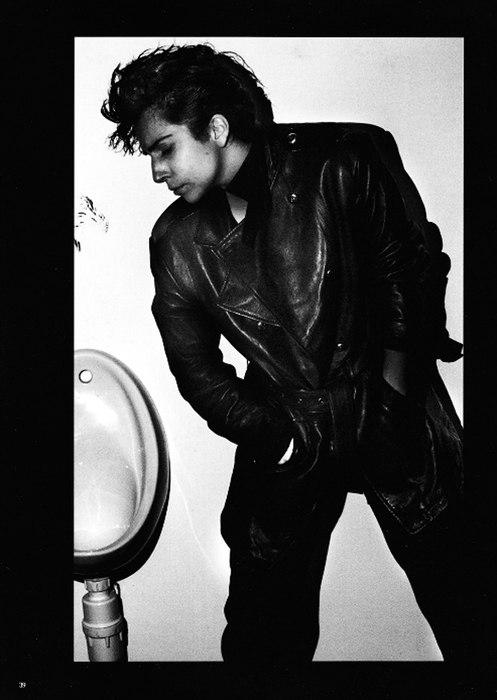
In addition to the alternate covers, we are also given another example that supports the idea of Jo as Gaga’s mirror. In posing next to a urinal, Jo invokes a very similar image of Lady Gaga peering into her creation of an homage to Duchamp’s urinal (shown in side by side photos below). It is a not-so-oblique wink and a nod to both performances, yes, but also a pointed commentary about gender. Consider how differently Gaga and Jo regard their urinals. For Gaga, it’s a work of art; a urinal is of no practical use to her at all. As a man, Jo would find the urinal useful, if not essential, and he probably doesn’t care if it’s art or not, as long as he can take a piss in it when he needs to.


5. Jo is how Gaga would see herself if she were a gay man.
This isn’t as far-fetched as it seems. In his interview with Gaga for the summer double edition of Rolling Stone, Neil Strauss wrote: “When she uses words like ‘fierce,’ or describes her sexual conquests of beautiful men, one sees why the hermaphrodite rumors about her have been so persistent: She seems, at times, like a gay man trapped in a woman’s body.”[i]

This observation is reinforced in the “Alejandro” film, evident in the frustration she shows when the men will not accept her as they accept each other, not even sexually, and perhaps especially sexually. Jo Calderone might be as close as Lady Gaga can get to being a gay man. That seems awfully personal, but Lady Gaga’s art is personal with a capital P, in addition to being pure artifice and spectacle.

If so, this implies something pretty big coming out of Born This Way, which has become Gaga’s anthem and war cry for the last several months. Something provocative, that’s a given. But maybe something very unexpected, too. We assume that BTW references the gay community that Gaga has so passionately embraced and has taken that passion to the next level, overt political action. But this mantle has already been laid across Jo Calderone’s shoulders. And it may mean more than we know.

6. He could be one of Stefani Germanotta’s long lost Sicilian cousins.
I’m speechless.

7. Keep it Simple Stupid
On the other hand, he could be very simply and obviously what he is: a male image created for a photo shoot in which she also appears as the Meat Model; interesting juxtaposition of images but…duh. Nothing so complicated. More like one of her trickster “Made you look!!!” moments.

And that she did. For now, we can only speculate and contemplate. Whereas the meaning of the Meat Bikini was made explicit later, Jo is still something of a blank, as personas go. The Meat Bikini came to life, became more than just an image, when Gaga used the same concept at the VMAs by wearing a meat dress, and tied it directly to DADT. She also reinforced its feminist message by picking up the magazine cover on Ellen’s set, and asserting that, “I’m not a piece of meat.” The reaction to the meat bikini in Vogue Homme was nowhere near the flood of opinions that resulted when she walked around wearing meat in plain sight. And hugging people, some of whom didn’t seem too comfortable getting that close to an uncooked steak dinner.

This is what happens when an image becomes incarnate. It becomes real. The persona acquires a life of its own. And that is where Jo Calderone is problematic. He hasn’t acquired a reality because he hasn’t yet been made flesh. He’s more like a blind date; we don’t know what to anticipate because we haven’t been properly introduced. He’s still a construct, a static image on a glossy page. Or rather, he’s rather like an empty suit still bagged up and hanging in Gaga’s wardrobe closet.

Jo Calderone is a two-dimensional slide show, not the living, breathing, performing hologram that is Lady Gaga. So we can’t quite know what to make of him. We see him but we don’t quite know what we’re looking at. And we don’t know what she plans to do with him, now that she has him. Maybe she doesn’t know either. That’s a meditation for a different evening.

But what I really really really want to know is: when she performs him, how is he going to walk in stilettos? He’s a mechanic, for crissakes.


When we meet him eventually, as I think we will, leaning hipshot against an old muscle car, a soft pack of Marlboros rolled into one sleeve of a grease-stained white tee…

What is she going to do to make him look taller?

Are you done? Good. Now I get the last word.
Contemplating Jo, insofar as “what does Jo mean,” is a bit like trying to know the unknowable, unless you want to go rummaging around in Lady Gaga’s psyche, and I’d recommend against it. But there are some conclusions that can be drawn.

Gaga clearly does not intend to confine her explorations of identity to female personae. Jo seem so jarring precisely because up to now, Gaga has only projected images of femininity, often conflicting, and often simultaneously seductive and grotesque. As much as she pushes the boundaries of how we define sexiness in a woman, Gaga always and everywhere projects as female, even when the forms are almost completely unrecognizable or extravagant parodies. She certainly performs drag but when she does, she drags other famous women who’ve inspired her (Madonna, Marilyn Monroe, Judy Garland, Jean Harlow, Marlene Dietrich, Veronica Lake, et al.), as well as reflecting iconic stereotypes like the pinup/calendar girl, but portraying them in transgressive. She can be awkward, gawky, not always attractive in some poses, but stunningly beautiful in others, but she’s indisputably female…despite the handful of hostiles who insist that she is intersexed or transsexual.

Gaga drags Marilyn Monroe

With the addition of Jo to her ensemble of characters that push the boundaries of gender and sexuality, he merely increases the discomfort that comes from not quite knowing what hers is. Unlike all the other characters Gaga has dragged, all her other personae, Jo is wholly and emphatically male, from the top of his pompadour to the tips of his shoes (which I imagine to be pointy-toed boots with stacked Cuban heels). There’s not a whisper of femininity in his looks, his posture, his poses, the visual energy he projects, or his brief biographical interview. He affirmed his gender in an August 27th tweet that said “I am a man. I am a human being. I am me. And I was Born This Way.”

Yet he seems oddly out of place in the man’s world depicted in Vogue Homme Japan, a glossy men’s fashion magazine that seems to be aimed toward affluent gay men. Sculpted faces and hair in high fashion, and properly toned, minimally clad male bodies are the norm. With the exception of Gaga as the Meat Bikini pinup girl, there are very few photos of women in the issue, and they are posed mostly as fashion accessories to the men they appear with and who seem decidedly disinterested.


Jo is doubly transgressive, not just in what he implies about Gaga’s identity but in his own right, by virtue of debuting in a magazine where he seems so out of place. He has nothing in common with the other models or the men in the other articles, and he doesn’t fit the magazine’s presumed demographic either. He doesn’t translate as notably queer in the sexual sense, if his answers in the interview are any clue (and they must be, because we’re not given any other information about him). Being working class to the bone and proudly so, he also breaches the very clear socioeconomic class boundaries of the magazine and its readership. He may be too cool to care, but we all know there’s a price to pay for that kind of deviance.

The sense, and pain, of being a misfit permeates Lady Gaga’s work, reflected in her performances and discussed at length in many of her interviews. She’s repeatedly spoken of feeling like a freak, an outcast, someone who didn’t belong. It was true in high school; it’s true to a large extent in her experiences in today’s pop music industry. She has a large following of fans who feel the same. Looking at Jo in the context of the magazine in which he appeared, he sticks out like a sore thumb. Like everyone in Gaga’s sphere of influence, Jo is different. He doesn’t belong. He doesn’t fit.

And there is simply no more perfect word for defining the freak, the misfit, or the outcast: that word is queer. Without using the word directly, Lady Gaga has nonetheless restored queerness to everyone who qualifies. The Monster Ball has become a celebration of Queerdom across a very broad swath of humanity. Anyone can drag, everyone can drag. The Monster Ball and by extension, the GagaVerse, is a place where “you can be whoever-or-whatever-you-wanna-be free,” as Posh puts it.

It’s the shared transcendent embrace and celebration of one’s queerness by artist and audience alike, as much as the music and performances themselves, that have produced the eerily intimate, mutually reflective love affair between Gaga and her Little Monsters. It is also the shared burden of mutual pain and mutual anger that requires more than a spectacular dance party to channel and discharge. It takes a battle cry, “Born This Way,” that everyone can take up. She invokes this phrase often, most notably in her concerts where she unleashes a fiery exhortation to her fans not be swayed or dissuaded or crushed by the daily litany of all the things they aren’t and all the things they can’t do, the sermon which affirms that everyone is a superstar and everyone is Born This Way.

In Gaga’s body of work, “Born This Way” isn’t just an explanation for one’s gayness. It’s an argument for every queer’s queerness. Queerness has been made more inclusive. For someone who is both gay and queer at the same time, it’s like a door opening into other parts of yourself that you may not have embraced. You can finally be gloriously queer in ways that have nothing to do with your genitals or where you like to put them.

And Jo Calderone seems to say, we’re all queers on this bus. And we were Born This Way.


[i]“The Broken Heart & Violent Fantasies of Lady Gaga,” Rolling Stone, July 8-22, 2010.


Author Bio:

Cheryl Helm is an old transgressive hippie, devoutly politically incorrect to all corners. She sold her soul to rock and roll in the 50s, picked up her first good electric guitar from Patti Smith's husband (Fred 'Sonic' Smith, RIP) in the late 60s, and never looked back. "Rock n roll, bitches, do or die," as Gaga says. She's written poetry, prose, the L-Word fan fiction, essays, editorials, music criticism, and some  things she can't quite define. She's written alone and with others, published in obscure ancient feminist literary journals no one ever heard of, as well as alternative presses, newspapers, Creem Magazine in its glory days, blogs, fan forums, leaving digital traces behind like glitter.

Sunday, August 29, 2010

Spectacle of the Other Woman: Lady Gaga and Art as Excess

By Beth Goodney 


Despite all the references to scholarly works and close textual analysis, Jack Halberstam’s essay about Lady Gaga’s “Telephone” video boils down to one major point: Don’t you just love her? Halberstam opens the essay “Can you hear me? Listen up: I am gaga for Gaga” and proceeds to unabashedly perform being gaga-ed throughout the rest of the essay. This sentiment, shared by many (as Halberstam readily admits), seems at first way too adoringly fan-ish to be the main argument of a queer theory essay. Further, the question is self-answering. To use a tone even more casual than the one Halberstam adopts, the answer to the question “Don’t you just love Lady Gaga?” is “Duh.” 


This is not to say that Halberstam’s essay is not an interesting, careful examination of Telephone(s). It is. But it is to say that the main taste left in one’s mouth (or echo ringing in one’s ear) is adoration and fascination, which Halberstam admits are their personal reactions to the work; Halberstam also gestures to a larger queer community which shares that reaction. It is almost like Halberstam is sending out a mass text message: “have u seen telephone? DAMN.” 


Other Internet commentators with a queer theory bent have taken a different approach,[i] writing about Lady Gaga’s work in a way largely divorced from their own reaction to it. They take a scholarly distance, carefully deciphering the meaning they see in Lady Gaga’s various music videos; rather than sending a text message, they are reading Gaga’s work like a text, looking for signs and interpreting symbols. I want to suggest that Halberstam’s response, which foregrounds their own reactions to Gaga’s art and engenders further reactions, may be more appropriate than a response which views Gaga’s work from a critical distance.  For Halberstam’s fan letter suggests something about the nature of art and our interactions with it: art engenders bodily reactions, and in the process transforms the bodies doing the reacting and the relations between them. That is art’s – and Gaga’s – political potential.


In her book Chaos, Territory, Art (2008), Elizabeth Grosz argues that art is spectacle that elicits and elaborates configurations of bodies and forces that were never imagined to be possible. For Grosz,  art does not convey meaning through signs, but rather induces and intensifies sensation. Her understanding of art’s workings also suggests the way to interact with it: “artworks are not so much to be read, interpreted, deciphered as responded to, touched, engaged, intensified” (79).  A work of art like “Telephone” need not be analyzed for its significance; rather, we should be seduced by it and proceed from there. 


For Grosz, art is seductive excess, and this definition allows her to see art in places far outside its traditional definition (a welcome framework when discussing pop music, which is often disparaged as a “lower” form of culture). She discusses art in the animal world, and finds architecture in hermit crab shells and choreography in mating displays. She pays special attention to music, writing, “music, like striking coloring or plumage, attracts and allures, it makes one notice, it alerts one to a spectacle, it becomes part of a spectacle” (32).  The appeal of art is in the spectacle, and it is the spectacle that should be engaged with.  


It is not that there is no significance in Gaga’s work, or in pop generally. Nor is reading the work analytically a bad exercise. But there is a problem with an engagement of Lady Gaga that attempts to see her work as a series of signs: an engagement that asks the question “what is the point?” of something like the “Telephone” video seems to miss the point entirely. The point is the spectacle itself, and the chains of reactions it engenders. 


Although art may be without purpose, recognizing it as such does have a purpose for Grosz. Giving in to the allure of the pointless has a point: it is excess, and excessive reactions, which hold the possibility for undermining, deforming, and transforming normative ways of being and relating. Grosz writes that through art “the natural and the lived are themselves transformed, the virtual in them explored, and strange connections – connections that have no clear point or value – elaborated with considerable effort and risk to the normalized narratives of the everyday and the assimilable” (78).  When we strangely, pointlessly connect with “Telephone,” we may be able to pose such a risk to normalized narratives.   


Halberstam’s and our responses to Gaga’s work can queer normative notions of what pop music is and does, and what it means to be a fan (or a scholar); in turn, those transmutations may suggest new ways of relating to ourselves and the world, even new ways of being human (or monster). Rather than trying to understand “Telephone,” we can appreciate the very aspects of it that defy understanding, not because the signs are so cryptic that only the most gifted semiotician could decipher them, but because they are arbitrary, superficial or aesthetic. These last have long been considered the realm of the feminine, the queer, the other, and to celebrate them is to undermine the idea that the only things that matter are those that have a point: things that communicate some deeper truth. We can contribute to a future that rejects objectivity and analysis as privileged modes of understanding, and that sees worth in things often considered worthless and insignificant – glamour, fashion, honeybees.  


In the end, a discussion about whether to focus on sensational responses to Gaga’s art rather than objective analysis of its signification may be superfluous: we simply may not have much of a choice but to be seduced. Halberstam summed it up perfectly in a recent talk at the University of MN: after a brief clip from the “Telephone” video, the audience collectively groaned, wanting to watch more, and Halberstam commented, “the danger is getting overshadowed by the clips.” Any writing about Lady Gaga just gets overshadowed by the clips: the audience wants to watch her, the dancing, the outfits, the glitter, the teeth again and again, the writing only a weak proxy for that fascination.  There is a lot to be said about Gaga but ultimately, the most astute observation of all may be DAMN! Would you look at her outfits?[ii]

[i] See, for example, most posts on this site.
[ii] This observation, as well as much else in this essay, could equally if not more so apply to such artists as Beyonce, Kelis, and Nicki Minaj. That Gaga has been embraced as a site of theorization by the largely white queer theory community in a way these women of color have not is a noteworthy exclusion. Potential reasons and implications are discussed here.
----- 
Author Bio:
Beth Goodney is a sexual health educator working in the Twin Cities. She holds a degree in Sexuality from Antioch College. Recently she choreographed a meeting between Lady Gaga and Elvis for the summer edition of Dykes Do Drag in Minneapolis – The jailhouse for bitches was definitely rocking. Her interests include Deleuze, desire, the future, consent, and glitter.