"[Gaga Stigmata has] very modern, edgy photography to free flowing, urban narratives without censure to analytical essays, et cetera—like Gaga, imagination without ... limits. And the beauty is that anyone can submit work to the site, so artists and writers from all over the [world] have joined this experiment." -The Declaration.org

"Since March 2010, [Gaga Stigmata] has churned out the most intense ongoing critical conversation on [Lady Gaga]."
-Yale's The American Scholar

Showing posts with label Guy Debord. Show all posts

Monday, August 8, 2011

Playing with Pearls: The Adornment of the Selves

by Laurence Ross

There was a table set out … and the March Hare and the Hatter were having tea at it. – Lewis Carroll, Alice in Wonderland


In 88 Pearls, Lady Gaga and Terence Koh sit at a table, laughing, playing, dressed up in costume. Indeed, dressed up in pearls. There is an empty wine glass and an empty tumbler, but these glasses are ignored. Gaga and Koh care only for the teacup. “Have some wine,” the March Hare said in an encouraging tone. Alice looked all round the table, but there was nothing on it but tea. “I don’t see any wine,” she remarked. “There isn’t any,” said the March Hare. It seems, from the viewer’s perspective, that we, just as Alice has done before us, are crashing the party – a party we have not necessarily been invited to, and one in which we are left to interpret what we see and hear, to attempt to make some sense of the whole mad affair (if we wish to make sense of the whole mad affair). We are spectators of (not participants of) the spectacle.

Illustration by Sir John Tenniel
Games/Performances of Madness

I’m afraid Alice is a bit of a killjoy. “It’s the stupidest tea-party I ever was at in all my life” She doesn’t know how, exactly, to respond to Wonderland. (Perhaps this is because she “grows” so much when she gets there? She drinks the wrong potion? There is nothing left in her of the Peter Pan?) She certainly doesn’t know how to respond to the mad Hatter and the mad March Hare at their mad tea party. Alice never actually becomes a part of the party. Yes, from a technical standpoint, there is dialogue between Alice and the party, but there is a persistent separateness, a failure of language, that prevents the occurrence of genuine communication. This same separateness exists for the viewer of the spectacle, the spectacle here being Gaga and Koh counting pearls. As Guy Debord comments in his The Society of the Spectacle, “The spectacle is by definition immune from human activity, inaccessible to any projected review or correction. It is the opposite of dialogue. Wherever representation takes on an independent existence, the spectacle reestablishes its rule” (17). Even the absence of rule – zero rule – is itself a rule, and we are not privy to the rules of the game Gaga and Koh play. Not only do we, as spectator, lack agency in regard to the spectacle, we cannot even inquire, in the absence of understanding, explanations from the spectacle. This information, the logical answer, is cut off from the audience.

Mad Tea Party (1969), illustration for Alice in Wonderland by Salvador Dali
This is, perhaps, a trouble with madness, in dealing with one who is mad: there is often an assumption on behalf of the other (the viewer) that there is an absence of logic with the mad person and that this absence is a totality. That the one who is insane, the fool, is incapable of uttering a truth. (Let alone the chaotic horror, the apocalypse that might develop if we were to entertain the notion that perhaps the madness is the truth). “Why not?” said the March Hare. Alice was silent. I remember, as a theology student, one of my professors saying, “You have two options: you can either believe that Jesus is the Son of God or that he is insane – there is no in-between.” This bi-versification is one that never sat well with me. Wasn’t Galileo’s sanity questioned when he posited that the sun was the center of the universe? Wasn’t Shakespeare constantly placing his truest lines in the mouth of the fool? The scientist who studies (for example) Water Crystal Theory is ostracized from the scientific community and defends her scientific beliefs from the outside, much in the way Wordsworth defends his poetic beliefs in Preface to Lyric Ballads. There is ridicule, disapproval, banishment. This or that person is (literally) out of line, an outlier, out of his mind, mad. From the perspective of many, the mere idea of Gaga’s “Holy Fool” is one that is not possible. It is not possible to blend madness and divinity, madness and truth. It is a blending, a bleeding, a conflation of two incompatible and unrelated attributes.

As I have stated before, if Gaga is consistently anything at all, she is a paradox. In 88 Pearls, she is both a girl at play and a woman (an artist) at work (performing). She is a figure rendered in both black and white. She is playing/performing a game with Koh that both makes sense (the simple task of counting to 88) and does not make sense (numbers and pearls are skipped, and why are Gaga and Koh counting them in the first place?).

Dali, The Pearl (1981)
Lady Gaga and Terence Koh are clearly not fans of following rules. Rules, in fact, are facts or constraints that artists have become expected to break. “Is that the way you manage?” asked Alice. Alexander McQueen stated: “You’ve got to know the rules to break them. That’s what I’m here for, to demolish the rules but to keep the tradition.” Koh playfully skips ahead while counting to the number 69, expecting that we will accept the fact that he has cheated a rule of mathematics and altered it to his own whim. Yes, Gaga and Koh count 88 pearls into the teacup in the reality of the film, but in our reality (our numeric reality) there are not 88 pearls in the teacup. There both are and are not 88 pearls here, a pearled paradox we can choose (or choose not to) swallow.

Pop artists, however, are not expected to break the rules. Pop artists are considered the hacks of the music world. There are many pop artists who are, perhaps, only called artists by default. They cannot be called musicians because, in many cases, there is no instrument in their hands. In fact, for many a pop artist, the pop artist is the instrument, at times even a corporate instrument, and certainly not the creator. And if the pop artist is a corporate instrument, then the corporation is running the show. Corporations that run on business models. Corporations that are accustomed to formula and replicating that formula over and over again until something isn’t working properly and then the formula (the pop artist) is scrapped. ‘N Sync is, perhaps, the most obvious example of this – the boy band that felt so tightly controlled by the corporation’s formula that they needed to cede, to cut all ties, and to produce No Strings Attached. But what happened once those strings were cut? The group soon dissolved. Even the group’s pro-pop anthem, “Pop,” frames pop music not as art, but as something contagious and fun, something that will endure the inevitable and never-ending criticism of the genre as garbage.

(Infinitely) Shucking the Pop Bivalve

The oyster, the bivalve, begets the pearl. Not every species of oyster is capable of producing a pearl. Not all bivalves are created equal. But there is a species of oyster, just as there is a species of pop star (of monster?), capable of producing a luminous object: the pearl. There is a species of pop star that can produce an object of (artistic) value.

Society establishes splits, artificial divisions, rules that exist only as we allow and invent them. Society has classified music into genres (species), divided music into the valuable and the worthless, the intellectual and the vapid, the good and the bad. In the face of this division, Lady Gaga must tell us – and tell us directly – “Pop music will never be lowbrow.” That pop music is not disposable trash. That pop music (as a genre, as a species) is something to pay attention to, something that could produce (and actually does, at times, produce) art. Lady Gaga takes a knife to the throat of pop music, shucks it in two, and shows us the effervesce of the nacre inside.


 And when a bivalve is split, a mirror image is created. A bivalve is, in a way, a living paradox of form: two inverse shapes positioned on top of one another, joined into one being. Francis Ponge, in his meditation on the oyster, tells us, “Inside one finds a whole world, to eat and drink; under a firmament (properly speaking) of nacre, the skies above collapse on the skies below” (37). When the bivalve is closed, its figure resembles that of a zero (0). When a bivalve is opened by its hinge, a new figure is formed, is birthed: a figure eight (8), which, viewed askance, is also the figure of infinity (∞). When closed, the world of the oyster is shut off from us completely, its luminous quality out of view, nullified. The open oyster, however, is an open world, a world, as Ponge tells us, that is two parts wide-open sky, two parts heavenly vault, two views of eternity. Whereas the closed(-minded) view of the oyster (of pop music) yields a zero, the open(-minded) view of the oyster (of pop music) yields an infinity.

And so Gaga and Koh count to 88. The pair counts – or, more accurately, creates – 88 pearls in a teacup. The pair creates not one infinity (∞), but two (88). A double-infinity, a concept that is itself a paradox, as infinity is already infinite in both directions and there is no need (and no mathematical reason) to double it. When Koh playfully skips ahead to the number 69, he skips ahead to a number that (if its two inverted figures were fused into one) very much resembles the figure eight, the figure of the bivalve, the figure of infinity.

This creation is play; this creation is work. This creation is game; this creation is performance. This creation is a world of dress-up/adornment/births/infinite births. The world, the play, the rule of play, is born this way, over and over again. The pearl from the oyster, the head from the vagina, the spectacle from the performer. “For the spectacle, as the perfect image of the ruling economic order, ends are nothing and development is all – although the only thing into which the spectacle plans to develop is itself” (Debord 15-16).


In 88 Pearls, Gaga, adorned in the very pearls she plays with, conjures once again her trope of continual birth. the rattling teacups would change to tinkling sheep-bells. But she also, by her very adornment, conjures the infinite death that must accompany that birth. “Once in a rare while a globule pearls in [the oyster’s] nacre throat, with which one instantly seeks to adorn oneself” (Ponge 37). And to shuck an oyster and retrieve the pearl (for adornment or the creation of a self) is to kill the oyster. When Lady Gaga wears these pearls, these pearls are not in the form of pretty necklaces, but affixed to her skin, to her jaw, to her cheeks. It appears as if the bone is being exposed, that we are viewing a glimpse of a skull. (Shaun Leane produced a similar effect for Alexander McQueen with his “Jaw Bone” Mouthpiece.) Gaga is both a woman in her pearls and a monster with a skeletal-pearled countenance. Gaga is (and has been) a series (a string) of selves through adornment, the new birthed through the death of the old, life and death piled on top of each other. “When a newly independent art paints its world … then a moment of life has grown old … The greatness of art makes its appearance only as dusk begins to fall over life” (Debord 133). Lady Gaga is continually paradox at work/play.


At the close of the film, as Gaga and Koh place the final pearl in the teacup, Gaga says, “Let’s do the last one together.” Gaga and Koh, together, each take hold of the pearl, each one’s thumb and finger carefully joining to pinch a side, their pair of hands forming two rings, two circles, which, when joined (jointed) at the point (joint) of the pearl, form the figure eight, form yet another figure of infinity.

Gaga as Gyre

Yeats had his own notions on infinity and birthing, notions that he forged in his poems and writings on gyres. In his poem, The Second Coming, he writes, “Turning and turning in the widening gyre” (line 1), the gyre a type of geometric cone, a cyclone really, one that spirals wider and wider in time until the apocalypse arrives. The moment when the gyre is at its widest, the moment when the end of the world has arrived, “The falcon cannot hear the falconer; / Things fall apart; the centre cannot hold” (2-3). This moment is chaos at its height, the world at its most advanced and complicated state, and Time at its lowest ebb. But this moment for Yeats is not entirely catastrophic, despite the fact that “Mere anarchy is loosed upon the world” (4). There is anarchy, yes, but “mere” anarchy, anarchy that can be treated just a bit flippantly because, though the end of the world (death) is at hand, there is a new beginning (life) that will happen at the exact moment the end occurs. “But what happens when you come to the beginning again?” Alice ventured to ask.

Diagram of opposing gyres, from W.B. Yeats’ A Vision
Here, there is a hinge, a joint, so that at the moment when the cyclone/world/game is at its wildest, widest end, that very same moment a new pinpoint begins. A new spiral is birthed. There is a second coming, a second birthing. The end of the world is not the end of the world. Or, rather, if it is the end of one world, then it is the beginning of a new one. “Surely some revelation is at hand” (9). And though Yeats’s vision in The Second Coming is not a cheerful one, it is one of birth nonetheless. “That twenty centuries of stony sleep / Were vexed to nightmare by a rocking cradle, / And what rough beast, its hour come round at last, / Slouches towards Bethlehem to be born?” (19-22). So yes, there is a Second Coming after the birth and death of Christ. There is the cradle. There is the birth of the beast, a birth the majority of us might not expect to follow the last birth. Gaga does not give us what we expect either (just look at “The Edge of Glory” video and our spectator’s response to it). But Gaga is not only okay with the idea of the monstrous, of the beast – she has, as Mother Monster, embraced the notion, embraced the title of birthing what might typically cause fear, repulsion, distain.

These gyres, the overlapping, inverted cones of Time’s diminishment and history’s expansion, create the shape of an hourglass, the shape of the figure eight, the figure of infinity. The inverted gyres represent the interdependence of two forces that we do not expect to be linked. Yeats writes, in A Vision, “As man’s intellect, say, expands, the emotional nature contracts in equal degree and vice versa ... one always narrowing, one always expanding, and yet bound for ever to one another.” And, according to Yeats, these gyres continue on, linked in a never-ending chain, an infinite process of rebirthing, a never-ending string (of pearls). And she could hear the rattle of the teacups as the March Hare and his friends shared their never-ending meal.

Digestion

So what is Lady Gaga doing with Terence Koh, playing with pearls and a teacup? She is making a short film. She is making a short film that we can either view as a piece of art or a piece of madness or both. She is, perhaps, making a short film that is part art and part madness, showing us, as many artists have done before her, that the two are not always separate entities. That one can stylize madness, that one can glue pearls to one’s body to create sequined fashion.

Debord discusses the spectacle in terms of style and fashion when he writes, “In contrast to the passing fashions that clash and fuse on the frivolous surface of a contemplated pseudo-cyclical time, the grand style of our era can ever be recognized in whatever is governed by the obvious yet carefully concealed necessity for revolution” (116). Debord discusses the spectacle in much the same way Yeats conceives of his gyres and Gaga conceives of her project: an evolution of revolution that is not cyclical in its infiniteness, but linear. Though there will be another Gaga video, another Gaga song, another Gaga performance, there will not be another Gaga video, another Gaga song, and another Gaga performance. There will not be another, not more of the same, but an other, an addition that differs from the previous edition. Lady Gaga and her work has (and presumably will) evolve not revolve, cycle not recycle. This infinite birthing of selves is why she has become the spectacle she has become. This infinite birthing of selves is why we find ourselves continually watching.

Note: The italicized lines of the text are taken from Lewis Carroll’s Alice in Wonderland.

Bibliography

88 Pearls. “Terence Koh Show”. Dir Terence Koh. Perf. Lady Gaga and Terence Koh. 2010. Film.

“Alexander McQueen: Savage Beauty.” The Metropolitan Museum of Art, New York. 21 July 2011.

Born This Way. Dir. Nick Knight and Lady Gaga. Perf. Lady Gaga. 2011. Film.

Carroll, Lewis. Alice in Wonderland. Ed. Donald J. Gray. New York: W W Norton & Company, 1971. Print.

Debord, Guy. The Society of the Spectacle. Trans. Donald Nicholson-Smith. New York: Zone Books, 1994. Print.

Lady Gaga. “Born This Way.” Born This Way. Interscope Records, 2011. CD.

Lady Gaga. “Judas.” Born This Way. Interscope Records, 2011. CD.

‘N Sync. “Pop.” Celebrity. Jive Records, 2001. CD.

Poker Face. Dir. Ray Kay. Perf. Lady Gaga. 2008. Film.

Ponge, Francis. The Voice of Things. Trans. Beth Archer Brombert. New York: McGraw-Hill Book Co., 1972. Print.

Yeats, William Butler. “The Second Coming.” The Norton Anthology of English Literature. Ed. Stephen Greenblatt. Vol. F. New York: W W Norton & Company, 2006. Print.

Yeats, William Butler. “A Vision.” The Collected Works of W. B. Yeats Volume XIII. Ed. Catherine E. Paul. New York: Scribner, 2008. Print.

Author Bio
Laurence Ross holds an MFA in Creative Writing from the University of Alabama. He lives, writes, and teaches in Tuscaloosa, AL. His essays have appeared in Brevity, Mason’s Road, Bluestem, and elsewhere. He has recently completed a novel, Also, I’m Dying, in which characters deliver performances of crisis, education, anarchy, vanity, husband, wife, child, and alcoholism, among other things.

Monday, October 4, 2010

Do Ask Do Tell: Lady Gaga and the Politics of Mimesis

by Willow Sharkey

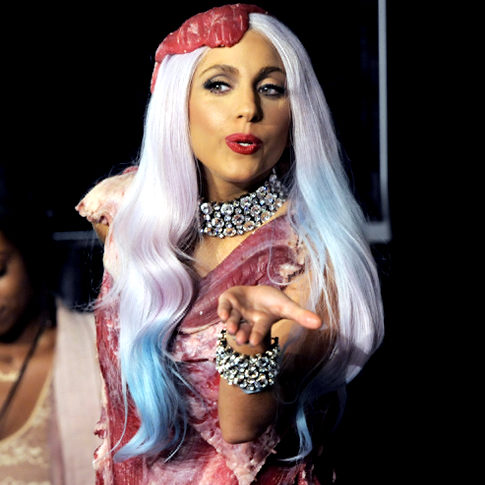
On Saturday Night Live’s September 25th, 2010 episode, in the sketch of Weekend Update, the writers submitted, in their de rigueur amalgam of wryness and serious political commentary (a tone that is both to be taken seriously and just kidding), that Lady Gaga’s efforts on behalf of repealing the policy of “Don’t Ask Don’t Tell,” while commendable, could not be taken seriously because she had only days before worn her dress made of meat to the MTV Video Music Awards.


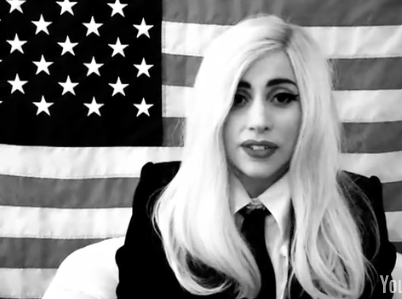
The incongruity of one day seeing her in a costume so adamantly grotesque and hideously funny, a costume that made its aspirations to the carnivalesque so obvious, and the next day in suit jacket and tie, in a black and white home-made digital video, purposely low-tech and under-produced, pleading with fans to make a concerted effort to engage their representatives and congress-people to repeal DADT, were too much; the nature of one would discredit the polarity of the other. She could not wish to be taken seriously, so suddenly. One does not segue from jester to lobbyist. It is an odd submission for SNL to make, given that the formatting and tone of the show itself seems predicated on the belief that parody and provocations to effect political change are mutually supportive modalities (an idea keenly reflected in the output of Lady Gaga).

Lady Gaga’s project is not quite as binary as this characterization. As has been argued elsewhere, Gaga repeatedly employs a mirroring technique in her work to reflect the spectacle of late-capitalism and pop-culture back to itself.[1] Her overtly political video is more than a ploy to be suddenly taken as something beyond a pop-culture provocateur, a serious voice for reason. The cultural landscape, for one thing, is just too populated with an ironic vernacular of the parodical for that, and Gaga has consistently shown a savvy awareness of how the varying channels of media create and respond to images of her.

Gaga’s work, if reducibly about anything, is about life in spectacular culture, and what riposte may be made. In Guy Debord’s pioneering thesis establishing the codes and characteristics of spectacular culture, he asserts that within spectacular culture, the image is privileged, and the populace submits to the monolithic power of those in control of the image.[2] Gaga’s video may have made her project more explicit and less obliquely political, but it was not a departure from her previous aims and modes of expression – those that seek to create pervasive images that may be democratically engaged with by a public.

Lady Gaga’s constant appropriation of cultural tropes is not only post-modern pastiche methodology, but is also an object lesson for her massive audience in the use of appropriation. In her “Don’t Ask Don’t Tell” video she made explicit what had already been implicit: we live in an age when the seduction of the image can isolate and make one apathetic, but it can also be quite easily appropriated, responded to, and virally spread. It was not by accident that the video was so lo-fi. It was telegraphing the notion – anyone can make this, anyone can participate in civil life, and you can even do it in the modes that feel comfortably like your own.

In the digital age, it is true more than ever that the image, and increasingly, the Internet meme, is a most powerful disseminator of what information the culture at large deems important and captivating. Lady Gaga’s output is a cipher that privileges and empowers reinterpretations of her projects, just as she has used the force of outstanding cultural tropes and excavated, mashed-up, and fed them to the public in her own work. This transposition of agency and responsibility, from pop star to anyone, is itself a kind of emancipatory political stance. Gaga has stated in interviews that her work is about trying to make it “a bit easier to swallow this kind of horrific media world we live in.”[3] This may be accomplished by problematizing the glorification of fame, but also through minimizing perceptions of distance between designated cultural producers and consumers.

The intent to minimize this distance is apparent, for example, in the way Gaga and her choreographer intentionally create dances for her music videos that are stylistically “D.I.Y,” Do-It-Yourself. Of course, one motivation for including dance moves simple enough to be mimicked by an audience and used in their own mimetic viral videos is a marketing savvy that recognizes the popularity of dance in video. And yet with Gaga, there is something else going on: a juxtaposition of the hyper-saturated, hyper-stylized vocabulary of the music video alongside the problematized, strange, anti-pop-star nature of Gaga. Her choreographer stated in an interview that in the process she “created the movement with someone who wasn’t so perfect.” She went on to say “I think that’s what a lot of people identify with. You don’t have to be perfect when you do the ‘Bad Romance’ dance or ‘Poker Face.’ The rhythmic emphasis falls on unexpected beats: They’re based out of an emotion, so when you hear the record, it’s choreographed as an emotional dance, and it’s kind of like people are experiencing her when you do the movements.”[4] Gaga intentionally creates a simple dance vocabulary that can be quickly absorbed and reiterated, a vocabulary that is simultaneously Gaga’s movements and one’s own.

Large swathes of fans have already responded to the absorb-able information by, indeed, creating their own videos that represent Gaga’s source material (and dance moves) along with their individualized expressions. This framework is again witnessed, when on September 17th, 2010, Gaga appealed to her Twitter followers to make their own anti-DADT videos addressed to their governmental representatives. Gaga created source material that could be mimicked and re-iterated by anyone; hundreds of response videos flooded back to her, which she in turn made into a video feed linked from her official media channels and accessible on YouTube. Gaga translated the back-and-forth, call-and-response trait of Internet memes into a direct appeal to political change.

This brings us back to the meat dress. Gaga operates fluidly, demonstrated by her elegant combination of the meat dress and the central metaphor of her anti-DADT speech (“The Prime Rib of America”) delivered in Portland, Maine. Gaga wants to make a case not only for the repeal of an unjust policy, but also to celebrate and instigate any instinct that would counteract the cultural entropy Debord saw as endemic to life in spectacle culture. The Prime Rib of America is composed of, in Gaga’s vision, the individuals who resist that entropy, who counteract it and the life it would create. The Meat Dress was a major publicity moment, one that was endlessly tweeted about, immediately parodied, and recapitulated everywhere, sometimes nervously, sometimes abhorrently, sometimes ecstatically, because it was imaginative.

The major cultural spectacles Gaga produces that are reiterated and generated as memes capture the imagination of a public that craves to gaze, but then feels inspired to respond, to co-own, to absorb, to participate. The inspiration of insistent, idiosyncratic production and guerilla creativity, builds a kind of momentum that generates the force of hope necessary to commit to an activist action.


[1] Vicks, Meghan. “The Icon and The Monster: Lady Gaga is a Trickster of American Pop Culture.” Gaga Stigmata: Critical Writings and Art about Lady Gaga. 19 Mar. 2010. Web. 30 Sept. 2010. 

[2] Debord, Guy. The Society of the Spectacle. New York: Zone Books, 2008.

[3] “Getting to Know Lady Gaga.’” The Oprah Winfrey Show. 15 Jan. 2010. 30 Sept. 2010 http://www.oprah.com/oprahshow/Lady-Gagas-First-Oprah-Show-Appearance.

[4] Bloom, Julie “D.I.Y. Music Videos Inspired by the Pros.” New York Times 30 April, 2010. 2 Oct., 2010. http://www.nytimes.com/2010/05/02/arts/dance/02videos.html

Author Bio:
Willow Sharkey is a first semester Art History graduate student at California State University, Chico. She’s interested in performance/time based art, and all things pop culture. When not staying up all night reading critical theory, she’s usually riding her bike in Bidwell Park listening to dancey things on her headphones. You can view more of her writings at http://willowbunny.blogspot.com.

Sunday, June 6, 2010

"Grab Your Old Girl With Her New Tricks": Lady Gaga and Reflective Performance

by Kathryn Leedom
“And then I was my reflection on / the mirror-like surface of the lake”– Joanne Stefani Germanotta, “For a Moment” 
“You know, Gaga, trust is like a mirror. You can fix it if it’s broken, but you can still see the crack in that motherfucker’s reflection.” – Beyonce and Lady Gaga, “Telephone” video
Celebrity worship blossomed in the twentieth century, with the advent of new media such as radio, television, and the internet. The combined force of these technologies has created a twenty-first century society dominated by media and the consumerism that this media promotes. The chaos produced by the society-dominating spectacle begs for directors, and it is this position that Lady Gaga has recently filled. Gaga’s rise to fame has differed from other current female performers in that she has molded herself into a position of authority within the spectacle. Her acquisition of this authority isn’t an accident; it’s the result of a carefully studied and meticulously enacted performance, both on and off stage. Gaga obliterates the line between reality and illusion by suggesting that our current reality is illusion, and vice versa. As Garry Leonard writes, “Reality, in an age of mass media, seems to be a convention that is formed in opposition to whatever polarized point of view we choose to view as ‘artificial’” (Leonard 29). Lady Gaga presents to her audience the illusory nature of reality, while simultaneously enacting narratives of a historical feminism, of commodity culture as religion, and of the self-destructiveness of fame which she represents through an all-encompassing performance consisting of music, fashion, and a figurative mirroring or projection of consumer culture which is referred to here as “reflective performance”; all of this is done in order elicit in the fans both a sense of striking individuality and a realization of their place in the large, like-minded community the allure of this independence attracts.

Let’s look first at a MTV Video Music Awards stage performance of Gaga’s song “Paparazzi,” which aired live on September 13th, 2009. The show opens with a string orchestra and a dancer flitting around stage. Lady Gaga says, “Can’t read my, can’t read my, no, he can’t read my poker face. Amidst all these flashing lights I pray that fame won’t take my life.”  She is lying on the floor, as if she lacked the strength to stand on her own. Dressed in white lace, with two large feathers sticking up from her head, she resembles a bunny rabbit. Her dancers slowly help her to her feet while she begins to sing. Soon, her dancers remove the headpiece. Blood begins to slowly color her chest, seeping into the white fabric. A wheelchair with a masked woman dressed in white inside is rolled onto the stage by a dancer. The woman is insane. She enters from stage right, leaves stage left. Lady Gaga approaches a large white piano. She begins to pound a repetitive tune. As she gets up from the piano and walks towards center stage singing “I’m your biggest fan, I’ll follow you until you love me,” her voice breaks as if she’s crying the lyrics and the blood from her chest runs down her stomach. She notices this and becomes more hysterical, smearing the blood on her hands and singing the lyrics in a desperate, pleading voice. A dancer lifts her in his arms, and she is hoisted onto a rope and pulled up into the air. Hanging from the rope by an arm, she poses for the camera noises with a vacant look and a bloody eye. The dancers bow their heads and the performance ends.


This stage show, while most clearly presenting the narrative of the destructive nature of fame, provides the viewer with images of other texts. The outfit of white lace could represent the old narrative of woman as angel, which Sandra Gilbert and Susan Gubar so aptly describe in The Madwoman in the Attic: “. . . until quite recently the woman writer has had (if only unconsciously) to define herself as a mysterious creature who resides behind the angel or monster or angel/monster image that lives on what Mary Elizabeth Coleridge called ‘the crystal surface’” (Gilbert & Gubar 17). Gaga uses fashion as an aspect of her general performance in order to convey narratives which she doesn’t have to literally state. Rather, the presentation of images on her body lets the viewers draw their own conclusions. Leonard writes,
Fashion, as Walter Benjamin put it, is a tiger leaping out to devour the past. It is not arbitrary, yet it cannot be anticipated. Style is to history what pantomime is to speech – a gesturing that is evocative rather than a statement that is (presumably) definitive. History, Jameson tells us, is what hurts. Style is not the truth, but rather gestures prompted by the truth, gestures that style embodies, thus evoking a sense of something being true. Style, because of its everyday, temporary quintessence, converts the inarticulate pain of history into attitude, performance, and pose (Leonard 5).
Through fashion, Gaga is able to portray this “inarticulate pain of history” in a way that contains commentary but also leaves ends open for interpreters “who render their own translation, who appropriate the story for themselves, and who ultimately make their own story out of it” (Rancière 280). Gilbert and Gubar also note that “whether she is a passive angel or an active monster, in other words, the woman writer feels herself to be literally or figuratively crippled by the debilitating alternatives her culture offers her. . .” (Gilbert & Gubar 57). The performance then takes on a feminist message. The categorizing of women by society into either angel or monster images is both archaic and relevant. The image of Lady Gaga bleeding and hanging on stage in her white lace could be read as the result of a consuming fame, but it also could represent the sacrifice of the virgin, or “angel” stereotype.

Another possible reading of these images involves interpreting Gaga’s self-sacrifice as a representation of the connections between Christian religion and commodity culture. The image of Gaga dressed innocently and being sacrificed on high for something ultimately greater than herself – the spectacle of fame -- draws parallels to Jesus’ crucifixion. Recent theorists and academics, such as Garry Leonard, have argued that commodity culture in modernity has become a new religion – a religion in which members pray/pay at “the altar of the marketplace” (Leonard 45). If worship of commodities has replaced worship of religious relics, what does this mean when thinking about the idea of celebrity and fame? The everyman’s desire to claim certain ideas that a celebrity represents and use these ideas (in terms of dress, mannerisms, or actions) to define him or her own self relates to this concept in that the celebrity is viewed as commodity. If seen from this perspective, Gaga has positioned herself as the second-coming. The members of the church devotedly worship her, praise her by singing her music, and will ultimately destroy (or tire of) her performance, and consequently, her person; all of this she represents on stage, in photography (see appendix), and in song lyrics. She hints towards impending demise and resurrection in songs like “Dance in the Dark,” in which she assumedly positions herself alongside the blondes she mentions:
Marilyn / Judy / Sylvia / Tell ‘em how you feel girls / Work your blonde (Jean) Benet Ramsey / We’ll haunt like Liberace / Find your freedom in the music / Find your Jesus / Find your Kubrick / You will never fall apart / Diana, you’re still in our hearts / Never let you fall apart / Together we’ll dance in the dark.
Gaga, as an image of the second-coming, resurrects past images of women she incarnates – like Marilyn Monroe – in order to present a fuller text in which she is the culminating product. In another song, “Teeth,” she addresses religion more directly: “Got no salvation / Got no religion / My religion is you.” Towards the end of the song, the phrase “my religion is you” is repeated. Picturing a scenario where Gaga is singing this phrase to an audience, one can assume that the fan is singing the lyric back to her -- creating an echoing of sentiment. In this way, Gaga has tricked the audience into telling her what she already knows; their religion is her.


After she murdered the angel stereotype and sacrificed herself as a Christ-figure on stage, Gaga took up the image of monster. The second half of her album, The Fame, came out on December 15th 2009, titled The Fame Monster. She started calling her fans her “little monsters,” and a song on her album is titled, “Monster.” Gilbert and Gubar put the term into a historical feminist context: “women who did not apologize for their literary efforts were defined as mad and monstrous: freakish because ‘unsexed’ or freakish because sexually ‘fallen’” (Gilbert & Gubar 63). Lady Gaga takes this dated concept – the woman portrayed as mad and sexually ill due to her ownership of creativity – and claims ownership to the label of monster in a way that is positive and trendy. The idea of the monster is portrayed by Gaga through an image-based narrative. Everything Gaga presents to the public is the fruit of a carefully studied and meditated performance. Even in interviews, she puts on her act:
As we began the conversation, Gaga spoke carefully in a very odd accent—some combination of Madonna as Madge and a robot, an affect enhanced by the fact that she refused to remove her lightly tinted sunglasses over the course of two hours. ‘What I’ve discovered,” said robo-Gaga, with a photo-ready tilt of her head, “is that in art, as in music, there’s a lot of truth—and then there’s a lie. The artist is essentially creating his work to make this lie a truth, but he slides it in amongst all the others. The tiny little lie is the moment I live for, my moment. It’s the moment that the audience falls in love’ (Grigoriadis 1).
This is almost a meta-moment in which Gaga embodies the illusory nature of reality while simultaneously explaining to the media how she presents the lie as the truth. These meta-moments where Gaga presents a lie in order to signify greater truths are where her performance finds its transcendent nature.

In “Manifesto of Little Monster,” a video shown during an interlude of her concert, the “Monster Ball,” Lady Gaga directly addresses what she calls “the lie” and simultaneously describes it as “the real truth”:
This is the manifesto of little monster. There’s something heroic about the way my fans operate their cameras. So precisely, so intricately, and so proudly. Like kings writing the history of their people. It’s their prolific nature that both creates and procures what will later be perceived as ‘the kingdom.’ So, the real truth about Lady Gaga fans, my little monsters, lies in this sentiment: They are the kings. They are the queens. They write the history of the kingdom, and I am something of a devoted jester. It is in the theory of perception that we have established our bond, or the lie I should say, for which we kill. We are nothing without our image, without our projection, without the spiritual hologram of who we perceive ourselves to be, or rather to become, in the future.  When you’re lonely, I’ll be lonely too. And this is ‘the fame.’ Love and art, 12/18/1974, Lady Gaga.
The ideas about perception and projection in this video, in which Gaga reads the text over images of herself dressed in various masks, provide a solid basis for what is referred to in this paper as reflective performance: an aspect of Gaga’s projection in which she functions as a mirror for consumer culture and her audience. She performs this mirroring through her fashion and her music. In terms of fashion, Gaga will occasionally dress in accordance with a specific person for whom she is performing; for example, when she sang for Queen Elizabeth II of England during the 2009 Royal Variety Performance, she wore a dress reminiscent of Queen Elizabeth I. There are several other instances of Gaga using fashion and her body as a mirror, including the outfit she wore to meet Barbara Walters for a televised interview titled “The Ten Most Fascinating People of 2009,” her mirroring of Beyonce’s dress and dance moves in the video for Beyonce’s “Video Phone,” in her mimicking of David Archuleta’s publically-established cuteness, and in taking pictures of the paparazzi as they take pictures of her. Most recently, on June 1st, 2010 Gaga appeared on “Larry King Live” for an interview dressed in attire reminiscent of Larry King himself -- even her posture and hand gestures echoed his.


The sound and content of her music also plays a role in reflective performance. Scott Plagenhoef writes in a review of The Fame Monster, “Elsewhere on The Fame Monster, she morphs into other stars-- Freddie Mercury on ‘Speechless’, ABBA on ‘Alejandro’, Madonna on ‘Dance in the Dark’, Britney Spears on ‘Telephone’, Kylie Minogue on ‘Monster’, and Christina Aguilera on ‘Teeth’” (Plagenhoef 1). Considering the reflective aspects of her fashion and music combined, a certain paradox begins to emerge in which Lady Gaga is extremely unique and yet reminiscent of many various people. 

Lady Gaga also mirrors the love her fans give to her back to them, and the community that they form is something she is set on cultivating. Powers, in her interview, writes of Lady Gaga, “She is growing ‘more compassionate,’ she says, and focusing more on ideas of community, especially the one formed by her core fan base . . . ”(Powers 1). Lady Gaga also said in an interview with Jonathan Ross, “In the show, I look out into the audience and at the end of the night I say, ‘If the show was successful, they don’t leave connected to me, they leave connected to each other.’” The message this sends is similar to the one Lady Gaga embodies herself: everyone is unique, yet similar enough to form a giant community. Getting past obsessions with individual uniqueness allows the fan base to unify and recognize their power in numbers. In creating a congregation, Gaga makes something larger than herself. The feeling of power and almost transcendence that accompanies the harmony of the community tightens the bond this population has to its subject: Gaga. Mirroring her fan’s love has the benefit of securing her position in fame, while also playing into her larger performance theme of reflection.

After cataloguing numerous instances in which Gaga uses reflective performance, one begins to think that there must be significance behind this move.  This mirror isn’t one that presents things exactly as is – it presents an image which invites contemplation and denies answers in favor of questions. Instead of saying “look at me,” Gaga has been telling her audience “look at you while you’re looking at me.” The Fame Monster seems to send the message that Gaga doesn’t want to be looked at or talked to, yet her position in the public spotlight tells society otherwise. In “Monster,” she says “don’t call me Gaga,” and “don’t look at me like that.” In “Alejandro,” she says “don’t call my name.” In “Telephone,” she says “stop calling, stop calling, I don’t want to think anymore.” Lady Gaga telling the world she doesn’t want to be looked at, while simultaneously living in the public spotlight, presents another interesting contradiction to her audience. She is unique and but also representative, seeking fame and also desirous of anonymity, claiming that “the real truth” is fiction.  Jean Baudrillard writes in The Perfect Crime, “The absence of things from themselves, the fact that they do not take place though they appear to do so, the fact that everything withdraws behind its own appearance and is, therefore, never identical with itself, is the material illusion of the world” (Baudrillard 2). Perhaps this concept is most easily grasped in a recent claim that Lady Gaga made: that she’s celibate – despite many of her songs depicting drunken debauchery and casual sex (Donaldson-Evans 1). As Baudrillard states, these things “do not take place though they appear to do so.” All of these paradoxes are presented by Gaga as co-existing. She can sing “don’t call me Gaga,” and afterwards ask to be referred to as Gaga. The appearance of contradiction does not negate either established information; it only suggests that the truth is not our perception of truth at all. As she says, “we are nothing without our image” (“Manifesto of Little Monster”). Without image, there is nothing – it is “the absence of things from themselves” (Baudrillard 2). Illusion is the truth, and Gaga embodies illusion. 

The way in which Lady Gaga presents herself to her audience is through a single, all-encompassing performance which she enacts both on and off stage through music, fashion, and reflective performance. In the credits of the booklet for her album The Fame, Gaga writes, “But before I begin, I need to say that each and every chemical moment of my life, every person I have spoken with, every street I have traveled, every museum, country, city, space or home that I have visited has been a profound instance and is mirrored, whether obviously or in some refracted way, in the work you see today.” Gaga’s performance mirrors society “whether obviously or in some refracted way” in order to allude to the illusory nature of reality. Her stage shows provide the audience with images of multiple, layered narratives which are open for interpretation. Her performance of “Paparazzi” at the 2009 VMA’s is an example of a text which is exposed for commentary on the destructiveness of fame, historical feminism, and commodity culture in relation to Christian religion. The unity she encourages her fans to create through mutual realizations of individuality encourages an acceptance of the co-habitation of contradictions present in her performance. “‘It’s kind of like a crusade in its own way,’ she said. ‘Me embodying the position that I'm analyzing is the very thing that makes it so powerful’” (Powers 1). Indeed. The secret about Lady Gaga is there is no secret.


Works Cited and Consulted
Baudrillard, Jean.  The Perfect Crime.  New York: Verso, 2002.

Debord, Guy.  The Society of the Spectacle.  New York: Zone Books, 2008.

Dery, Mark.  “Aladdin Sane Called. He Wants His Lightening Bolt Back: On Lady Gaga.” TRUE/SLANT. 20 April 2010.  23 April 2010  http://trueslant.com/markdery/2010/04/20/aladdin-sane-called-he-wants-his-lightning-bolt-back-on-lady-gaga/

Donaldson-Evans, Catherine.  “Lady Gaga Tells Fans: ‘Don’t Have Sex.’”  People.  12 April 2010. 15 May 2010 http://www.people.com/people/article/0,,20360204,00.html

Freud, Sigmund.  “On Narcissism: An Introduction.”  The Complete Works of Sigmund Freud. New Haven: Yale UP, 1991.

Gilbert, Sandra M. and Susan Gubar.  The Madwoman in the Attic.  New Haven: Yale UP, 1984.

Grigoriadis, Vanessa.  “Growing Up Gaga.”  New York 5 April 2010.

Jameson, Frederic.  Postmodernism, or, The Culture of Late Capitalism.  Durham: Duke UP, 1991.

Lacan, Jacques.  “The Mirror Stage as Formative of the I Function, as Revealed in Pyschoanalytic Experience.” Ecrits.  New York: Norton, 2002.

“Lady Gaga’s Bad Romance – The Occult Meaning.” The Vigilant Citizen. 15 Nov. 2009. 25 March 2010 http://vigilantcitizen.com/?p=2737

---.  “Lady Gaga, The Illuminati Puppet.”  The Vigilant Citizen.  4 Aug. 2009.  25 April 2010
http://vigilantcitizen.com/?p=1676

“Lady Gaga and Social Death: a Genealogy.” Dystopolitik. 25 March 2010. 1 April 2010 http://dystopolitik.blogspot.com/2010/03/lady-gaga-and-social-death-genealogy.html

Leonard, Garry.  Advertising and Commodity Culture in Joyce.  Gainsville: UP of Florida, 1998.

Plagenhoef, Scott.  Rev. of The Fame Monster, by Lady Gaga.  Pitchfork.  13 Jan. 2010. 1 April 2010 http://pitchfork.com/reviews/albums/13823-the-fame-monster/

Powers, Ann.  “Frank Talk with Lady Gaga.”  Los Angeles Times 13 Dec. 2009.

Rancière, Jacques.  “The Emancipated Spectator.” Artforum March 2007: 271-280.

Writer Bio:
Kathryn Leedom is currently a student in the English literature master's program at CSU Sacramento. She graduated with a bachelor's degree in literature from UC Santa Cruz last year. She enjoys any old cup of jasmine green tea, the smell of ancient books, and pretending to be cool. When thoughts of Lady Gaga aren't getting her out of bed to scribble on 3x5 cards, they're infiltrating her dreams.