"[Gaga Stigmata has] very modern, edgy photography to free flowing, urban narratives without censure to analytical essays, et cetera—like Gaga, imagination without ... limits. And the beauty is that anyone can submit work to the site, so artists and writers from all over the [world] have joined this experiment." -The Declaration.org

"Since March 2010, [Gaga Stigmata] has churned out the most intense ongoing critical conversation on [Lady Gaga]."
-Yale's The American Scholar

Showing posts with label Drag. Show all posts

Thursday, May 10, 2012

:: +Stigmata Dreams+:: The Realness of Jo Calderone


By Jennie Gruber

“To be able to blend – that’s what realness is.”
– Dorian Corey, in Paris is Burning

 “Drag... describes discontinuities between gender and sex or appearance and reality but refuses to allow this discontinuity to represent dysfunction. In a drag performance, rather, incongruence becomes the site of gender creativity.”
– Judith Halberstam, Female Masculinities

“On a stage, the laws of fantasy are meant to be broken, but I have always found it difficult to bring my real pussy out there with me.”
– Lady Gaga, from her November 2011 “Memorandum” in V Magazine

+ + +


HEY!

The 2011 Music Television Video Music Awards[i] open with this antagonizing roar, which emanates from an unfamiliar silhouette cloaked in smoke and spotlight.

Emerging onto the stage with an almost limping gait, the figure’s features become clear. A greasy pompadour and sideburns frame a small pretty face and sunken eyes.

The figure introduces and explains itself:

“My name is Jo Calderone. And I was an asshole.”

The live audience and those of us watching on televisions and streaming video are rushing to understand. Wasn’t the opening act of this show hyped as Lady...

“Gaga?”

As if he read our minds, Calderone spits out the nonsense words that have been imbued with so much new cultural significance in the past few years.

“Yeah, her!”

The audience starts to put two and two together, realizing that the Guido-accented Calderone is, actually, Gaga herself in very understated drag.

At this point in history, Lady Gaga is known for many things, and understatement is not one of them. Though her outfit is shockingly minimalist, her presentation is bold and dynamic. She has the audacity to filter drag as a performance concept into a mainstream idiom without ever pandering to the inevitable discomfort this elicits from the MTV cameras.

“She left me!”

Calderone, it would seem from his ranting, is not just another Gaga costume, but a fully developed persona. His presence is one of exaggerated and deliberately staged masculinity. His body language has a method. Elbows cocked, he holds a cigarette between thumb and forefinger, the other three fingers fanned out. He gesticulates like a man who has been using a cigarette to make a point since he was 14 years old. His posture is slouched forward into his black, loosely fitting Brooks Brothers suit, shoulders shaking his jacket with the muscle memory of someone who wears it everyday.

“But she’s fuckin’ crazy too right?”

Egging on the live crowd by variably charging downstage at them, he reiterates:

“I mean, she’s ... fuckin’ ... crazy!”

Describing a bedroom scene in which Gaga flaunts the ultimate femme refusal to take off her stilettos (even in the shower), Calderone himself is wearing boots with three some odd inches subtly wedged into the heels. This is perhaps the only clue in his entire ensemble that his costume is an androgynously stylized one; and his acknowledgement of Gaga’s usual hyper-feminine presentation subtly reveals that she knows exactly what she’s doing.

The MTV house cameras (who also know exactly what they’re doing) cut to the cartoonishly girlie pop starlet of the hour Katy Perry doing her best with raised eyebrows and open-mouth smile to convincingly look shocked yet delighted at what she’s witnessing.

Calderone continues to rail against Gaga – on the subject of her wild hair, her love of the spotlight, and perhaps in anticipation of the public’s reaction to this performance: “At first it was sexy but now I’m just confused.”

Britney Spears is revealed by the probing cameras, mouth agape, indeed looking predictably dumbfounded.

“And I think it’s great, you know, I think it’s really fucking great that she’s such a stah. A big, beautiful stah in the sky.”

The crowd starts to cheer intermittently, drowning some of Calderone’s punch lines. It’s almost as if they’re attempting to throw off his timing. More likely MTV’s teleprompts are begging them to act as if they understand and approve of what’s happening.

“But how am I supposed to shine?”

The powers-at-be at MTV understand that they have to fabricate reactions, like a nervous hostess frantically keeping drinks filled and hors d’oeuvres circulating. Their audience is getting awkward. This, as it turns out, ain’t no female pop star in a fashionable suit. This is a drag king show; easily the highest concept drag king show ever to be performed by a high-femme-identified pop star on mainstream television. It’s undoubtedly the first time such a pop star has asked her audience, with very little warning, to accept her as not only an unfamiliar character but as another gender for the duration of an entire media spectacle.

“I’m startin’ to think that’s who she is. I mean maybe that’s just who. she. is.”

Tomorrow and for the next few months, distressed online media reportage will sneer headlines along the lines of: “Was it too much?” and, “Brilliant or creepy?” and, “Did Lady Gaga just end her career with this embarrassing Jo Calderone?” It seems that even artists with reputations for defying expectations will be called to task for attempting something, well, unexpected- in this case, something that not only revels in its queerness but spits its high concept pretensions in its audience’s face. Though his speech is haunted by the audience’s thwarted expectations of Gaga’s femininity, Calderone is unfaltering in the face of the their unease.

“I gotta get in thea.”

A pregnant pause with cigarette outstretched, palm turned up and shaking.

“When she cums,[ii] she covers her face, like she can’t stand to have one honest moment whea nobody’s watching!”

The audience has come to expect Gaga in particular and MTV in general to be both entertainment and provocation, but they are also desensitized to contrived shocks well within their comfort zone. This digestible outrageousness has become the bread and butter of the mainstream music industry. Gaga bursts through these boundaries, playing deliberately with discomfort. Her artistic agency is all too rare in the pantheon of female pop star into which she has launched herself; almost as rare as, say, talking about their orgasms onstage.

“I want her to be real. But she says, ‘Jo...’”

A suck of the cigarette for dramatic effect.

“I’m not real. I’m theatah. And ‘you and I’...”

As these last three words are the name of Gaga’s most recent single, the crowd’s enthusiasm sounds significantly more genuine. A bone has been thrown. This is a joke they get, one they can participate in.

Their encouraging cheer all but drowns the speech’s deliberate conclusion:

You and I (meaning Gaga and Calderone, meaning Stephanie Germanotta[iii] and her audience)...

“...This is just rehearsal. I gotta get in theah.”
+ + +

If you take an elevator ride in the Imperial Palace on the Las Vegas strip, you will hardly be able to ignore the television advertising the hotel’s main attraction: Frank Marino’s Divas, a celebrity female impersonation extravaganza. Following a rapid-fire series of clips showcasing an assortment of drag queens doing Britney, Madonna, and other glamour standards, the leering mug of the blonde bejeweled queen persona of Marino materializes. The voice-over blares: “You won’t believe your eyes...” and the queen morphs into a head-shot of an out-of-drag, decidedly masculine Frank, accompanied by the assurance that: “...these gals are really guys!”

This “revelation” will be jarring to anyone who has ever frequented drag shows in dingy dives, where kings and queens immerse themselves in the attire, body language, and pronoun of a gender other than the one they were assigned at birth. The purpose of this facade is to be at once exaggerated and convincing in the chosen gender, as is the case with the dramatically campy but believably macho Calderone. The joy of being on a drag stage is weaving a collective fantasy, regardless of the degree to which the gender being depicted is a part of the performer’s identity when they peel off the spirit gum mustache or unhook their girdle.

When the Imperial Palace marketers literalize the “impersonation” aspect of Marino’s act, they undermine the central mystique of drag. In Vegas, a heterocentric territory of comfortable sensationalism not unlike the aforementioned digestible shock value of MTV, drag can profit so long as it panders to anticipated queer anxiety of its audience. “These girls are really guys” is a reassurance that the queerness inherent in drag doesn’t carry over into “real life.” Gender inversion is marketable entertainment provided it is clearly delineated within the confines of theatricality, and doesn’t spill over into identity, desire, or what the performer wears on their day off.

Gaga, in contrast, revels in the gender ambiguity implied by a drag act that never lets on that an offstage life exists. She may even achieve what the voguing queens of Jennie Livington’s 1990 documentary of underground Harlem drag balls Paris is Burning call “realness”: complete embodiment of an archetype in a performance.
+ + +

Jo Calderone’s significance is even more notable when considered alongside other instances of female pop stars in some semblance of drag.


Eleven VMAs ago Britney Spears appeared onstage in a baggy suit to sing possibly the most neutered-ever rendition of the covered-to-death Stones classic “Satisfaction”[iv]. One minute into the song the suit was ripped off to reveal a body stocking, transparent except for glittering sequins, and Spears proceeded through the motions of her standard routine of stiffly suggestive dancing. Her allure is more stripper kitsch than personal sexual expression.

R&B Singers Beyonce, Mariah Carey, Ciara, and Mya have all appeared in their own music videos[v] wearing masculine costumes, either to highlight sexist double standards or parody their male celebrity counterparts. In each case, the masculine incarnation dances alongside or otherwise transforms into her typical public imagine, writhing in stunningly feminine glamour. Though they might slip into baggy pants or fashionable blazers, any butch identification is quickly glossed over with mini-dresses and enormous diamonds.

Annie Lennox pulled her own drag stunt at the 1984 Grammys. Like Calderone, the Eurythmics frontwoman sported sideburns, pompadour and simple black suit. Lennox’s signature androgyny made this a convincing fashion statement, but she was less embodying a fully realized character than doing a superficial, if convincing, Elvis impression. In the Eurythmics’ “Who’s that Girl” video, Lennox plays the double role of “Elvis” and a blonde-bombshell in pink lipstick. Dated CGI allows the male and female Lennox to make out at the clip’s conclusion, unifying Lennox’s dual personas in androgynous lust.


Each of these flirtations with masculinity are accompanied by a “these guys are really gals” reveal, distinguishing them from drag kings as what Judith Halberstam calls “femme pretenders.” With the same queer-anxiety soothing disclaimer as the Vegas show, each of these artists shows “how thoroughly her femininity saturates her performance – she performs the failure of her masculinity as a spectacle.” (Halberstam 250) Any exploration of masculinity only serves to reinforce the feminine, a disclaimer that renders it commercially comfortable. Calderone, in contrast, never tears off his suit, or even acknowledges that he is being personified by Gaga, eliciting discomfort that is in and of itself revealing. He remains firmly committed to his character, and gender, even when he sings Gaga’s song...

+ + +

His well-rehearsed speech completed, Calderone dashes to an upright piano to launch into a barroom version of the foreshadowed “You and I.” A hidden band kicks in, and the camera cuts to cartoonishly boyish pop star of the hour Justin Bieber looking more hostile than confused, like no one told him rocknroll was gonna be gay.

The singer tears off his jacket, does another verse with Calderone-clone back-up dancers,[vi] announces the onstage arrival of Brian May[vii] on lead guitar and closes the act by hurling himself atop and off the piano, spraying beer into the bewildered crowd, and posing next to May with the enthusiasm of a very confident and clearly wasted karaoke contestant.


The relative banality of this song’s lyrics (“taste like whiskey/when you kiss me” etc) and chord progression (which it must be noted May could wail on with his hands tied behind his back) is drowned by the display of utter showmanship from Gaga, for whom the margin between inventiveness in image and originality in music has always been so suspiciously wide as to almost seem intentional.

The performance doesn’t stop with the song. When he joins the audience to watch the rest of the show, returns to the stage as an award presenter, and schmoozes backstage, Calderone remains in character with an Andy Kauffman-like commitment. Hardly a mention of the event will neglect to make particular note of him using the men’s bathroom. He has a back-story, corroborated in the Autumn/Winter 2010 Vogue Homme Japan: origin (Palermo by way of Jersey) occupation (Mechanic), and identity in relation to Gaga herself (erstwhile lover). At the post-show press conference, Calderone responds to a reporter’s query, “What can you express as Calderone that you can’t express as Gaga?” with a blank look and mumbled; “I don’t undahstand the question.”[viii]

Extraordinarily, Gaga plays the whole thing straight. She never gives an ironic wink, never points to the Lady behind the curtain. She allows her audience to squirm, and revels in the blurred boundaries of man/woman, costumed character/authentic person, fantasy/reality. Calderone’s speech, with its exploration of on-and-off-stage existence, and the 4th wall-breaking execution of the character himself, illustrates Gaga’s comfort in ambiguity. The entire stunt is a daring critique of cultural strictness, not only with regards to gender, but to the authenticity of fame culture as well.

+ + +

At the center of this frenzy of theatrics is Germanotta herself, a multiplicity of “threats”: singer, dancer, writer, entrepreneur, media manipulator, sexual provocateur. The audience wants, like Calderone wants of the woman he embodies and desires, to get in thea, inside that frenzy to understand what Gaga is really all about and why she does the sensational things she does. Is this guy really a gal? What kind of glittering underwear has he got on? Gaga resistance to a reveal not only preserves the integrity of her invented character, but also transmits the message that onstage or off, every person performs their gender and persona. Uncompromising, she offers herself as an example. The roles she plays are as real as the person creating them; her streamlined masculine persona is as real as her hyper-feminine fashion statements or abject alter-egos. Maybe the “real” Lady Gaga is the monstrous, the theatrical, the outsized, her characters, her dopplegangers.

Maybe that’s just who she is.


[i] hereafter MTV VMAs, an event whose name, once charmingly redundant, is by now just short of being a total contradiction in terms
[ii] “cums” is bleeped out by the MTV cameras along with the numerous “fuckin’”s
[iii] Gaga’s given name
[iv] rock’s most shameless expression of heterosexual male lust and frustration, containing a significant consciousness of attire which the Spears version changes from “how white my shirts can be” to “how short my skirts can be”
[v] “Upgrade U” (‘07), “Obsessed” (‘09), “Like a Boy” (‘07) and “My Love is Like..Wo” (‘03), respectively
[vi] None of whom appear to be women in drag, but who can be sure?
[vii] of the incomparable 70’s rock band Queen, and thus no stranger to shredding alongside a flamboyant frontman
[viii] along with untoward soundbites such as; “Didn’t you jerk off to Britney when you were a kid?” and, “It’s fuckin’ bright in heah!” and, in a response to an accusation of Guido-ness, “You got a problem with Italians? Wassamatter wichyoo?” – all departures from Gaga’s typically demure attitude with the press


Author Bio:
Jennie Gruber is a Creative Non-Fiction Writing MFA student at Sarah Lawrence College.  She is also an award-winning documentary filmmaker, zine-maker, and face-melting rocknroller. Her work has been published in Whore! magazine, AORTA magazine, Mcsweeney’s The Believer, and numerous Cleis Press anthologies. She has performed at San Francisco’s Litquake along with a multitude of other reading series, academic panels, and community educational events. Her preoccupations include shameless expressions of transgressive sexual identities, the para-literary, and punk communities. She lives in Brooklyn.  imnotayoungmananymore.tumblr.com

+ + +

Gaga Stigmata is currently sleeping, preparing for her cultural rebirth in print form. Submissions are currently closed. Watch for news about our book's release in Fall 2012. :: +Stigmata Love+ ::

Click here to follow Gaga Stigmata on Twitter.
Click here to “like” Gaga Stigmata on Facebook.

Thursday, December 16, 2010

Contemplating Jo

by Cheryl Helm


Lady Gaga lives and creates her own iconography in sudden, separate moments captured by – snap snap – the lens opening and shuttering closed. The camera lens. The video lens. The cell phone lens. The lens of the eye of the beholder. She knows how to make the camera love her because she is, in those moments, its sole reason for being. And through the camera, she seduces us. Through the lens, she burns her image directly into our retinas and straight on through to the other side. This is where she lives and this is where we perceive her. As Gaga herself said, in Manifesto of Little Monsters, “It is in the theory of perception that we have established our bond, or the lie I should say, for which we kill.”

But we have an odd visual relationship (our bond) with Lady Gaga: one that is projective and reflective, and one in which most of us don’t grasp our own roles. Projection and reflection are both one-way streets. Gaga holds the balance of power. She projects the image she wants us to see. Then reflects back to us what we see, when what we see actually originates with her projection in the first place. That is a pretty serious visual mind-fuck. As mind-fucks go.

Jo Calderone may be one of Gaga’s greatest visual mind fucks. This guy is seriously outside the boundaries of Gaga’s “normal” gender performances, and that in itself makes him quite queer in the “Old School” definition of the word. Even the questions he raises are problematic in one way or another. You can only go so far in thinking about some aspect of Jo’s performance before you reach one of those “But what about....?” moments. And before you can say Stefani Germanotta, you’re off on a different tangent.

And then you start talking to yourself.

What can you glean from someone who’s nothing but a collection of images?
Hey! Someone went to a lot of trouble to create Jo; I’m sure he didn’t come quick or cheap. If anything, the effort that went into creating, capturing, and displaying him testifies to his importance in Gaga’s exploration of a fluid identity which, at the least, suggests a very crowded interior hologram of self. He also bears silent witness to the power of Gaga’s images and imagery, both of which create the illusion of a persona who may or may not actually be there.

It’s in her mental, emotional, and visual images that Gaga embeds the underlying messages of her work. Imagery is both part of her aesthetic and her dominant medium. No other pop artist has or does create primarily for commentary-saturated visual presentation. More Warhol than Madonna, everything she does is designed to have a specific visual impact, from wardrobe/styling to the set design, art and fashion installations, and film. All to stage her music. Except the music is really the bait. It’s really all about Show and Tell.

And everything she shows us is a projection or a reflection of someone or something, wrapped in a sonic of visual narrative. So, too, is Jo Calderone. Gaga is very particular about how she presents visually, and just how many messages or commentary she can cram into one presentation. Well, Jo comes packed with mute commentaries, even if they’re all oblique as hell. But what is he, exactly? I believe her Manifesto of Little Monsters helps explain or at least narrows our choices.

“We are nothing without our image. Without our projection. Without the spiritual hologram of who we perceive ourselves to be, or to become, in the future.”

This really is central to Lady Gaga’s artistic philosophy: that our image, our projection, and our spiritual hologram (as we perceive ourselves) are vital to our existence. We are nothing without them, she says. That’s a pretty powerful personal declaration. All three are aspects of the self, but they manifest differently. Logic dictates that Jo Calderone is at least one of these: image, projection, spiritual hologram. None of these is the self itself, but they usually provide clues about that self, because an image is usually a shadow of something real. Usually.

So contemplating Jo almost inevitably leads back to some meditation on or about Lady Gaga. Merely by “showing” Jo Calderone, revealing him to the camera, and from the camera to our eyes, she has started a viral buzz of speculation about who he is and what he means. Is Jo Calderone a statement? Or is he a question?

Isn’t Contemplating Jo a lot like reading tea leaves?
Worse. When reading tea leaves, at least you get a nice cup of tea for your trouble. Contemplating Jo, usually at 3:00 in the morning, leads to not enough sleep and a longer list of possibilities than I started out with. Besides being a carrier of Gaga’s viral subversion of gender in as many permutations as she can think of, he confirms the philosophy underlying Gaga’s work: that constructing a persona from pop-cultural sources can be an expression of personal truth. If so, what personal truth does Jo reveal about Gaga? See what I mean?

So in keeping with Gaga’s mischievous delight in visually spamming us with multiple messages at the same time, we have Jo Calderone and many possibilities as to what s/he represents. These are a handful of mine. I’m sure you have plenty of your own.

1. Jo is a fictive construct, a one-off look created for a fashion shoot to get double exposure (so to speak) in the same issue of a magazine.

Fictive yes, a definite construct, but one-off? I think not. Because he comes with a bio, his own Twitter account, and a lot of viral buzz. That’s a lot of effort just to create a one-time persona for a fashion shoot. Besides, Lady Gaga is not one to waste a good persona, even if it DOES get her double billing. She’s more calculating than that.

2. Jo references the persistent rumors that Gaga is either intersexed or transsexual.
Doesn’t work for me. Because for those ‘critics,’ the image that is so gender transgressive is the image of Gaga as woman. They don’t see her as male even though their very argument posits that she is one. They see her as dragging a drag queen. Some of these folks may genuinely believe she’s male, but the image they see is the male as female, not the male as male. They cannot imagine, or describe, what they think the man beneath Gaga, so to speak, looks like.

And if they were to try to describe the man who drags Lady Gaga, well, I don’t think he’d look like Jo Calderone. For one thing, he simply looks too heteronormative to successfully drag any woman, much less Gaga. More importantly, like Gaga’s pinup girl, he’s decidedly out of his time element. He’s a very 50s character in 21st century fashion. He’s a fan of rock n roll and Elvis, but also likes Dean Martin and Frank Sinatra. He’s a proto-tough, but not rough, guy, a rebel with or without a cause, West Side Story in Palermo. He’s vulnerable, with his James Dean worried brow, but doesn’t show any chinks in his affective armor.


He’s too cool to care, the cover says. His poses are nonchalant, and his expressions serious. Unlike Gaga whose invasive stare commandeers the lens, Jo studiously avoids looking directly at the camera except for a couple of heavy-lidded glances where dark makeup and shadowed eyes make him just vaguely creepy, much like Gaga’s use of the grotesque in her female imagery. There’s a hint of pathos, the suggestion of some hidden wound, but his studied casual poses seem to shrug them off.

Jo is the kind of guy that baby butches like myself back in the day tried to look like…duck’s ass haircut, preferably with fins, held in place with Brylcreme or even better, Butch Hair Wax (honest). But beneath the diffident stance, he’s got the vulnerability of Fabiano Forte and the soft sadness of Sal Mineo. Not exactly household names in twenty-first century America.

That doesn’t mean he doesn’t reference the hermaphrodite or tranny rumors. He could be Gaga’s answer to the question they don’t ask: “but what does he really look like?” A parody of a parodic cultural phenomenon in the GagaVerse.

3. She’s performing drag. And didn’t Madonna already do that?
Well, maybe. But I don’t think so. I have not performed drag, (I just lived it in my 12-year-old baby dyke self, and she hung around my life for a long time), but it seems to me that a drag persona is a reflection of some self-image within the person performing the drag. Especially if it’s deep dragging, which is almost always very nearly autobiographical.

Case in point. In another lifetime, I was on the road with one of the earliest all-girl bands out of Detroit. One of the week-long gigs we played was in Omaha, Nebraska. We played a room in a hotel that also owned a local drag club, and both the band and the queens stayed in the same hotel as part of our salary. I spent a lot of off time hanging out with Charles/Cocoa. When he was dragging, she was Cocoa. And when she was not, he was Charles, an effeminate gay man but a man nonetheless in his own mind and therefore, exactly so. And he would sometimes have to lecture Cocoa to behave herself or she was going to get them both in trouble. The point is that Cocoa is a part of Charles, a projection of a sexy self-image he has of himself as female. There’s never been the slightest indication that Gaga’s spiritual hologram includes a male self-image.

It’s also somewhat lazy to compare Jo to historic examples of females doing drag performance, most notably Madonna’s, since everything Gaga says and does gets filtered through a side-by-side comparison with Madonna. The essential difference is that Madonna never drags deep enough to surrender her femininity; her drag characters always look like a woman in drag. Jo Calderone does not. And that argues against the theory that he is a drag performance; the subversive visual cues of the paradox that is classic drag are nowhere to be seen.


The most striking feature of Jo Calderone is just how male he seems. Jo isn’t even a comfortably androgynous figure. Androgyny requires ambiguity to work; it is both male and female, and neither. Jo is not the least bit ambiguous. He translates as male despite the almost certainty that he is performed by a woman. His images lack the kind of ambiguity that makes androgyny work, that makes you look. His androgyny is something perceived, not seen; it stems from what you think you know about him, not what you are being shown. If this is drag, it is a very queer form of drag.

4. Jo is the mirror image of Gaga.
This is probably one of the few things you can say about Jo with reasonable certainty, and entirely consistent with Gaga’s aesthetic in practice. A great deal has been written about Gaga as a reflective performance artist, and she speaks of the importance of mirroring and reflecting her audience in her performances. And in many ways, he is an image of Gaga reversed. You only need look at the two alternative covers for Vogue Homme Japan, in which she appeared both as Gaga and Jo Calderone.


He’s male to her female, Sicilian to her Italian American, olive skinned, almost swarthy in some shots, to her porcelain whiteness, brunette to her (current) blonde, working class origins to her middle-class origins, “wants to own his own garage” compared to her “wants to become the world’s most famous pop star” (and she’s already there).

The prominent nose, wide mouth, and slight overbite that pose cosmetic challenges for Gaga are accentuated in Jo’s profiles, in ways that seem to strengthen the impression of his maleness. In fact, Gaga seldom appears in a pure profile shot precisely because it would emphasize those features. The very same facial features that some say are plain or even ugly in Stefani Germanotta seem to reinforce the impression of Jo Calderone as a good-looking guy.

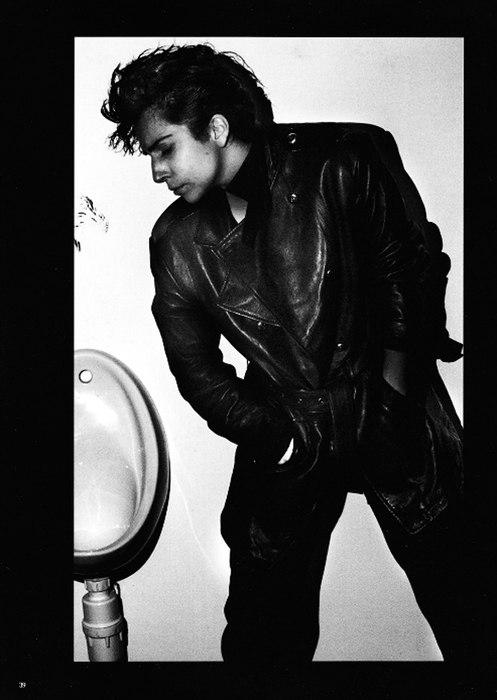
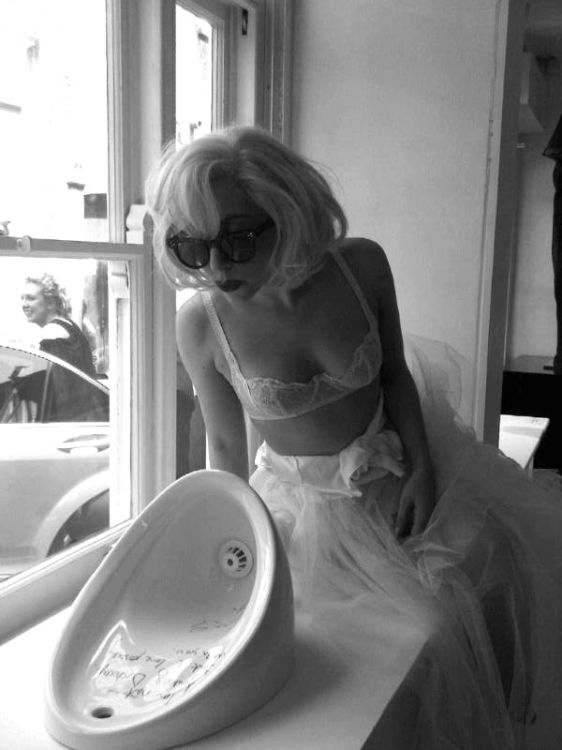
In addition to the alternate covers, we are also given another example that supports the idea of Jo as Gaga’s mirror. In posing next to a urinal, Jo invokes a very similar image of Lady Gaga peering into her creation of an homage to Duchamp’s urinal (shown in side by side photos below). It is a not-so-oblique wink and a nod to both performances, yes, but also a pointed commentary about gender. Consider how differently Gaga and Jo regard their urinals. For Gaga, it’s a work of art; a urinal is of no practical use to her at all. As a man, Jo would find the urinal useful, if not essential, and he probably doesn’t care if it’s art or not, as long as he can take a piss in it when he needs to.


5. Jo is how Gaga would see herself if she were a gay man.
This isn’t as far-fetched as it seems. In his interview with Gaga for the summer double edition of Rolling Stone, Neil Strauss wrote: “When she uses words like ‘fierce,’ or describes her sexual conquests of beautiful men, one sees why the hermaphrodite rumors about her have been so persistent: She seems, at times, like a gay man trapped in a woman’s body.”[i]

This observation is reinforced in the “Alejandro” film, evident in the frustration she shows when the men will not accept her as they accept each other, not even sexually, and perhaps especially sexually. Jo Calderone might be as close as Lady Gaga can get to being a gay man. That seems awfully personal, but Lady Gaga’s art is personal with a capital P, in addition to being pure artifice and spectacle.

If so, this implies something pretty big coming out of Born This Way, which has become Gaga’s anthem and war cry for the last several months. Something provocative, that’s a given. But maybe something very unexpected, too. We assume that BTW references the gay community that Gaga has so passionately embraced and has taken that passion to the next level, overt political action. But this mantle has already been laid across Jo Calderone’s shoulders. And it may mean more than we know.

6. He could be one of Stefani Germanotta’s long lost Sicilian cousins.
I’m speechless.

7. Keep it Simple Stupid
On the other hand, he could be very simply and obviously what he is: a male image created for a photo shoot in which she also appears as the Meat Model; interesting juxtaposition of images but…duh. Nothing so complicated. More like one of her trickster “Made you look!!!” moments.

And that she did. For now, we can only speculate and contemplate. Whereas the meaning of the Meat Bikini was made explicit later, Jo is still something of a blank, as personas go. The Meat Bikini came to life, became more than just an image, when Gaga used the same concept at the VMAs by wearing a meat dress, and tied it directly to DADT. She also reinforced its feminist message by picking up the magazine cover on Ellen’s set, and asserting that, “I’m not a piece of meat.” The reaction to the meat bikini in Vogue Homme was nowhere near the flood of opinions that resulted when she walked around wearing meat in plain sight. And hugging people, some of whom didn’t seem too comfortable getting that close to an uncooked steak dinner.

This is what happens when an image becomes incarnate. It becomes real. The persona acquires a life of its own. And that is where Jo Calderone is problematic. He hasn’t acquired a reality because he hasn’t yet been made flesh. He’s more like a blind date; we don’t know what to anticipate because we haven’t been properly introduced. He’s still a construct, a static image on a glossy page. Or rather, he’s rather like an empty suit still bagged up and hanging in Gaga’s wardrobe closet.

Jo Calderone is a two-dimensional slide show, not the living, breathing, performing hologram that is Lady Gaga. So we can’t quite know what to make of him. We see him but we don’t quite know what we’re looking at. And we don’t know what she plans to do with him, now that she has him. Maybe she doesn’t know either. That’s a meditation for a different evening.

But what I really really really want to know is: when she performs him, how is he going to walk in stilettos? He’s a mechanic, for crissakes.


When we meet him eventually, as I think we will, leaning hipshot against an old muscle car, a soft pack of Marlboros rolled into one sleeve of a grease-stained white tee…

What is she going to do to make him look taller?

Are you done? Good. Now I get the last word.
Contemplating Jo, insofar as “what does Jo mean,” is a bit like trying to know the unknowable, unless you want to go rummaging around in Lady Gaga’s psyche, and I’d recommend against it. But there are some conclusions that can be drawn.

Gaga clearly does not intend to confine her explorations of identity to female personae. Jo seem so jarring precisely because up to now, Gaga has only projected images of femininity, often conflicting, and often simultaneously seductive and grotesque. As much as she pushes the boundaries of how we define sexiness in a woman, Gaga always and everywhere projects as female, even when the forms are almost completely unrecognizable or extravagant parodies. She certainly performs drag but when she does, she drags other famous women who’ve inspired her (Madonna, Marilyn Monroe, Judy Garland, Jean Harlow, Marlene Dietrich, Veronica Lake, et al.), as well as reflecting iconic stereotypes like the pinup/calendar girl, but portraying them in transgressive. She can be awkward, gawky, not always attractive in some poses, but stunningly beautiful in others, but she’s indisputably female…despite the handful of hostiles who insist that she is intersexed or transsexual.

Gaga drags Marilyn Monroe

With the addition of Jo to her ensemble of characters that push the boundaries of gender and sexuality, he merely increases the discomfort that comes from not quite knowing what hers is. Unlike all the other characters Gaga has dragged, all her other personae, Jo is wholly and emphatically male, from the top of his pompadour to the tips of his shoes (which I imagine to be pointy-toed boots with stacked Cuban heels). There’s not a whisper of femininity in his looks, his posture, his poses, the visual energy he projects, or his brief biographical interview. He affirmed his gender in an August 27th tweet that said “I am a man. I am a human being. I am me. And I was Born This Way.”

Yet he seems oddly out of place in the man’s world depicted in Vogue Homme Japan, a glossy men’s fashion magazine that seems to be aimed toward affluent gay men. Sculpted faces and hair in high fashion, and properly toned, minimally clad male bodies are the norm. With the exception of Gaga as the Meat Bikini pinup girl, there are very few photos of women in the issue, and they are posed mostly as fashion accessories to the men they appear with and who seem decidedly disinterested.


Jo is doubly transgressive, not just in what he implies about Gaga’s identity but in his own right, by virtue of debuting in a magazine where he seems so out of place. He has nothing in common with the other models or the men in the other articles, and he doesn’t fit the magazine’s presumed demographic either. He doesn’t translate as notably queer in the sexual sense, if his answers in the interview are any clue (and they must be, because we’re not given any other information about him). Being working class to the bone and proudly so, he also breaches the very clear socioeconomic class boundaries of the magazine and its readership. He may be too cool to care, but we all know there’s a price to pay for that kind of deviance.

The sense, and pain, of being a misfit permeates Lady Gaga’s work, reflected in her performances and discussed at length in many of her interviews. She’s repeatedly spoken of feeling like a freak, an outcast, someone who didn’t belong. It was true in high school; it’s true to a large extent in her experiences in today’s pop music industry. She has a large following of fans who feel the same. Looking at Jo in the context of the magazine in which he appeared, he sticks out like a sore thumb. Like everyone in Gaga’s sphere of influence, Jo is different. He doesn’t belong. He doesn’t fit.

And there is simply no more perfect word for defining the freak, the misfit, or the outcast: that word is queer. Without using the word directly, Lady Gaga has nonetheless restored queerness to everyone who qualifies. The Monster Ball has become a celebration of Queerdom across a very broad swath of humanity. Anyone can drag, everyone can drag. The Monster Ball and by extension, the GagaVerse, is a place where “you can be whoever-or-whatever-you-wanna-be free,” as Posh puts it.

It’s the shared transcendent embrace and celebration of one’s queerness by artist and audience alike, as much as the music and performances themselves, that have produced the eerily intimate, mutually reflective love affair between Gaga and her Little Monsters. It is also the shared burden of mutual pain and mutual anger that requires more than a spectacular dance party to channel and discharge. It takes a battle cry, “Born This Way,” that everyone can take up. She invokes this phrase often, most notably in her concerts where she unleashes a fiery exhortation to her fans not be swayed or dissuaded or crushed by the daily litany of all the things they aren’t and all the things they can’t do, the sermon which affirms that everyone is a superstar and everyone is Born This Way.

In Gaga’s body of work, “Born This Way” isn’t just an explanation for one’s gayness. It’s an argument for every queer’s queerness. Queerness has been made more inclusive. For someone who is both gay and queer at the same time, it’s like a door opening into other parts of yourself that you may not have embraced. You can finally be gloriously queer in ways that have nothing to do with your genitals or where you like to put them.

And Jo Calderone seems to say, we’re all queers on this bus. And we were Born This Way.


[i]“The Broken Heart & Violent Fantasies of Lady Gaga,” Rolling Stone, July 8-22, 2010.


Author Bio:

Cheryl Helm is an old transgressive hippie, devoutly politically incorrect to all corners. She sold her soul to rock and roll in the 50s, picked up her first good electric guitar from Patti Smith's husband (Fred 'Sonic' Smith, RIP) in the late 60s, and never looked back. "Rock n roll, bitches, do or die," as Gaga says. She's written poetry, prose, the L-Word fan fiction, essays, editorials, music criticism, and some  things she can't quite define. She's written alone and with others, published in obscure ancient feminist literary journals no one ever heard of, as well as alternative presses, newspapers, Creem Magazine in its glory days, blogs, fan forums, leaving digital traces behind like glitter.