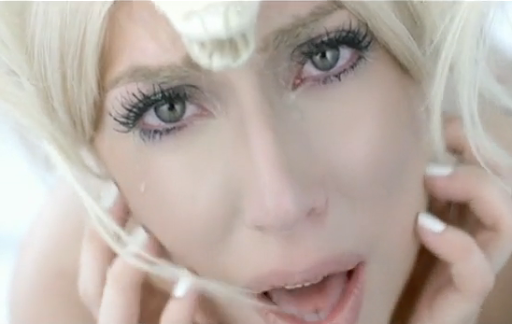
"[Gaga Stigmata has] very modern, edgy photography to free flowing, urban narratives without censure to analytical essays, et cetera—like Gaga, imagination without ... limits. And the beauty is that anyone can submit work to the site, so artists and writers from all over the [world] have joined this experiment." -The Declaration.org

"Since March 2010, [Gaga Stigmata] has churned out the most intense ongoing critical conversation on [Lady Gaga]."
-Yale's The American Scholar

Showing posts with label Evolution. Show all posts

Sunday, March 6, 2011

From "Alejandro" to "Born This Way," Dirge to Liberation

By Cheryl Helm

The following piece is the sixth in our series on Lady Gaga’s video for “Born This Way.” Click here for our previous analyses of the video.

Eight months ago, Lady Gaga released “Alejandro” to great hoopla over its religious imagery, and over its (apparent) similarities to Madonna’s “La Isla Bonita” (musically) and “Vogue” (choreographically). Now she’s gifted us with “Born This Way,” a film with far more expansive religious imagery, and whose main controversies are the graphic birth scenes and inevitable debate over whether the song is a Madonna knockoff of “Express Yourself” (musically) and “Vogue” (the spoken/rapped lyrics).

“Born This Way” is not a narrative sequel to “Alejandro” (as “Telephone” follows the narrative line of “Paparazzi”). Rather, when compared with “Alejandro,” “Born This Way” reveals major conceptual pivots in Gaga’s aesthetic, and dramatic evolution in her approaches to certain themes. The most notable evolutions between the two videos are found in Gaga’s depiction of female power figure(s) and protagonists, in the progression from a closed gay community to an open inclusive community, and in a seeming shift away from the treatment of religion solely as a means of social and political oppression to a more catholic spirituality as a source of solace and strength.

Compare, for example, how the communities of the two films are shot and introduced. “Alejandro” is shot in cold low lighting, which matches its tonal darkness that stems from being a grievously sad story set in a bleak militant dystopia where solace in any form is in very short supply. Soldiers march bearing emblems of the Holocaust and its horrific human toll, which, as we well know, was justified by institutionalized racism and homophobia.


In contrast, “Born This Way” is shot in warm low-light that simulates birthing environments. The dancers are seen kneeling, in preparation for their births into full-grown offspring of the Eternal Mother. It is as joyous and celebratory as “Alejandro” is sorrowful and elegiac. While “Born this Way” is a liberation birth dance, “Alejandro” is a dirge, and an angry one at that.


“Born This Way” is strikingly different from “Alejandro” in tone and subtext, but a more careful examination of common elements and character types reveals them to be companion pieces that signify a change in Gaga’s overall project.

Institutional Religion vs. Popular Spirituality
An important distinction between “Alejandro” and “Born This Way” lies Gaga’s depiction of religion and faith. To the extent that “Alejandro” is, in part, about faith and freedom, it is both springboard and study in contrast to the philosophy behind “Born This Way.” Whereas the faith of “Alejandro” serves as sanctuary, escape, and justification for oppression, the faith of “Born This Way” functions as respite, solace, and a catalyst for liberation. The faith of “Alejandro” deals in stasis and death; “Born This Way,” in life and rebirth.

“Alejandro” presents faith in the context of a specific religious institution, which is rigid, controlling, and oppressive. It is faith in doctrine; it is a faith in which the light of divinity has gone out. The iconography in “Alejandro” is explicitly Christian, and of the Catholic variety. Crosses, crucifixes, rosaries, and nuns serve up an abundance of controversy. This Christian imagery is accompanied by symbols of oppression. For instance, a helmeted soldier and Gaga-as-nun are strung up like puppets, signifying that religious faith is a kind of bondage (and not the fun kind) – a sardonic twist in a film laden with lots of sex but no pleasure.


In contrast, “Born This Way” depicts faith as affirmative – something that can be called upon as a source of strength and comfort. More importantly, perhaps, the faith here is independent of any explicit religion or doctrine. The video contains a plethora of religious/spiritual images, however they are nondenominational: eastern and esoteric imagery abound while the cross is used only sparingly. From the upright and inverted triangles replete in both political and esoteric meaning, to the Eternal Mother’s lotuses, butterflies, and Third Eye chakra, “Born this Way” signals a shift away from religion (e.g. the Catholic Church) to a more universal, dare we say “catholic” (katholikos) expression of faith. Lyrically, Gaga invokes God explicitly (God makes no mistakes) and implicitly (Capital HIM), not as a basis for oppression but a spiritual affirmation of one’s own inherent divinity.


Two Faces of Liberation
The driving narratives of both “Alejandro” and “Born This Way” is a quest for acceptance liberation, but from opening to closing shots, those quests take place in very different worlds, and seek opposing kinds of freedom. These differences are largely functions of Gaga’s evolving artistic/political intentions and messages in the two videos.

“Alejandro” was created in the context of the debate over Don’t Ask, Don’t Tell. Although the video never overtly addresses the issue, it is nonetheless an impassioned plea for the abolition of policies, regulations, and laws that discriminate against LGBTQ people. Institutional liberation requires the rejection of religious influence behind every homophobic law and policy. On the surface it appears to be a denial of faith, but what it really requires is a change in the way people exercise their faith.

“Born This Way” is the Gospel of Gaga, which advocates for self-actualized liberation: self-acceptance, self-respect, self-empowerment. To achieve it requires no institutional acquiescence, no defeat of personal opponents or bullies (in fact, there’s not a hint of any adversarial personal or institutional relationships). It is an act of faith to embrace ourselves with full belief that we are exactly as we were meant to be, whether we consider ourselves to be divinely created or not. It is an article of faith to say, “I am beautiful, I am perfect in my own way,” and walk by that faith, live by it.

What Gaga seeks in “Alejandro” is escape, not self-liberation. She uses religion to avoid dealing with her grief and her frustrated relationships. In “Born This Way” Gaga seeks to find and express the liberation that is already hers by birthright. The Gaga of “Alejandro” desperately looks outside herself for freedom in other people and things, and uses sex to force her way to acceptance by a group that doesn’t really want her. The Gaga of “Born This Way” seeks her freedom within, and shares the quest and celebration of this freedom with kindred folk.

The Goddess/Queen Archetype
“Born This Way” begins with a Creation Myth, a Gaga Genesis tale. The Eternal Mother is a figure of Light, giver of life, protector of her young. We first see the back of her head, bearing a face that evokes both Metropolis as well as the faces on her offspring. The opening sequence accompanying the narrative is among the most visually powerful in Gaga’s oeuvre, particularly the skyward turn toward G.O.A.T., where constellations form a pair of ovaries. There, the Eternal Mother is the womb, and the vaginal birth canal is an amber-lit translucent ramp. She is attended by a midwife, and flanked on both sides by dancers in soft shadows. Note the recurrent appearance of the letter “V” visually framed in different ways, which reinforces time and again that “No, I don’t have a penis. I have a vagina. Now watch me put it to work.”


Her nature is procreative. She is chained to her birthing throne, her hoof-like feet raised in stirrups, but is otherwise not confined or restricted. At the birth of evil, she herself is torn in two, the Evil Mother sitting atop a lightning bolt ziggurat, birthing twin skeletal figures and an AK-47 (I’ll see your machine gun bra, and raise you a rapid-fire monster gun). Her corollary in “Alejandro,” the cyborg queen, trains an army of soldiers; the Evil Mother gives birth to the weapons with which to equip this army. While the army is not explicitly defined as evil, the birthing of their weapons is an act that promotes death instead of life. Rather than retaliate, the Eternal Mother wonders, “How can I protect such perfection without evil?” This is the essential nature and the moral challenge she passes on to her children.


The Dark Queen of “Alejandro” is as menacing and lustful as the Eternal Mother is protective and nurturing. She is an insectile cyborg vampire who exists in darkness and who rules a dystopia redolent with militarism.


She lusts after Alejandro’s barb-wired heart, stroking her red lips as the heart passes by in a funeral procession. This lust takes on added meaning as she opens her mouth and flashes gold fangs. She hides her eyes behind steampunk goggles, sardonically opening each lens one at a time to sing “she won’t look at you.” She’s malevolent and uncomfortably seductive, even though she never participates directly in the rampant sexual performances.


She is attended by a sleeping armed soldier and a high-ranking officer who peers over her shoulder as she reviews the troops. Under her watchful gaze, the soldiers perform their martial drills and Spartan training against the backdrop of a screen where images of war and violence are projected. The training exercises militarize sexuality and sexualize militarism. The eroticism is muted by their aggression and violent movements as the soldiers circle, embrace, shove, choke, and slam each other to the ground. These are the Cyborg Queen’s offspring. But she’s not birthing a new type of humanity; she’s overseeing the training of an all-too-familiar master race of soldiers.


The Innocent Starchild vs. The Nun
In a vast nursery of gestating heads in translucent wombs, one Starchild has already begun to mature and take complete form. She is the new race in its infancy. Her wide-eyed look and playful nature speak of virginal innocence and oneness with oneself. She has not yet had to fight the battles for self-acceptance and respect that her older siblings are engaged in. She’s just a baby. She still remembers who and what she is. She is spiritual by her very nature. Like her Eternal Mother, she’s a creature of Light.


In contrast, the nun of “Alejandro” represents the grieving woman who buried Alejandro’s love. She flees to religion for solace, not only from her grief, but also from other unfulfilling relationships that require more than she wants to give (“Don’t want to talk, don‘t want to touch, just smoke my cigarette and hush”). Dressed in passionate red, she ingests rosary as an act of communion, and prays for release from the love/attraction of these men.


When she is dressed in pure white and bearing St Peter’s Crosses (papal symbol of humility), she seems to have achieved the spiritual release and wisdom sought by her red novice. She also appears free of the lust that drives Gaga to bed and dominate the soldier in the barracks. But lust is imposed on her by the soldiers: they surround and force her into a violent group grope in which she eventually sacrifices her religious purity for not-entirely-mutual sexual desire. In a clearly wry moment during the orgy/rape scene, however, the white nun’s cross over her crotch is revealed to be an arrow pointing to her vagina, as if to say…no no, gay boys, it goes in HERE! It’s also a sight gag: See, I have a vagina. No penis.


The Essential Gagas
To perform the central character in both videos, Gaga literally strips herself down to the essentials. In “Alejandro,” director Steven Klein forced her to cut her hair and appear without makeup, to make her feel more vulnerable in keeping with her character. In the barracks scene, she wears only a nude set of Calvin Klein underwear, silk hose, and pumps with a sensibly high heel of perhaps four inches. Her eyebrows are bleached and she wears virtually no makeup except for dark lipstick, giving her a pale, ethereal, fragile look. Even at her most sexually aggressive, she seems almost doll-like, the kind you would take home, put up on your shelf, and dust occasionally.


The Gaga of “Born This Way” is also minimally costumed and makeup. Most shocking is that Gaga gives up shoes and stockings altogether. She dances barefoot, wearing only a half-sole dance shoe for added stability and traction. In stark contrast, this Gaga is fierce and muscular, both physically and emotionally. This is not some porcelain doll, this is a strong woman fighting for her freedom from prejudice and condemnation, and celebrating her liberation.


The Pas de deux
In “Alejandro,” Gaga seeks to gain acceptance within the group of soldiers through sexual domination. The scene is highly sexual, yet not erotic: desperation and frustration characterize the mood.


None of the characters in this scene derive any kind of pleasure or even sexual release. Gaga’s partner responds to her advances with violent aggression bordering on rape. Both force themselves into this sexual pas de deux, and neither is satisfied by it.


In “Born This Way” Gaga partners with model Rick Genest (Rico), aka Zombie Boy, in a playful, joyful pas de deux. Using one of her favorite motifs, the mirrored performance, Gaga’s makeup mimics Rico’s whole-body tattoos, and she wears a matching Mugler tuxedo (which may reference her male alter-ego, Jo Calderone, instead of Madonna as some surmise). Alternately coltish and fiercely passionate, Gaga uses Rico as partner and sometimes prop, while he remains largely impassive as one would expect a non-hungry zombie to do.


The Dance
Gaga’s relationship to the dance company is quite different in the two films. In “Born This Way,” she celebrates and embraces them in relationships that are non-sexual; they share a common origin, quest, and struggle. This company is as diverse with respect to race, gender, class and fashion as is the human family at large, reinforcing “Born This Way” as anthem and ode to inclusivity.


More importantly, Gaga is the featured dancer, and dances solo throughout the video. BTW has been called Gaga’s liberation album, and this is certainly reflected in her movement, and her fiercely joyous personae.


In “Alexandro,” Gaga’s relationship to the company is fraught with desperate attempts to engage them either as sex partners or as comrades. Gaga has described this as trying to have the same kind of relationship with gay men as they have with each other, but they don’t want her. The dance revolves around the company, not around her. Compared to the rich diversity of “Born This Way,” the dancers in “Alejandro” are homogenous with respect to race (and possibly, gender) and fashion. This homogeneity visually reinforces the film’s German subtext and connection to fascism, which cannot wholly be separated from the notion of a master race that is exclusive by its very definition.


Group Hugs, Gropes and Orgies
“Born This Way” features a number of group scenes in which Gaga lies in a tangle of bodies, touching and being touched, stroking and being stroked.


In some scenes, they lie in amniotic fluid/Mugler latex goo, recalling their common origin as the Eternal Mother’s children. These scenes are highly sensual but not explicitly sexual.


The orgy scene in “Alejandro” is violent and blatantly sexual. The soldier/dancers surround the nun in white, grab her, push her, shove her, toss her, hoist her in the air and throw her down to couple with a soldier on the floor.


In its own queer way, this scene is related to a rite of passage by which Gaga earns acceptance as a soldier. In a decidedly Fosse-inspired ensemble dance, she sheds her Liza with a Z vest, and dons a bra with machine guns attached.


In the end, she gains acceptance not by becoming more herself, but by becoming more like them. It’s not liberation; it’s surrender and resignation. In the closing shot, the red nun’s features dissolve, as if her embrace of religion has consumed her from within.


Implications
The trajectory from “Alejandro” to “Born This Way” signals something of a quantum leap for Gaga musically and narratively. There’s a clear progression in how she creatively, politically, and spiritually portrays female power. Does this reflect a shift in Gaga’s interpretation and/or depiction of a more conventionally recognizable feminist philosophy? More likely, it is a deeper reflection of how she has long defined her personal and artistic mission statement:

“Women are strong and fragile. Women are beautiful and ugly. We are soft spoken and loud, all at once. There is something mind-controlling about the way we’re taught to view women, and my work is both visually and musically a rejection of those things. But more importantly, it is a quest.”
Showstudio.com, In Camera with Lady Gaga, May 2010

Rather than adopting a more recognizable feminist stance, her depiction of the female in “Born This Way” signals a broadening of her visual and musical vocabulary as she pursues her own quest for defining and empowering her own femaleness.

There’s also a clear shift in how she has chosen to shape her stance on LGBTQ equality. The militancy of “Alejandro” clearly stems from its ties to the policy of DADT, which was repealed not long before “Born This Way” was filmed. The song itself was written months before this political watershed, and we all surely know there are battles yet to come for equality on all fronts (marriage, adoption rights, etc.). It is unlikely that Gaga will abandon her strong political activism and advocacy on these issues, but she is striking at the heart of how we become victims of legalized bigotry and social bullying in the first place. Our oppression begins with believing that we are as others define us. When we accept that we are inherently less than because of race, gender, sexual orientation, physical appearance, etc., oppression is easy, whether it is institutional or social.

“Born This Way” also lacks the open attack on religious institutions (specifically the Catholic Church) that foster homophobia and misogyny, and that drive the legal codification of these prejudices. Instead, once again, she broadens her visual and lyrical vocabularies of faith and spirituality to make them as inclusive as the narration of the song itself. No doubt, she will continue to personally and artistically confront religious institutions that promote bigotry, but what she has done in “Born This Way” is to enrich the soil of spiritual alternatives in which this generation can grow and thrive without needing the approval of church or state.

Ultimately, with “Born This Way,” Gaga has shifted the frontline of activism. She has taken the battle away from a focus on outside forces and opponents, and instead towards a deep inward embrace of our inherent self-worth that needs no approval or institutional acceptance, thereby strengthening us both personally and in community. Considering the physical, visual, and musical energy of “Born This Way,” it is clear that the artist has experienced some kind of major leap forward on all fronts. A Hallelujah moment.


Author Bio:
Cheryl Helm is an old transgressive hippie, devoutly politically incorrect to all corners. She sold her soul to rock and roll in the 50s, picked up her first good electric guitar from Patti Smith’s husband (Fred “Sonic” Smith, RIP) in the late 60s, and never looked back. “Rock n roll, bitches, do or die,” as Gaga says. She’s written poetry, prose, the L-Word fan fiction, essays, editorials, music criticism, and some things she can’t quite define. She’s written alone and with others, published in obscure ancient feminist literary journals no one ever heard of, as well as alternative presses, newspapers, Creem Magazine in its glory days, blogs, fan forums, leaving digital traces behind like glitter.

Click here to follow Gaga Stigmata on Twitter.
Click here to “like” Gaga Stigmata on Facebook.

Tuesday, March 1, 2011

From The Fame to Born This Way: Lady Gaga and the Monstrous Evolution of Identity

By Kate Durbin and Meghan Vicks

This is the first in a series of pieces that analyzes the video for "Born This Way." Each day for the next week, we'll be posting an essay that explores a specific aspect of the video.


When Lady Gaga hit the pop culture-scape with “Just Dance” in 2008, her performance was accompanied by the slogan “Pop Music Will Never Be Low Brow,” which was appropriately projected in her video-screen glasses, the first of many props that would celebrate the power of the image in culture. Since then, Lady Gaga has remained steadfast in her declaration that her performance – her lies – are her truths to be taken seriously, even while blatantly marketing, branding, and “selling” herself out. The power of performance was explored in depth throughout the era of her debut album The Fame, during which Gaga literalized and embodied the spectacle, perpetually drew attention to the power of the image in our everyday and humdrum lives, and exhibited how fictions, lies, performances, costumes, and poses make up our existence, personalities, and identities. In short, during The Fame era, Lady Gaga became synonymous with performative and creative identity – an identity that rejects essentialism, determinism, and foundationalism.

These notions are echoed in “Manifesto of Little Monsters,” a video shown during an interlude of the Monster Ball; in this video, Lady Gaga discusses “the lie” as the “real truth.” “It is in the theory of perception that we have established our bond, or the lie I should say, for which we kill,” she says. “We are nothing without our image, without our projection, without the spiritual hologram of who we perceive ourselves to be, or rather to become, in the future.” During these two years of The Fame and its dark twin The Fame Monster, Lady Gaga repeatedly illustrated – in her daily outrageous outfits, in her music videos, in her stage performances – how life is art. There was no difference between the street and the stage: Gaga never took off her costumes, in fact, they were not costumes in the classical sense just as “Lady Gaga,” she repeatedly told us, is not a persona or a stage name – there is no fixed identity behind the mask. If art is synonymous with life, then life itself is but a performance – and we are all a part of the (freak) show. This was the idea of The Fame/Monster.

However, with her sophomore album Born This Way, Lady Gaga problematizes the notion of performative identity by moving toward the flesh, the meat(dress), the immanent muck and essential ether of being. Her most recent fashion (especially the prosthetic shoulder and cheek bones), her 2011 Grammy performance, and the video for “Born This Way” further complicate her earlier explorations with performative identity: in the Born This Way era, Lady Gaga explores a new type of identity – both natural (essential) and constructed (performative) simultaneously.


In a recent Billboard interview, Lady Gaga discusses these notions of birth in relation to a constructed identity: “[Birth] is a process of living and it’s also not ultimately a goal. It’s something ever-changing. My bones have changed in my face and in my shoulders because I am now able to reveal to the universe that when I was wearing shoulder pads or when I was wearing jackets that looked like I was wearing shoulder pads, it was really just my bones underneath. My fashion is part of who I am, and though I was not born with these clothes on, I was born this way.” Lady Gaga views fashion and the human body as cut from the same cloth: as we witnessed in “Anatomy of Change,” “fashion is essential – become part of the essence of the human body.” And fashion, like life, is something that takes intentionality and, most importantly, choice. Gaga’s goal is to empower her fans to choose to consciously become, or to choose to become conscious of the seemingly limitless potentials of who they can be. Fashion is one important way to harness this evolving identity. As Gaga also said in that same Billboard interview: “[Fashion] is part of who I am. My creativity is in my blood and in my bones as I said, and it takes time to become myself every morning.” In a very real sense, Gaga has become her clothes, just as her clothes become her. It is in this play that one’s fluctuating identity is birthed and re-born, over and over. But it takes will and consciousness: one cannot be blind and born, at least not into Gaga’s new race.

Lady Gaga’s new looks have influences that are both alien/unnatural (her new bone structure, her sharply whittled fingernails, the latex) and organic (the amniotic hair-coloring at the Grammys). Though Gaga is dealing heavily with the theme of evolution with this new album, there is no survival of the fittest here, but rather the survival of the freak. The freaks, Gaga says, will become “a new race of beings within the race of humanity…one with no prejudice.” The song “Born This Way” proclaims: “I was born to survive.” Gaga (and it may be relevant to note that gaga is often one of the first things that a baby says upon speaking) sees birth – something usually viewed as a once-in-a-lifetime experience – as something that is an “ever-changing process.”

Lady Gaga is the lie that was “born this way.”

She puts performative identity in the space of essential identity; her creation of her identity becomes how she was born.


All these notions come to a beautiful crescendo in the recently released video for “Born This Way.” The video opens with a new manifesto – “Manifesto of Mother Monster” – which Lady Gaga reads while the theme from Alfred Hitchcock’s Vertigo plays in the backtrack:

On G.O.A.T, a Government-Owned Alien Territory in space, a birth of magnificent and magical proportions took place. But the birth was not finite. It was infinite. As the wombs numbered and the mitosis of the future began, it was perceived that this infamous moment in life is not temporal, it is eternal. And thus began the beginning of the new race, a race within the race of humanity, a race which bares no prejudice, no judgment but boundless freedom. But on that same day, as the eternal mother hovered in the multi-verse, another more terrifying birth took place, the birth of evil. And as she herself split into two, rotating in agony between two ultimate forces, the pendulum of choice began its dance. It seems easy, you imagine, to gravitate instantly and unwaveringly towards good. But she wondered, “How can I protect something so perfect without evil?


In this manifesto, Lady Gaga re-envisions and problematizes the notion of birth – as an infinite process of becoming, not as a singular moment of having become. As with the “Manifesto of Little Monsters,” which redefines the lie as truth and the image as reality, “Manifesto of Mother Monster” redefines birth as eternal, infinite, monstrous, and free – that is, one can choose to be born into whatever being one wishes. One is put in control of his or her own birth. 

The video features split-screen images of Lady Gaga giving birth to multiple versions of herself: both good and evil, alive and dead, nearly naked and fully dressed, Michael Jackson and Madonna. This hybridity is monstrous – it defies borders. In typical Gaga fashion, the video pays homage to much from the aesthetic arsenals of high and pop cultures: the expressionist paintings of Francis Bacon, the work of Salvador Dali and other surrealists, James Cameron’s Aliens, Hitchcock’s Vertigo, Stanley Kubrick’s 2001 and A Clockwork Orange, Fritz Lang’s Metropolis, the choreography of Alvin Ailey, and Madonna’s video for “Express Yourself,” to name a few. Given the theme of the video – Born This Way – Gaga’s use of these visual cultural quotations implies that she is unequivocally the offspring of these cultural giants, born in their images, created from their influences. This reflects what she said in a recent interview for Vogue:

It’s not a secret that I have been inspired by tons of people. David Bowie and Prince being the most paramount in terms of live performance. I could go on and on about all of the people I have been compared to – from Madonna to Grace Jones to Debbie Harry to Elton John to Marilyn Manson to Yoko Ono – but at a certain point you have to realize that what they are saying is that I am cut from the cloth of performer, that I am like all of those people in spirit. I was born this way.

Gaga as an artist perpetually messes with our notion of decades, eras, even time itself. For all her talk of “the mitosis of the future,” she is heavily informed by the past. She was born this way – organically fashioned from the cloth of the performer. These are the new identity politics of Born This Way: not just performative identity, but never-ending performative, infinite, and, above all, free births.

The video’s most interesting symbol of this performative birth is Gaga’s vagina, which houses the space where mirrors meet. Considering Gaga’s play with reflective performance and mimesis throughout The Fame era, the placement of the mirror at the vagina quite physically brings performative identity into the space of biological and essential identity. Mother Monster gives birth to little monsters; or, following the two manifestos, Mother Monster infinitely births “the spiritual holograms of who we perceive ourselves to be.”


Click here to follow Gaga Stigmata on Twitter.
Click here to "like" Gaga Stigmata on Facebook.

Monday, May 10, 2010

2010: A Gagadyssey

by Meghan Blalock

It's been a few months since Lady Gaga's video for Bad Romance premiered and I first wrote a blog post comparing the video's aesthetics to Stanley Kubrick's A Clockwork Orange and 2001: A Space Odyssey. Now, I want to take the comparison a bit further and talk about the two main themes that consistently present themselves in Gaga's work since the Bad Romance video premiered, and which also show themselves in Kubrick's work: ultraviolence and technological evolution.

First of all, the opening shot of Bad Romance is strongly reminiscent of a famous shot from A Clockwork Orange.
True, Gaga's shot is black on a white background, while Kubrick's is obviously white on black, but the composition is still essentially the same, and they serve as foils of one another. In the bottom photo, Alex (the main character of Clockwork) and his gang are holding glasses of milk or have glasses of milk on the lady tables in front of them. Gaga and her entourage have similarly shaped gold glasses on the floor surrounding them. The two girls sprawled on the floor in front of Gaga are strikingly similar to the lady tables in the Clockwork milk bar. Worth noting: in the film, Kubrick starts this shot wide and slowly zooms in, as if we the viewers are walking toward Alex and his gang; the shot in Bad Romance moves the same way. Also important: the tingy music playing during this part of Bad Romance - and again at the end of the video - is eerily reminiscent of the theme from Clockwork, called Ultraviolence, which you can listen to here, and which Gaga famously used during her time in New York, post-Stefani and pre-fame, as the intro to her performances in dive bars on the Lower East Side.

After the camera zooms in slowly for a few seconds, it cuts to a close-up of Gaga and her razorblade glasses. In an interview with MTV, she said that she wanted these to represent female strength, as an homage to the women she knew in New York who carried razorblades in their mouths - but when I saw them, I immediately thought of this scene from Clockwork, clipped below, during which Alex undergoes a Pavlov's Dogs-reminiscent procedure to make him physically ill when he witnesses or feels the urge to commit acts of violence.
The significance of Gaga's nod to Clockwork and its pervasive theme of Ultraviolence has become more and more clear as she continues to produce work that focuses on the aestheticization of violence. Clockwork is arguably the best example of contemporary art - at least pre-Gaga - that thoroughly aestheticizes violence; the film depicts heinously random acts of violence performed by a beautiful person, wearing beautifully clean clothing, illuminated by beautiful light, in meticulously beautiful settings, and backed by the beautiful orchestrations of Beethoven. The influence of the film on the Bad Romance video is significant because the first video off The Fame Monster preceded a slew of work she produced that also aestheticized violence, the most prominent of which is her video for Telephone, which includes a scene of Gaga and Beyoncé doing a choreographed dance routine in a diner filled with the dead bodies of the people they just poisoned - not unlike how Alex and his gang dance around their victims before beating and/or raping them.

Even more abundant than the imagery of Clockwork in the Bad Romance video is the various imagery from Kubrick's 2001: A Space Odyssey. First, it should be noted that the entire futuristic look of the Bad Romance video is incredibly similar to 2001: the white lights, the glowing floors and walls, the monster pods, the clothing. During the first part of the video, the camera zooms in to reveal Gaga's finger on some sort of black speaker/MP3 player. It reminded me of the monolith, the big black rectangle in 2001 that, depending on who you ask, might represent a number of different aspects of human existence. Here, in relation to both Kubrick's film and Gaga's video, I'm going to argue that it represents human technological evolution as it relates to the self.
The monolith theme - some sort of rectangular black object against a white background - keeps reappearing in Gaga's video, just like it keeps showing up in different places in 2001. First of all, the semblance below is undeniable. The first is a shot from Bad Romance, when the sun is coming up right before we see her little monsters emerging from their pods. The second is from 2001, a shot of the sun rising over the edge of the monolith, flipped on its side.
The monolith keeps appearing. First, Gaga herself as monolith.
We see Gaga crawling between two monoliths (her suitor's legs).
The computers that show the winning bid for Gaga are sideways monoliths.

Later, the suitor becomes a monolith.

Soon after, he becomes incinerated. However, he is replaced by a scantily-clad Gaga, all in black, on a charred black bed. Yep, huge monolith.
Oh, and speaking of that bed/bedroom - look at this famous shot from 2001.
True, the bedroom in Bad Romance is simpler - from what we see, there are no chairs or armoirs or Greco-Roman statues - but the similarities are still striking.

Now that it's clear that Gaga incorporates the imagery of the monolith from 2001 in her video for Bad Romance, it's crucial to understand why she does this. We first see the monolith in 2001 in the middle of a desert, during prehistoric times, when humans are still technically apes, covered in hair and not yet walking erect. We see a group of them huddling together, squawking and milling about while they, presumably, forage for food (grass) and water. We then see a sequence of events separated by black screens - the band of apemen fighting with another group, one of the apemen getting attacked by a leopard - before we see the apemen go to sleep, only to wake in the morning to the presence of the monolith, large, black and humming. They gather around and the group's leader hesitantly reaches out and touches the monolith; this is when the sun begins to rise over the edge of the object, producing the shot I mentioned earlier. Later that day, the group's leader is foraging for food when he picks up a bone and realizes he can use it as a weapon. He starts beating a skeleton with it, as an image of the monolith flashes before us again.
The next day, we see the apeman use his newly discovered tool to actually kill one of his fellow apemen. I would argue, in this case, that Kubrick intended the monolith to be the object that inspired the first step in human evolution. Had it not been for the contact with the alien monolith, the apemen may have never been inspired to think outside the box of their current forage-and-gather way of life. This is further supported by the various stages at which we see the monolith appear in the film. We next see the monolith in the year 2000, buried under the surface of the moon. It has been discovered by a group of spacemen, who treat it as evidence of alien life and make efforts to hide its existence from the general public. They go to the moon to see it, and we see Dr. Floyd, the leader of the spacemen, approach the monolith and reach out a gloved hand to touch it. They all gather around the monolith to take a photo as the sun rises and sunlight hits the object. Suddenly a deafening, high-pitched note emits from the monolith and they all crouch to protect their ears.
The third monolith is seen later in the film, during the main character Dave Bowman's voyage to Jupiter, orbiting the planet. The fourth and last appearance of the monolith in the film is when Dave, now a balding old man lying in bed in some sort of parallel universe, reaches out for it in the bedroom pictured above. As he reaches for it, he is transformed into a fetus in utero, which we then see floating in space. All three of the significant human interactions with the monolith immediately precede an important technologicaly evolutionary step: the discovery of tools, the discovery of alien life, and the discovery of the self, which is, Kubrick seems to be arguing, the ultimate point of all technological advancements. The films depicts a sort of direct lineage of evolution: apeman, apeman with tools, human, human with (bigger, better, badder) tools, aliens, and a return to the ultimately vulnerable state of the human ego.

All of this is significant because Gaga, as an artist and as a businessperson, continues to prove that she is ahead of the curve when it comes to technological advancement. She was named creative director of Polaroid earlier this year, and just recently tweeted about the work she is doing to advance their brand. When it comes to branding herself and utilizing the Internet to do so, she is at the forefront. She tweets regularly, and her Bad Romance video has been viewed more than 360 million times since it was released last fall, pushing her total number of Vevo video views past 1 billion - making her the artist with the most online music video views ever. This is quite impressive when you consider that she has only been making music as Lady Gaga for a few years, and she has only been super-popular for just more than one.

The Lady also doesn't shy away from product placement, regularly placing her Heartbeats by Lady Gaga headphones in her videos, in addition to ads for Virgin Mobile, who supports her concert tour The Monster Ball - both next to what one can assume are paid ads for PlentyofFish.com and her own Polaroid, among others. Everything she touches seems to turn to evolutionary gold, starting trends at the same time she taps into existing ones. She utilizes the technology of her (and our) generation better than perhaps any artist in the history of music, or perhaps American culture. At the beginning of May, she will release a USB version of The Fame Monster that contains 800 MB of content, including the album and all her music videos to date. And, of course, it's cleverly designed.

In addition to the correlation of Gaga's push for technological evolution with the evolutionary symbolism of the monolith in 2001, the overarching theme of evolution is prevalent in not only the Bad Romance video, but the Monster Ball Tour as well. In Bad Romance, the video begins with Gaga and her crew emerging from pods labeled "monster," then we see her slowly evolve from a creature with a hunched back and a protruding spine to a creature with a monster-inspired hair piece (barely visible, it's the dragon-like creature made of hair tied into her own hair), to a beautiful creature being auctioned off to the highest bidder, to an even more beautiful creature conflagrating her bidder. Similarly, the Monster Ball Tour begins with a dimmed Gaga, donning flashing LED lights behind a screen, walking around aimlessly, like she's looking for some sort of direction, and we see her slowly grow through different stages of her musical life. Gaga on the development of a concept for the tour: "We started talking about evolution and the evolution of humanity and how we begin as one thing, and we become another. I begin as a cell and I grow and change throughout the show." She evolves through different stages of battling her personal demons - love, sex, money, alcohol, fame - concluding by emerging from her now infamous orb to perform, of course, Bad Romance, the song that inspired the music video that most directly relates to Kubrick's emphasis on evolution.

More important than her ability to evolve the technology of pop culture before our eyes, I would argue, is Gaga's ability to do what Kubrick seems to be illustrating in 2001 - and this is also a prevalent theme in the Monster Ball Tour - to bring us all, ultimately, back to ourselves. Gaga has been quoted as saying things like, "When they ask my fans why they love Lady Gaga, I want them to say, 'I don't love Lady Gaga. I love myself.'" Just like Kubrick used the monolith in 2001 to trace the technological evolution of man away from and then back to himself, Gaga uses this same imagery in the Bad Romance video as a symbol for what she ultimately stands for as an artist: a celebration of the self. No matter what she reflects back at us, she consistently emits the message that it doesn't matter: we are perfect just the way we are.

The reason the Kubrick references in the Bad Romance video are significant is that they pinpoint two reasons why Gaga is important to current-day American culture: like no one else in mainstream media, she comments on the ultraviolence that we have all grown so accustomed to, and she pushes pop culture and music into the future technologically while serving to simultaneously illustrate various aspects of human evolution and bring us back in touch with ourselves. As Gaga wraps up working on the music video for Alejandro, one can only hope to see a Gomer Pyle or Dr. Strangelove type on the screen, talking to us about violence and technology, but really saying so much more.


Author Bio:
Meghan Blalock is a writer and editor based in East Harlem, New York. She is a research editor for Gotham magazine, and she writes for Gotham's website. She also maintains a blog that won Blogger's Blog of Note award in December and was linked to by The Washington Post in February. She also writes poetry, some of which she posts to her blog, and reads aloud at Cornelia Street Cafe and the Bowery Poetry Club in Manhattan. Her next reading is at the Bowery Poetry Club this Sunday, May 16, at 4 p.m. She also just celebrated the one-month birthday of her first tattoo, an inked homage to Lady Gaga's hair bow. Little monsters forever. She can be reached at mcblaloc@gmail.com.